
You are using an out of date browser. It may not display this or other websites correctly.
You should upgrade or use an alternative browser.
You should upgrade or use an alternative browser.
Running Bear's Coffee Shop XLVIII
- Thread starter Bill Tidler Jr.
- Start date
ModelRailroadForums.com is a free Model Railroad Discussion Forum and photo gallery. We cover all scales and sizes of model railroads. Online since 2002, it's one of the oldest and largest model railroad forums on the web. Whether you're a master model railroader or just getting started, you'll find something of interest here.


I am glad you did thank you!


Good Morning!
Chance of rain with a high of 52.


Temperature in Tipton IN


Curt I was looking for that show online but I had no luck finding it, I'll keep looking.
I did find this video I know 113 will like. https://www.youtube.com/watch?v=fA3zHkkCzEc#t=23

Affiliate Disclosure: We may receive a commision from some of the links and ads shown on this website (Learn More Here)
montanan
Whiskey Merchant
This was a hard time for a lot of railroads, and I think part of it could have been made harder by the ICC.
The Milwaukee Road did attempt a merger with the Burlington Northern but it ran directly counter to what the ICC had envisioned for the northern tier of states. They wanted the Milwaukee to be a competitor for the BN, and the BN didn't think it would be profitable for the stockholders. The high cost of protecting the 14,000 Milwaukee Road employees would offset any benefits of parallel lines.
I wish I knew more about the other railroads going through hard times during this time period. There were a lot, but being that I have relatives who worked for the Milwaukee Road, I am a lot more familiar with its situation.
The Milwaukee Road did attempt a merger with the Burlington Northern but it ran directly counter to what the ICC had envisioned for the northern tier of states. They wanted the Milwaukee to be a competitor for the BN, and the BN didn't think it would be profitable for the stockholders. The high cost of protecting the 14,000 Milwaukee Road employees would offset any benefits of parallel lines.
I wish I knew more about the other railroads going through hard times during this time period. There were a lot, but being that I have relatives who worked for the Milwaukee Road, I am a lot more familiar with its situation.
Milwaukee Road 113
Milwaukee Road addict...
Agree Louis! Super interesting posts Garry and Montanan, learn a lot here, love it, thanks a bunch! 
Milwaukee Road 113
Milwaukee Road addict...
I wasn't gonna go any further than '76, as that's where my main and personal interest ends with the railroads, but after your latest posts, I'll keep sharing the Wiki stuff...
1977
1978
That's some increase in the minimum operating revenue, $40 million, to be a class 1 railroad!
1977
- The Virginia and Maryland Railroad replaces Conrail on most of the old New York, Philadelphia and Norfolk Railroad. Operations are transferred to the Eastern Shore Railroad in 1981 and to the Bay Coast Railroad in 2006.
- October 1: The Michigan Interstate Railway (Class I) begins operating the former Ann Arbor Railroad, taking over from Conrail on trackage owned by the state of Michigan.
- December 1: The number of Class I railroads goes up by one, from 58 to 59, due to the start-up of the Michigan Interstate Railway.
1978
- April 1: Crown corporationVia Rail Canada takes over operations of intercity passenger trains from the Canadian National Railway and Canadian Pacific Ltd.
- October 24: The Penn Central Corporation (ex-Penn Central Transportation Company) emerges from reorganization as a real estate company. It has given up its one-sixth share of the Richmond, Fredericksburg and Potomac Railroad.
- November 1: The Missouri-Illinois Railroad is merged into parent Missouri Pacific Railroad.
- December 31: The ICC raises the minimum operating revenue from $10 million to $50 million effective January 1, 1978, dropping seventeen railroads to Class II:
- Bangor and Aroostook Railroad
- Canadian Pacific Lines in Maine
- Central Vermont Railway (Canadian National Railway subsidiary)
- Chicago and Illinois Midland Railway
- Detroit and Toledo Shore Line Railroad
- Duluth, Winnipeg and Pacific Railway (Canadian National Railway subsidiary)
- Georgia Railroad (Seaboard Coast Line Railroad subsidiary)
- Georgia Southern and Florida Railway (Southern Railway subsidiary)
- Illinois Terminal Railroad
- Maine Central Railroad
- Michigan Interstate Railway
- Missouri-Illinois Railroad (Missouri Pacific Railroad subsidiary)
- Norfolk Southern Railway (Southern Railway subsidiary)
- Northwestern Pacific Railroad (Southern Pacific Transportation Company subsidiary)
- Richmond, Fredericksburg and Potomac Railroad
- Texas Mexican Railway
- Toledo, Peoria and Western Railroad
- The Auto-Train Corporation and National Railroad Passenger Corporation (Amtrak) are also removed from the list, which now only includes freight carriers, reducing the number of Class I railroads from 59 at the end of 1977 to 40 as of December 31, 1978.
That's some increase in the minimum operating revenue, $40 million, to be a class 1 railroad!
Bruette
Well-Known Member
I wasn't gonna go any further than '76, as that's where my main and personal interest ends with the railroads, but after your latest posts, I'll keep sharing the Wiki stuff...
...
I am glad you did
thank you!
Trussrod
Well-Known Member
Good evening all,
I've had my problems as of late but nothing medically but rather car registration and getting it smogged. Evidently the Idle Speed Air Sensor is malfunctioning and causing the check engine light to come on. So I had to order one through NAPA to get the situation resolved, hopefully.
Say Garry: This is quite a rundown about the demise of the various railroads and the various govt regulations that seemed to be a cause of the down slide along with the inflation in the past and even at present it would seem?
I know here in Central Calif., in past years I saw various railroad lines running on what I thought were just SP trackage when I saw several D&RG or D&RGW diesels rolling down the line while I was in Madera, about 18 miles North of Fresno with a string of cars behind them head for the what used to be the SP Yard in Fresno North of the downtown area. That was at least fifteen years years back. Now I think the line belongs to UP or maybe the BNSF as Fresno also had an SF yard just South of the Downtown area.
It almost seems to be an ever changing situation with the various RR's trying to gain control rather than attempting to work together so everyone is profitable. That seems to be something to many individuals aren't capable of due to greed.
In the example you gave about, Enginees being high profit & Fenders being low profit I couldn't understand why they didn't ship both at the same time even in different cars to average out the cost of shipping to the various locations within the same area I would imagine if they were both used to assemble the same vehicles? I guess it can get complicated but it would seem it should be able to be sorted out without too muchh effort.
Anyway thanks for all the info as it sure does give a person a different perspective on what's going on.
I've had my problems as of late but nothing medically but rather car registration and getting it smogged. Evidently the Idle Speed Air Sensor is malfunctioning and causing the check engine light to come on. So I had to order one through NAPA to get the situation resolved, hopefully.
The government created Conrail from unprofitable lines in the East, and I wonder how things would be if they did likewise in the West. If they combined MILW, CNW, ROCK, MKT, DRGW, WP and SP while deregulating the industry, the result would have been a major railroad company that could have survived in my opinion.
Another point to be made is the impact of interstate highways and trucking. Here is where the government established tough competition which took away much of the high revenue business. Highways are half funded with user fees (mostly fuel taxes). The rest of highway are paid from the general fund. Highways are part of the deficit. Anytime I tell people fuel taxes should be doubled in order to fully pay for highways, nobody agrees with me. Nobody wants higher taxes.
So, the MILW did lose some of its transcontinental business to trucking as was the case with the other railroads. Once again, bad government policy leads to bad choices.
Regarding railroads in the 1970's and early 1980's... As I said, this was a challenging period for railroad companies. I recall the GTW being unprofitable then. To increase its revenues with more traffic and longer hauls, GTW acquired some lines from Penn Central when it went out of business, and it acquired the DT&I. It was half owner of D&TSL, and bought the other half from N&W. I recall the PC tracks were in deplorable condition. DT&I locomotives had deferred maintenance, and they would sometimes fail while hauling trains. ... Basically, GTW was combining unprofitable companies in an effort to be more profitable. That is challenging. ... The DT&I was supposed to gain a connection to "friendly connections" in Cincinnati, but soon the SOU and N&W merged (Norfolk Southern) and also the L&N (with Family Lines) merged with Chessie System (CSX). ... (Later much of the former DT&I route was sold by parent, CN, to a short line operator. ).... As I said earlier, GTW did attempt to acquire the MILW Midwest lines, but as I explained, Soo Line eventually did that. ... GTW/CN entered into a coordinated service agreement with BN which was beneficial to GTW. .... (Footnote: I wrote parts of GTW's application to the ICC to acquire DT&I and the half ownership of D&TSL from N&W) . ... Of course, international business with Canada is a mainstay for the GTW. The new tunnel at Port Huron was a significant improvement. GTW, however was still a short railroad, and revenue per carload was low as a result. CN acquired Illinois Central and Wisconsin Central, and of course, the length of haul for GTW's business improved substantially after that. Now GTW is really just a subdivision of Canadian National.
Say Garry: This is quite a rundown about the demise of the various railroads and the various govt regulations that seemed to be a cause of the down slide along with the inflation in the past and even at present it would seem?
I know here in Central Calif., in past years I saw various railroad lines running on what I thought were just SP trackage when I saw several D&RG or D&RGW diesels rolling down the line while I was in Madera, about 18 miles North of Fresno with a string of cars behind them head for the what used to be the SP Yard in Fresno North of the downtown area. That was at least fifteen years years back. Now I think the line belongs to UP or maybe the BNSF as Fresno also had an SF yard just South of the Downtown area.
It almost seems to be an ever changing situation with the various RR's trying to gain control rather than attempting to work together so everyone is profitable. That seems to be something to many individuals aren't capable of due to greed.
In the example you gave about, Enginees being high profit & Fenders being low profit I couldn't understand why they didn't ship both at the same time even in different cars to average out the cost of shipping to the various locations within the same area I would imagine if they were both used to assemble the same vehicles? I guess it can get complicated but it would seem it should be able to be sorted out without too muchh effort.
Anyway thanks for all the info as it sure does give a person a different perspective on what's going on.
Bill Tidler Jr.
Retired N&W/NS Signalman
Good Morning!
Chance of rain with a high of 52.
Temperature in Tipton IN
IronBeltKen
Lazy Daydreamer
Good morning. Hovering near the freezing mark in my area of central MD - that means Black Ice from the melting snow 
David, I seem to remember [Garry correct me if I'm wrong?] that the railroads were required by the ICC to charge specific rates for the various types of cargo, they did not have any flexibility whatsoever in pricing. That is one of the absurdities that the Staggers Rail Act sought to abolish.
In the example you gave about, Enginees being high profit & Fenders being low profit I couldn't understand why they didn't ship both at the same time even in different cars to average out the cost of shipping to the various locations within the same area I would imagine if they were both used to assemble the same vehicles? I guess it can get complicated ...
David, I seem to remember [Garry correct me if I'm wrong?] that the railroads were required by the ICC to charge specific rates for the various types of cargo, they did not have any flexibility whatsoever in pricing. That is one of the absurdities that the Staggers Rail Act sought to abolish.
Milwaukee Road 113
Milwaukee Road addict...
Good morning everyone...
Hope that you all are doing well...
Have a nice day!
1979
1980
Hope that you all are doing well...
Have a nice day!
1979
- The Spokane, Portland and Seattle Railway is dissolved, its property going to lessee Burlington Northern Inc.
- November 1: The San Diego Metropolitan Transit Development Board purchases control of the San Diego and Arizona Eastern Railway (no longer Class I) from parent Southern Pacific Transportation Company, which continues to operate east of Plaster City. Freight service west of Plaster City will be operated by several companies, most recently the Carrizo Gorge Railway and San Diego and Imperial Valley Railroad.
1980
- The Colorado and Wyoming Railway (no longer Class I) abandons its operations in Wyoming.
- March 1: The Chicago, Milwaukee, St. Paul and Pacific Railroad, in trusteeship since February 13, 1978, abandons all operations west of Miles City, Montana. Very little of this trackage is taken over by other railroads.
- March 31: After a bankruptcy that started on March 17, 1975, and directed operation by the Kansas City Terminal Railway since October 5, 1979, the Chicago, Rock Island and Pacific Railroad shuts down entirely. Over the next few years, other railroads will buy large portions of the Rock Island's system, most notably the Iowa Interstate Railroad (Chicago-Council Bluffs), Chicago and North Western Transportation Company (Spine Line), Missouri-Kansas-Texas Railroad subsidiary Oklahoma, Kansas and Texas Railroad (OKT Line), and Southern Pacific Transportation Company subsidiary St. Louis Southwestern Railway (Tucumcari Line). The Fort Worth and Denver Railway (Chicago, Burlington and Quincy Railroad system) becomes sole owner of the Joint Texas Division, formerly owned by the Burlington-Rock Island Railroad until 1964 and then equally by the two companies.
- June 24: The Grand Trunk Western Railroad buys control of the Detroit, Toledo and Ironton Railroad from the Penn Central Corporation.
- September 2: The New York, Susquehanna and Western Railway begins operating the former New York, Susquehanna and Western Railroad (no longer Class I), which filed for bankruptcy in January 1976.
- November 1: Chessie System, Inc. and Seaboard Coast Line Industries merge to form the CSX Corporation, parent of the Atlanta and West Point Railroad (no longer Class I), Baltimore and Ohio Railroad, Chesapeake and Ohio Railway, Clinchfield Railroad, Georgia Railroad, Louisville and Nashville Railroad, Seaboard Coast Line Railroad, Staten Island Railroad (no longer Class I), Western Railway of Alabama (no longer Class I), and Western Maryland Railway.
- November 21: The St. Louis-San Francisco Railway merges into Burlington Northern Inc.
montanan
Whiskey Merchant
Starting today off at 32 degrees again this morning. We did hit 62 yesterday and are expected to get there again today.
Forgot to post my Montana pictures yesterday afternoon. I was in a hurry to get to the post office for some incoming goodies.
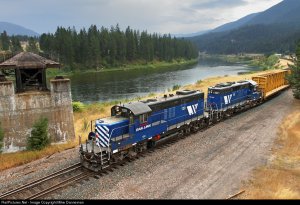 Here an MRL train at St Regis, MT. The bridge on the left side of the photo is the old Milwaukee Road right of way. As you can see the rails have been torn up but the bridge still stands. The bridge crosses the Clark Fork River just a few hundred feet from Interstate 90.
The next picture was taken when the Milwaukee Road was still around.
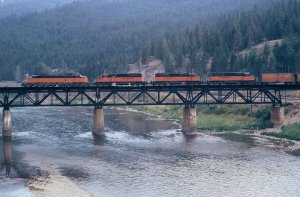
In this picture you can see the Northern Pacific main line passing under the bridge approach on the right. This is an interesting part of Montana as even today it is easy to pick out the old Milwaukee Road right of way traveling down the interstate. A lot of the old Milwaukee trestles are still up and at points the old roadbed is a matter of feet away from the present day Montana Rail Ling tracks. Old Milwaukee Road tunnels and power stations are easily seen from the interstate.
Talk about distracted driving.
Forgot to post my Montana pictures yesterday afternoon. I was in a hurry to get to the post office for some incoming goodies.
Here an MRL train at St Regis, MT. The bridge on the left side of the photo is the old Milwaukee Road right of way. As you can see the rails have been torn up but the bridge still stands. The bridge crosses the Clark Fork River just a few hundred feet from Interstate 90. The next picture was taken when the Milwaukee Road was still around.
In this picture you can see the Northern Pacific main line passing under the bridge approach on the right. This is an interesting part of Montana as even today it is easy to pick out the old Milwaukee Road right of way traveling down the interstate. A lot of the old Milwaukee trestles are still up and at points the old roadbed is a matter of feet away from the present day Montana Rail Ling tracks. Old Milwaukee Road tunnels and power stations are easily seen from the interstate.
Talk about distracted driving.
Last edited by a moderator:

logandsawman
Northern Pacific history enthusiast
Good morning, we have 30 and partly cloudy, going for a high in the 50's. Just about broke a record here yesterday, and supposed to be warm all week.
I have some workshops this week, hopefully get enough coffee in me to stay awake.
I have some workshops this week, hopefully get enough coffee in me to stay awake.
Milwaukee Road 113
Milwaukee Road addict...
As you all know, you've got to have a proper cup!
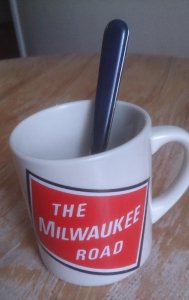
Good morning all. It's 64 , going to 86 .
"The falling leaves drift by my window" , covering my lawn- again. Oh well, it's good exercise. We have several species of birds that enjoy the feeder we keep filled for them. Deb has a book to refer to and says she has seen seven different ones.
I see the N E is going to be hit with more cold crap. Good luck!
Prayers for all.
Phil
"The falling leaves drift by my window" , covering my lawn- again. Oh well, it's good exercise. We have several species of birds that enjoy the feeder we keep filled for them. Deb has a book to refer to and says she has seen seven different ones.
I see the N E is going to be hit with more cold crap. Good luck!
Prayers for all.
Phil
PRR Modeler
Well-Known Member
Morning All,
I'm a little bit stiff from making another set of shelves in the garage. We still need to figure out storage for all our old scuba equipment that we have not used for 13 years. I want to give it away since it will all requiring servicing even if it is still in good enough shape to use, but MOH wants to keep it for some reason and there is a lot of stuff.
Today we are probably going grocery shopping and not sure what else.
I did the measuring on the layout Sunday and have come up with a plan. I have a total of 30 ft to work with. I decided on and ordered 2-3% WS incline sets which will take up 24 ft leaving approximately 6 ft for a bridge. I found a ME bridge that I really like. The existing layout has a 4% grade on the one side so 3% is actually better. Using 2% inclines takes 32 ft, so that is not a option.
The show last night on "Trains and Locomotives" was great since there was a lot of K4s and GG1's in PRR livery.
Garry and Montanan- Thanks for all the great info.
Milw113- Thank you also for the historical information.
I hope everyone has a good day.
I'm a little bit stiff from making another set of shelves in the garage. We still need to figure out storage for all our old scuba equipment that we have not used for 13 years. I want to give it away since it will all requiring servicing even if it is still in good enough shape to use, but MOH wants to keep it for some reason and there is a lot of stuff.
Today we are probably going grocery shopping and not sure what else.
I did the measuring on the layout Sunday and have come up with a plan. I have a total of 30 ft to work with. I decided on and ordered 2-3% WS incline sets which will take up 24 ft leaving approximately 6 ft for a bridge. I found a ME bridge that I really like. The existing layout has a 4% grade on the one side so 3% is actually better. Using 2% inclines takes 32 ft, so that is not a option.
The show last night on "Trains and Locomotives" was great since there was a lot of K4s and GG1's in PRR livery.
Garry and Montanan- Thanks for all the great info.
Milw113- Thank you also for the historical information.
I hope everyone has a good day.
GarryCBQ
Well-Known Member
Good morning .
David ... Auto parts shipped by rail or truck have different origins. GM made engines in Flint, MI and fenders in Kalamazoo, MI. Also, the eight densities were a factor. Fenders were often shipped in 86' high cube box cars. Engines would be in shorter box cars which could accommodate heavy loads. So, they could not combine the loads. .... The exception was the replacement part business shipped by what was once called GMPD with mixed loads of parts.
Montanan ... I like the pictures you posted.
David ... Auto parts shipped by rail or truck have different origins. GM made engines in Flint, MI and fenders in Kalamazoo, MI. Also, the eight densities were a factor. Fenders were often shipped in 86' high cube box cars. Engines would be in shorter box cars which could accommodate heavy loads. So, they could not combine the loads. .... The exception was the replacement part business shipped by what was once called GMPD with mixed loads of parts.
Montanan ... I like the pictures you posted.
Bruette
Well-Known Member
The show last night on "Trains and Locomotives" was great since there was a lot of K4s and GG1's in PRR livery.
Curt I was looking for that show online but I had no luck finding it, I'll keep looking.
I did find this video I know 113 will like. https://www.youtube.com/watch?v=fA3zHkkCzEc#t=23
Affiliate Disclosure: We may receive a commision from some of the links and ads shown on this website (Learn More Here)