
You are using an out of date browser. It may not display this or other websites correctly.
You should upgrade or use an alternative browser.
You should upgrade or use an alternative browser.
Running Bear's Coffee Shop XLVIII
- Thread starter Bill Tidler Jr.
- Start date
ModelRailroadForums.com is a free Model Railroad Discussion Forum and photo gallery. We cover all scales and sizes of model railroads. Online since 2002, it's one of the oldest and largest model railroad forums on the web. Whether you're a master model railroader or just getting started, you'll find something of interest here.


I have to ask how well that has worked out for the US tax-payer?
My understanding it has always operated in the red. Typical of any government ran operation I suppose.
A couple years ago I was pricing travel to my Mom's service.
An Amtrak ride was going to be well over $500 and put me within a two hour drive of the nearest pick-up point from a relative.
A Greyhound ticket cost me about $150 and got me within 30 miles.
Money was very much an issue at the time.
Don't get me wrong. I would have absolutely LOVED to have taken the train!!
Just my observation.....


Garry, thanks for clarifying that for me although the 8 densities somewhat throws me, but I imagine you might be referring to the various locations of manufactures required to accumulate all the parts required to assemble a car? But not being familiar with the inter workings of a railroad and the various classifications of cars and the loads they handled is another eye-opener as I didn't realize there was that much difference? I assumed the newer Box cars were just built that much stronger as they got bigger to support the heavier loads.
Remember I'm familiar, at least to some extent, with the transition from, 'Truss rod cars to Steel under frame', and just figured they built the cars stronger to carry the added weight. That's interesting to learn about the High Cube Cars. Seems like they are more suited to carry loads of Foam and lighter materials. Even fenders can sure add up in weight if there was anything like a car full.
I'm thinking of what merchandise my early Truss Rod cars might carry for the time period and can see the added knowledge required to set up a MRR pick-up and delivery schedule with the newer cars if a person wanted to stay prototypically [the site spell checker says it's incorrect but it isn't] correct. Heck, it's bad enough trying to set-up one even for my cars.
Say Eric: Better be careful or they'll get you for robbing the cradle, remember the old saying 16 will get you twenty!


Good Morning!
Fog with a high of 57.


Temperature in Tipton IN

I may speaking out of line here Terry and I do truthfully and honestly apologies if I do so, but....if you want hold some kind of memorial for your brother, which I'm sure was a great lad, why not do something here, I'm just thinking that you've been a member here for seven years and if anyone would ask, you and your brother would be family to them, members here on the forum...
Again, I do apologise if I caused any kind of trouble...

Affiliate Disclosure: We may receive a commision from some of the links and ads shown on this website (Learn More Here)

Milwaukee Road 113
Milwaukee Road addict...
Nice wee video Louis, thanks!
Good find there as well BigE!
Good find there as well BigE!
LOUIS- The show is on RFD , satellite Monday eve from 6 til 7
Same one that shows Classic Lionels and others from the earliest days of toy trains. Thursdays at 4 til 4:30. [p m ]
Raked some more to the tune of " OAK LEAVES KEEP FALLING ON MY HEAD " ! Better than snow.
Phil
Same one that shows Classic Lionels and others from the earliest days of toy trains. Thursdays at 4 til 4:30. [p m ]
Raked some more to the tune of " OAK LEAVES KEEP FALLING ON MY HEAD " ! Better than snow.
Phil

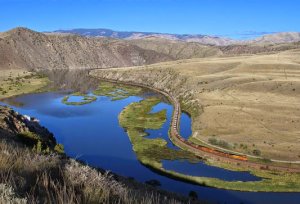
Milwaukee Road 113
Milwaukee Road addict...
Almost time for another shift and I'm loaded with the cold....'sniff'...'cough'..
1981
1981
- Burlington Northern Inc. merges subsidiaries Oregon Electric Railway (no longer Class I) and Oregon Trunk Railway (never Class I) into a new subsidiary, Burlington Northern (Oregon-Washington), Inc.
- January 12: The Atchison, Topeka and Santa Fe Railway acquires full control of the Toledo, Peoria and Western Railroad (no longer Class I) by buying the Penn Central Corporation's 50% share.
- April 13: The Grand Trunk Western Railroad gains control of the Detroit and Toledo Shore Line Railroad (no longer Class I) by buying the 50% share owned by the Norfolk and Western Railway.
- April 30: The Auto-Train Corporation (no longer Class I) ceases operations. Amtrak's Auto Train replacement will begin on October 30, 1983.
- May 14: Burlington Northern Inc. is renamed Burlington Northern Railroad.
- June 8: The Quanah, Acme and Pacific Railway (no longer Class I) merges into parent Burlington Northern Railroad.
- June 16: Guilford Transportation Industries purchases the Maine Central Railroad (no longer Class I).
- August: The Hooper-Myron Corporation, an affiliate of the Kankakee, Beaverville and Southern Railroad (not Class I), buys a portion of the old Chicago, Terre Haute and Southeastern Railway (ex-Chicago Southern Railway) between Hooper and Danville, Illinois from the Chicago, Milwaukee, St. Paul and Pacific Railroad. The rest of the old Chicago Southern has been abandoned, while the remnant of the CTH&SE in Indiana was sold in 2006 to the Indiana Rail Road.
- September 1: The Norfolk and Western Railway acquires the property of the Illinois Terminal Railroad (no longer Class I), formerly controlled jointly by 11 railroads (two of which were part of the N&W system).
- October 1: The Detroit and Toledo Shore Line Railroad (no longer Class I) is merged into parent Grand Trunk Western Railroad.
- December 31: The Colorado and Southern Railway is merged into parent Burlington Northern Railroad.
BigE
Active Member
April 30: The Auto-Train Corporation (no longer Class I) ceases operations. Amtrak's Auto Train replacement will begin on October 30, 1983.
I have to ask how well that has worked out for the US tax-payer?
My understanding it has always operated in the red. Typical of any government ran operation I suppose.
A couple years ago I was pricing travel to my Mom's service.
An Amtrak ride was going to be well over $500 and put me within a two hour drive of the nearest pick-up point from a relative.
A Greyhound ticket cost me about $150 and got me within 30 miles.
Money was very much an issue at the time.
Don't get me wrong. I would have absolutely LOVED to have taken the train!!
Just my observation.....
logandsawman
Northern Pacific history enthusiast
We hit 57 today!! cause for celebration. Tough to do anything indoors when we get these first nice days.
Trussrod
Well-Known Member
Good morning .
David ... Auto parts shipped by rail or truck have different origins. GM made engines in Flint, MI and fenders in Kalamazoo, MI. Also, the eight densities were a factor. Fenders were often shipped in 86' high cube box cars. Engines would be in shorter box cars which could accommodate heavy loads. So, they could not combine the loads. .... The exception was the replacement part business shipped by what was once called GMPD with mixed loads of parts.
Garry, thanks for clarifying that for me although the 8 densities somewhat throws me, but I imagine you might be referring to the various locations of manufactures required to accumulate all the parts required to assemble a car? But not being familiar with the inter workings of a railroad and the various classifications of cars and the loads they handled is another eye-opener as I didn't realize there was that much difference? I assumed the newer Box cars were just built that much stronger as they got bigger to support the heavier loads.
Remember I'm familiar, at least to some extent, with the transition from, 'Truss rod cars to Steel under frame', and just figured they built the cars stronger to carry the added weight. That's interesting to learn about the High Cube Cars. Seems like they are more suited to carry loads of Foam and lighter materials. Even fenders can sure add up in weight if there was anything like a car full.
I'm thinking of what merchandise my early Truss Rod cars might carry for the time period and can see the added knowledge required to set up a MRR pick-up and delivery schedule with the newer cars if a person wanted to stay prototypically [the site spell checker says it's incorrect but it isn't] correct. Heck, it's bad enough trying to set-up one even for my cars.

Trussrod
Well-Known Member
I think I just found the future Mrs. White!! Of course she doesn't know it yet.
However, I'm probably old enough to be her Dad.
[video=youtube;RUnvVD1uKWo]https://www.youtube.com/watch?v=RUnvVD1uKWo[/video]
Say Eric: Better be careful or they'll get you for robbing the cradle, remember the old saying 16 will get you twenty!
Trussrod
Well-Known Member
Late evening all,
Say Chet, Thanks for all the great info you've provided too along with Garry, it really adds to the knowledge and info we're enjoying!
Ken, Thanks too as your bringing forth info I was never familiar with. I previously read on here about the Staggers Rail Act but although it took place during my younger years I really new nothing about it.
>*Here it is from Wiki:
After reading through the majority of it, it appears as though it did more good than harm but that's contrary to what has been said by you and others so maybe I'm misreading or interpreting something wrong or things didn't play out as implied?
I hope everyone has a good night and day tomorrow.
This was a hard time for a lot of railroads, and I think part of it could have been made harder by the ICC.
The Milwaukee Road did attempt a merger with the Burlington Northern but it ran directly counter to what the ICC had envisioned for the northern tier of states. They wanted the Milwaukee to be a competitor for the BN, and the BN didn't think it would be profitable for the stockholders. The high cost of protecting the 14,000 Milwaukee Road employees would offset any benefits of parallel lines.
I wish I knew more about the other railroads going through hard times during this time period. There were a lot, but being that I have relatives who worked for the Milwaukee Road, I am a lot more familiar with its situation.
Say Chet, Thanks for all the great info you've provided too along with Garry, it really adds to the knowledge and info we're enjoying!
Good morning.
David, I seem to remember [Garry correct me if I'm wrong?] that the railroads were required by the ICC to charge specific rates for the various types of cargo, they did not have any flexibility whatsoever in pricing. That is one of the absurdities that the Staggers Rail Act sought to abolish.
Ken, Thanks too as your bringing forth info I was never familiar with. I previously read on here about the Staggers Rail Act but although it took place during my younger years I really new nothing about it.
>*Here it is from Wiki:
Staggers Rail Act
From Wikipedia, the free encyclopedia
Harley O. Staggers, sponsor of the Staggers Rail Act.
The Staggers Rail Act of 1980 is a United States federal law that deregulated the American railroad industry to a significant extent, and replaced the regulatory structure that existed since the 1887 Interstate Commerce Act.[1]
Contents
1 Background
2 Provisions of the act
2.1 Sponsor
3 Impact of the law
4 Related deregulatory legislation
5 See also
6 References
Background
In the aftermath of the Great Depression and World War II, many railroads were driven out of business due to competition from the new interstate highway system and airlines. The rise of the automobile led to the end of passenger train service on most railroads. Trucking businesses had become major competitors by the 1930s with the advent of improved paved roads, and after the war they expanded their operations as the highway network grew, and acquired increased market share of freight business.[2]:219 During this time, however, the railroads continued to be regulated by the Interstate Commerce Commission (ICC) and a complex system for setting shipping rates.
The Staggers Act followed the Railroad Revitalization and Regulatory Reform Act of 1976 (often called the "4R Act"), which reduced federal regulation of railroads and authorized implementation details for Conrail, the newly created northeastern railroad system.[3] The 4R reforms included allowance of a greater range for railroad pricing without close regulatory restraint, greater independence from collective rate making procedures in rail pricing and service offers, contract rates, and, to a lesser extent, greater freedom for entry into and exit from rail markets.
Although the 4R Act established these guidelines, the ICC at first did not give much effect to its legislative mandates. However, as regulatory change began to appear in the 1976-79 period, including the phasing in of the loss of collective ratemaking authority, most of the major railroads shifted away from their effort to maintain the historic regulatory system, and came to support greater freedom for rail pricing, both as to higher and lower rail rates. Major railroad shippers also continued to believe that they would be better served by more flexibility to arrive at tailored arrangements that were mutually beneficial to a particular shipper, and to the carrier serving a particular shipper. These judgments supported a second round of legislation.[4]
Provisions of the act
The major regulatory changes of the Staggers Act were as follows:
A rail carrier could establish any rate for a rail service unless the ICC were to determine that there was no effective competition for rail services.
Rail shippers and rail carriers would be allowed to establish contracts subject to no effective ICC review, unless the Commission were to determine that the contract service would interfere with the rail carrier's ability to provide common carrier service (a finding rarely if ever made, and not apparent in the history of the rail industry thereafter).
The scope of authority to control rates to prevent "discrimination" among shippers was substantially curtailed.
Across-the-board industry wide rate increases were phased out.
The dismantling of the collective rate making machinery among railroads begun in 1976 was reaffirmed, with railroads not allowed to agree as to rates they, respectively, could perform on their own systems, and were not allowed to participate in the determination of the rates on traffic in which they did not effectively participate.
The Act also had provisions allowing the Commission to require access by one railroad to another railroad's facilities where one railroad had in effect "bottleneck" control of traffic. These provisions dealt with "reciprocal switching" (handling of railroad cars between long-haul rail carriers and local customers) and trackage rights. However, these provisions did not have as much effect as those described above.
Sponsor
The act was named for Congressman Harley Staggers (D-WV), who chaired the House Interstate and Foreign Commerce Committee. Although it is traditional for laws to be known by the names of their sponsors, this is believed to be the first (but not last) case in which the sponsor's name was officially incorporated into the text of a Federal statute.
Impact of the law
Studies of the rail industry showed dramatic benefits for both railroads and their users from this alteration in the regulatory system.[2]:253–4 According to the Department of Transportation's Freight Management and Operations section's studies, railroad industry costs and prices were halved over a ten-year period, the railroads reversed their historic loss of traffic (as measured by ton-miles) to the trucking industry, and railroad industry profits began to recover after decades of low profits and widespread railroad insolvencies.[5] In 2007 the Government Accountability Office reported to Congress that "The railroad industry is increasingly healthy and rail rates have generally declined since 1985, despite recent rate increases... There is widespread consensus that the freight rail industry has benefited from the Staggers Rail Act."[6]
The Association of American Railroads, the principal railroad industry trade association, stated that the Staggers Act has led to a 51 percent reduction in average shipping rates, and that $480 billion has been reinvested by the industry into their rail systems.[5]
Related deregulatory legislation
The Staggers Act was one of three major deregulation laws passed by Congress in a two-year period, as the cumulative result of efforts to reform transport regulation begun in 1971, during the Richard Nixon Administration. The other two laws were the Airline Deregulation Act of 1978 and the Motor Carrier Act of 1980. This legislation in effect superseded almost a century of detailed regulation begun with the establishment of the ICC in 1887. The Interstate Commerce Commission Termination Act of 1995 abolished the ICC, and created its successor agency, the Surface Transportation Board, an administrative affiliate of the United States Department of Transportation.[7]
See also
History of rail transport in the United States
References
Staggers Rail Act of 1980, Pub. L. 96-448, 94 Stat. 1895. Approved 1980-10-14.
Stover, John F. (1997). American Railroads (2nd ed.). Chicago: University of Chicago Press. ISBN 978-0-226-77658-3.
Railroad Revitalization and Regulatory Reform Act, Pub. L. 94-210, 90 Stat. 31, 45 U.S.C. § 801. Approved 1976-02-05.
Derthick, Martha; Quirk, Paul J. (1985). The Politics of Deregulation. Washington, DC: Brookings Institution Press. pp. 14–16. ISBN 978-0-8157-1817-8.
Association of American Railroads, Washington, D.C. (2011). "The Impact of the Staggers Rail Act of 1980."
Hecker, JayEtta Z. (2007-09-25). Freight Railroads: Updated Information on Rates and Competition Issues. Washington, DC: U.S. Government Accountability Office. p. 6. Testimony Before the Committee on Transportation and Infrastructure, House of Representatives. Report No. GAO-07-1245T.
U.S. Surface Transportation Board. Washington, D.C. "Overview of the STB." Accessed 2010-11-04.
Moore, Thomas G. (November–December 1988). "Rail and Truck Reform: The Record So Far". Regulation: 57–62.
Rose, Mark H.; Seely, Bruce E.; Barrett, Paul F. (2006). The Best Transportation System in the World: Railroads, Trucks, Airlines, and American Public Policy in the Twentieth Century. Historical Perspectives on Business Enterprise. Ohio State University Press. ISBN 978-0-8142-1036-9.
Categories:
United States railroad regulation
United States federal transportation legislation
1980 in law
1980 in rail transport
96th United States Congress
History of rail transportation in the United States *<
After reading through the majority of it, it appears as though it did more good than harm but that's contrary to what has been said by you and others so maybe I'm misreading or interpreting something wrong or things didn't play out as implied?
I hope everyone has a good night and day tomorrow.
Trussrod
Well-Known Member
Say Chet, This is more interesting info.
You mentioned about the memories of riding in the box cabs. They were smelly [diesel and electric I assume] and rode like a >lumber wagon<? But being a kid and able to ride in them, Who Cares!
Great comment! But what made them smelly? Burning diesel fuel to create electricity?
This was a hard time for a lot of railroads, and I think part of it could have been made harder by the ICC.
The Milwaukee Road did attempt a merger with the Burlington Northern but it ran directly counter to what the ICC had envisioned for the northern tier of states. They wanted the Milwaukee to be a competitor for the BN, and the BN didn't think it would be profitable for the stockholders. The high cost of protecting the 14,000 Milwaukee Road employees would offset any benefits of parallel lines.
I wish I knew more about the other railroads going through hard times during this time period. There were a lot, but being that I have relatives who worked for the Milwaukee Road, I am a lot more familiar with its situation.
Nice video Louis. Brings back many memories of riding in the box cabs. They were smelly and rode like a limber wagon, but when you were a kid and could ride in them, WHO CARES. Cover many many miles in them and left nose prints on the windows on a regular basis.
You mentioned about the memories of riding in the box cabs. They were smelly [diesel and electric I assume] and rode like a >lumber wagon<? But being a kid and able to ride in them, Who Cares!
Great comment! But what made them smelly? Burning diesel fuel to create electricity?
Bill Tidler Jr.
Retired N&W/NS Signalman
Good Morning!
Fog with a high of 57.
Temperature in Tipton IN


Milwaukee Road 113
Milwaukee Road addict...
Good morning everybody...
Hope that you all are doing well....
Have a nice day!
1982
Hope that you all are doing well....
Have a nice day!
1982
- In preparation for common control with the Norfolk and Western Railway by the Norfolk Southern Corporation, Southern Railway subsidiary Norfolk Southern Railway (no longer Class I) is renamed Carolina and Northwestern Railway, a company it had merged with in 1974.
- The Providence and Worcester Railroad (not Class I) expands its operations to include Amtrak's Northeast Corridor between Pawtucket, Rhode Island and Old Saybrook, Connecticut, a former main line of the New York, New Haven and Hartford Railroad and most recently Conrail. In 1991 these freight rights are extended from Old Saybrook to East Haven.
- The New York, Susquehanna and Western Railway (no longer Class I) buys several lines from Conrail. This includes most of the old Syracuse, Binghamton and New York Railroad and a piece of the old Lehigh and Hudson River Railway between Sparta, New Jersey and Warwick, New York. After the NYS&W rehabilitates its trackage between Butler and Sparta, the latter becomes part of its main line in 1986.
- January 1: The Akron, Canton and Youngstown Railroad (no longer Class I) is merged into the Norfolk and Western Railway, its owner since 1964.
- March 31: The Chicago, Milwaukee, St. Paul and Pacific Railroad, in trusteeship since February 13, 1978, abandons all operations west of Ortonville, Minnesota. The Burlington Northern Railroad takes over operations on much of this trackage.
- June 1: The Norfolk Southern Corporation takes control of the Norfolk and Western Railway and Southern Railway.
- June: The Soo Line Railroad gains control of the Minneapolis, Northfield and Southern Railway (no longer Class I).
- October: The Michigan Interstate Railway (no longer Class I) discontinues operations on the former Ann Arbor Railroad north of Ann Arbor. The Tuscola and Saginaw Bay Railway takes over from Ann Arbor north to Alma, and the Michigan Northern Railway operates the remainder to Frankfort until 1983, when it too goes to the T&SB. The latter company is renamed Great Lakes Central Railroad in 2006.
- November 4: The Seaboard Coast Line Railroad acquires the rail assets of the Georgia Railroad and Banking Company, and absorbs lessee Georgia Railroad (no longer Class I), jointly controlled by the SCL and subsidiary Louisville and Nashville Railroad.
- December 22: The Union Pacific Railroad gains control of the Missouri Pacific Railroad and Western Pacific Railroad.
- December 31: The Fort Worth and Denver Railway is merged into parent Burlington Northern Railroad.
IronBeltKen
Lazy Daydreamer
Good morning. Weather conditions here in central MD are the same as for Louis in Baltimore, except 6* colder.
I'll be staying home from work today, waiting for the furnace repairman. We haven't had any heat since yesterday morning and the earliest they could get somebody out here was today. Sure hope he can fix it while he's here, without having to order a new part from the opposite side of the continent. I'm guessing it's a failed igniter, all the fans and pump motors seem to work.
I'll be staying home from work today, waiting for the furnace repairman. We haven't had any heat since yesterday morning and the earliest they could get somebody out here was today. Sure hope he can fix it while he's here, without having to order a new part from the opposite side of the continent. I'm guessing it's a failed igniter, all the fans and pump motors seem to work.
Milwaukee Road 113
Milwaukee Road addict...
Good morning. It is raining and 51.
My nephew has already wrecked my brother`s car.
The university will not take my brother`s remains for study, so he will be cremated Friday.
There still will be no funeral or memorial service for him.
I may speaking out of line here Terry and I do truthfully and honestly apologies if I do so, but....if you want hold some kind of memorial for your brother, which I'm sure was a great lad, why not do something here, I'm just thinking that you've been a member here for seven years and if anyone would ask, you and your brother would be family to them, members here on the forum...
Again, I do apologise if I caused any kind of trouble...
IronBeltKen
Lazy Daydreamer
Mil, I think Terry and his relatives already have something planned:
...
My cousins and I are going to have a rememberence "party" in my brother's honor, as soon as the weather in Pennsylvania warms up and the snow melts. ...
Affiliate Disclosure: We may receive a commision from some of the links and ads shown on this website (Learn More Here)