Running Bear's Coffee Shop XLVIII

ModelRailroadForums.com is a free Model Railroad Discussion Forum and photo gallery. We cover all scales and sizes of model railroads. Online since 2002, it's one of the oldest and largest model railroad forums on the web. Whether you're a master model railroader or just getting started, you'll find something of interest here.


Terry- What goes around comes around. He will get his comeuppance.
Hang in. You and your cousins are doing what is right.
Oh! Did nephew want you to send money to help him out?? Why the heck would he call? That's chutzpah! [gall]

When you clean the dust off the track, push the track cleaner car.
Best wishes,
Phil
p.s. Can tell you what it is like to have the EYE COME OVER YOUR home with 200 mph winds.
 
Hello and good evening everyone,

For those of you who remember Sherrel Weems, the forum member who had a huge tumor in his colon, he is recovering fine.
The tumor was contained and hadn't spread so he was very lucky as the Surgeons could remove a portion of his intestine with the tumor to solve that problem. Now he has a aneurysm to be fixed but hopefully that will just entail putting a mesh wrap around the affected area?


David .... Changing all of our clocks twice a year ticks me off.

Garry, I can't under stand how anybody really benefits from all the time change nonsense in the first place!

I do remember a Paul Harvey comment on the issue: He said the whole thing started quite a number of years ago with two Senators? arguing back and forth and one said, 'The people are a bunch of Lemmings', "I'll bet if I told them they had to set their clock back an hour at a certain time of the year and forward again at another, they would do it", and that is the Rest of the Story Paul Said!


Speaking of sad times, we went to funeral yesterday for a neghbor. He was my age. Makes me think.

Yes Garry, we can count our lucky stars as well as our thinking ability to keep ourselves healthy! It sure is a wake-up call if a person wants to view it as such? Life is a learning process if we allow ourselves to view it that way?

I hope everyone has a good evening and a great weak ahead.
 
COFFEE_CREME1.png


Good Morning!

Partly cloudy with a high of 52.

BLUECOFFEEMAN.png


TRAIN_ROUNDANDROUND.png


Tipton.gif

Temperature in Tipton IN


Good morning everybody!

32 with mostly cloudy skies in southeast Baltimore. The high today is expected to be nearly 60. I hope the last snow storm was winters last stand.

Have a great day everybody!
 
Starting off right at 32 degrees this morning. Got up to 60 yesterday. Should get close to it again today.

th.jpg

Back to the Milwaukee Road. Probably the biggest contributing factor to the demise was bad management. The de-electrification was a contributing factor right at the beginning of the oil crisis of the 70's, but they also abandonded a lot of it western trackage. It's transcontental freight service was the money maker for the railroad. Freight service had over $12 million in profits in 1976 and by 1978 it had dropped to $2.5 million. With decreased revenues, they didn't have the cash to maintain the track like it should have. Sort of like the PC. At one time the Milwaukee Road virtually controlled the Port of Seattle and it didn't hurt that they could cut a day off the transit time to Chicago of the Great Northern and Northern Pacific, which as you know became the Burlington Northern. They also controlled about 50 percent of the container traffic out of the Pacific northwest. Eventually the poor condition of the track and right of way caught up with them around 1977. Deferred maintenance had about 4,000 miles of track under slow orders. Trains that once took about 55 hours to make the trip to Chicago were now taking up to 140 hours or more. The main line through Montana was averaging a derailment a day with costs that approached $4 million a month.

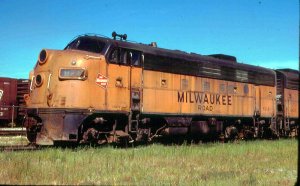
Their locomotive fleet was dying due to their "run to failure" policy. When ever there was a major failure with a locomotive, instead of repairing it, it was simply parked. I'm sure that many of you have seen the photos of all of the parked Milwaukee power. A lack of freight equipment in the pacific northwest, on top of the condition of the track further hurt the railroad. Instead of having the revenue of the freight from the pacific northwest which was the real money maker for the railroad, all they were really left with was the mid west part of the railroad.

History, and my relatives all agree that the management of the railroad was the problem.
 
Last edited by a moderator:
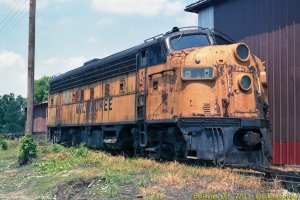
Would these engines, belong to that category?

milwshop_zpsmuudnyqx.jpg


Maybe if the management had seen Milwaukee Road differently and not just a steady paycheck...
 
Good Morning, it is + 29 and the snow is disappearing!! Spring is in the air and welcome.

As far as the time change, that is the only think the Politicians could agree on, something that will inconvenience everyone!!


Good morning, 43° and overcast. Going to low 50s with sun. Still a lot of snow and ice on the ground.
 
Good morning, -- degrees ,going up to -- .
Did two bags of leaves yesterday. Dumb tree doesnt know spring from autumn as the blankity blank leaves keep falling. Looks like I have another bag or two to rake up. Good exercise for my shoulders and arms.
It's Bike Week in Daytona and the area is crowded.
Phil
 
Good morning everybody....

bo7613sa_zpsgt1zbkt7.jpg


B&O's EM-1 #7613 at Cumberland, MD, in '54....

Source: Northeast Railfan and photographer Paul McGrane,

That is what I call a steam locomotive, my personal favorite, thank you 113!

As a little league baseball coach I like day light savings time. Other than that I don't see much advantage to it, but it certainly is not something to worry much about. I have to say I am confused about the argument that DST is bad for farmers. Do farmers even need clocks? Or am I just city boy who does not know any better?

Interesting discussion about the Milwaukee Road. From my uninformed point view it sounds like another corporation focused on quarterly profits with little regard for long term planning. Great pictures gentlemen, thank you.

Good work Phil! I feel sorry for the dumb tree though, if I lived in Florida I would be confused about what season it is as well. Are the biker visitors good guests?
 
Louis- There is a small group called The One Per Centers that give Bikers [Riders] a bad rep. How many riders would want to ruin a bike worth 20g s or more? Heck some of the bikes have paint jobs that are worth more than the bike. Most riders are hard working folks that enjoy the feel of the wind and road. More or less like we enjoy our [toy] trains.
Look at it this way- We have open houses to show off our pikes to one and all. Riders go to Daytona or Sturgis or just have 'RUNS' to benefit others in need and have TOY RUNS for less fortunate kids .
Phil
 
Last edited by a moderator:
Good morning folks.

We are in a heat wave! Highs in the 50's for the next week or so. Goodbye snow! Of course, it can snow around here into May.:(

Work is going well. There are the usual things in employment that can bother a person a little but nothing major. The deal hounds are out in force now so nothing is a good enough deal for them. A lot of people have never been into our store before so they don't know how much nice, U.S. made furniture can cost.

I have tomorrow off and we are to have a high of 60 so I think I'll spend some time organizing the garage. That'll last at least a month!

Have a good day everyone.
 
Good to hear Phil!

Bikers today are different then when I was young. Riff-raff can't afford a $20000 bike and they certainly won't get credit to buy one. I should retire the term "biker" and use your term "Rider".
 
I do not think the MILW's demise was bad management or focusing on quarterly profits. The entire rail industry was experiencing financial difficulties because of bad governing polices and excessive regulations. Also, the economic climate in the 1970's and early 1980's was very challenging. As I said before, the Staggers Act of 1980 deregulated the railroads, and that improved matters. Creation of Amtrak a decade earlier did help, too.

The 1970's was a period of high inflation in the USA. Accordingly, railroad operating costs were increasing rapidly. The companies needed their revenues to increase to offset the higher costs. There was a long, complicated, burdensome process to obtain ICC approval to raise rates. The ICC would approve percentage increases across-the-board. The railroads went through the process repeatedly in the 1970's. Each time, the low revenue freight had smaller increases in dollars than with the high revenue freight. The high revenue freight was of course the most profitable, and really did not need rate increases. However, the high revenue freight had the biggest increases in dollars. The government, represented by the ICC, said to raise rates for all freight using the same percent. ... Repeating the process caused railroads to lose the high revenue business to trucking companies. Railroads kept the low revenue freight. Profitability of the railroads was eroded with this ICC process.

For example, the GTW hauled large volumes of freight for the automotive companies. Included among the many items shipped by rail was engines and fenders. Engines were high revenue per carload. Fenders were low revenue per carload. Repeated across-the-board freight rate increases caused GTW to lose the engines traffic to truckers because of high railroad rates. However, GTW retained the low revenue fenders traffic. Profitability of the entire railroad suffered. .... All of the railroads had similar experiences with their freight traffic. Deregulation greatly improved this problem. ... The economic climate and the regulatory climate though the early 1980's was very challenging and doomed the western lines of MILW along with the entire Rock Island Railroad. All of the railroads which merged into Conrail has similar experiences.

The 1970's high inflation rates were finally brought to an end in the early 1980's when the federal Reserve Board raised interest rates sky high. There was a long, deep recession in the early 1980's because of that. That recession deeply impacted all railroad companies.

Back to the MILW western lines...... I can imagine, the railroad went through an objective process to decide what to do with its electrified railroad lines. I can imagine they looked at an aging electric locomotive fleet to decide what to do about the older locomotives which were beyond their economic life. I suspect, they did compare with new locomotives based on information from General Electric and maybe other companies. They would have looked at diesel fuel prices.They would have looked at the price to operate and maintain power generation, the wires, poles, etc.... They would have conducted a discounted cash flow analysis comparing cash flows of keeping electrification vs. all diesel. ... It would have been a completely objective analysis.

Other railroads made similar decisions regarding electrification. Great Northern's electrification ended. Conrail ended electric operation of freight trains. ...

Another example of government impacting railroads is in the current day regarding the situation with Amtrak. Many people simply say Amtrak would be profitable without bad management, and I think those people are wrong. Congress has stacked the deck against inter-city railroad passenger business for decades. The best business minds in the world can not overcome government stupidity. I am not being political, but I am explaining how railroads are impacted by government policies.
 
Great post Garry, I appreciate you sharing your knowledge, thank you. Also is not political to say congress has more then it's share of stupidity because the stupidity is on both sides of the aisle. USPS is another example of foolish congressional interference.

The 70s were very unusual economic times, seldom is it seen that we have both double digit inflation and double digit unemployment, but we had both in the 70s.

I believe we may have had both again after the collapse of the economy in 2008, but the way inflation is calculated has changed since the 70s.
 
One of the biggest problems management made was not to pursue the trans continental line. This was the money maker for the railroad. By abandoning line is the Pacific northwest they lost a lot of revenue. This added to the condition of the main line to the mid west really hurt the profits. It was a snowball effect, just like the problem that the Penn Central had. I can remember when I was a kid riding in the cabs of locomotives between Harlowtown, MT and Avery, ID, that the main line was really kept up. This was from the mid 50's to the mid 60's. I left Montana in 1964 when I went into the Navy. I finally managed to return home in 1977 and rode the same routes again when I could and it was easy to see the way the condition of the track was not what it used to be. My relatives working for the Milwaukee Road did say that track maintanence was not what it used to be years back when I mentioned this to them.

They had several money losing years in the 70's and they voluntarily entered into reorganization in late 1977. The trans continental line was what was making the profit for the railroad and in turn subsidizing the mid west part of the railroad, which was only about 25 percent of the operation.

There was also a study done by Michael Sol that if electrification as it existed in 1972, operating at max capacity with no additional locomotives that the savings could have amounted to over $32 million by 1977 and over $68 million by 1980 factoring in the increase of diesel fuel costs.

Interestingly, during this period, 1971 and 72, the Company as a whole had lost 66,000 carloads, while traffic on the Extension was increasing prodigiously. The Eastern lines of the Milwaukee, with it's multitude of branchlines and short hauls were succumbing to the same forces that would drag the other Granger roads into financial uncertainty. The Rock had no one and would go down. The Northwestern had the UP to help keep it afloat. The Milwaukee had the Pacific Extension, and now was the time to take full advantage of it. The era of profitable granger roads was long over, giving way to long haul carriers. With the shortest, fastest, and lowest cost route from Chicago to the Northwest, the Milwaukee was ideally suited to compete in this marketplace. Instead, something strange happened. They threw in the towel.

The final chapter came with the Milwaukee Road down sized to a 3,200 mile mid west line and abandoning the unprofitable lines and finally the SOO took over in 1985.

It was a shame to see. There were so many bad decisions made. Even the employees could see the handwriting on the wall. Thousands of people were put out of work and a great railroad ceased to exist. I am so glad that I was around to see the Milwaukee Road be one of the major trans continental railroads. Even though I didn't personally work for the railroad, I think it hurt me as much as the people who did. I have so many fond memories of the Milwaukee Road.
 
Last edited by a moderator:


The government created Conrail from unprofitable lines in the East, and I wonder how things would be if they did likewise in the West. If they combined MILW, CNW, ROCK, MKT, DRGW, WP and SP while deregulating the industry, the result would have been a major railroad company that could have survived in my opinion.

Another point to be made is the impact of interstate highways and trucking. Here is where the government established tough competition which took away much of the high revenue business. Highways are half funded with user fees (mostly fuel taxes). The rest of highway are paid from the general fund. Highways are part of the deficit. Anytime I tell people fuel taxes should be doubled in order to fully pay for highways, nobody agrees with me. Nobody wants higher taxes.

So, the MILW did lose some of its transcontinental business to trucking as was the case with the other railroads. Once again, bad government policy leads to bad choices.

Regarding railroads in the 1970's and early 1980's... As I said, this was a challenging period for railroad companies. I recall the GTW being unprofitable then. To increase its revenues with more traffic and longer hauls, GTW acquired some lines from Penn Central when it went out of business, and it acquired the DT&I. It was half owner of D&TSL, and bought the other half from N&W. I recall the PC tracks were in deplorable condition. DT&I locomotives had deferred maintenance, and they would sometimes fail while hauling trains. ... Basically, GTW was combining unprofitable companies in an effort to be more profitable. That is challenging. ... The DT&I was supposed to gain a connection to "friendly connections" in Cincinnati, but soon the SOU and N&W merged (Norfolk Southern) and also the L&N (with Family Lines) merged with Chessie System (CSX). ... (Later much of the former DT&I route was sold by parent, CN, to a short line operator. ).... As I said earlier, GTW did attempt to acquire the MILW Midwest lines, but as I explained, Soo Line eventually did that. ... GTW/CN entered into a coordinated service agreement with BN which was beneficial to GTW. .... (Footnote: I wrote parts of GTW's application to the ICC to acquire DT&I and the half ownership of D&TSL from N&W) . ... Of course, international business with Canada is a mainstay for the GTW. The new tunnel at Port Huron was a significant improvement. GTW, however was still a short railroad, and revenue per carload was low as a result. CN acquired Illinois Central and Wisconsin Central, and of course, the length of haul for GTW's business improved substantially after that. Now GTW is really just a subdivision of Canadian National.

 
Last edited by a moderator:


Affiliate Disclosure: We may receive a commision from some of the links and ads shown on this website (Learn More Here)

Back
Top