DSD's Layout Progress Thread

ModelRailroadForums.com is a free Model Railroad Discussion Forum and photo gallery. We cover all scales and sizes of model railroads. Online since 2002, it's one of the oldest and largest model railroad forums on the web. Whether you're a master model railroader or just getting started, you'll find something of interest here.


DairyStateDad

Mumbling in the corner
Going forward I'm consolidating all my reports on the progress of my pike under this thread.

I have a handful of small components for the final benchwork construction that need to be trimmed, squared off, or what have you. I don't have a chop saw or a table saw, so for a lot of those tasks I've relied on the kindness of better-equipped friends. They've done things like help me rip plywood for framing and cut various angles in cross braces and so on.

Plan is for those last bit of trims to happen tomorrow, followed by the final touches on the benchwork. I'll post photos as soon as the framing is cleared off enough to see. (I have never seen a horizontal surface that couldn't be occupied by stuff that needed to be put down somewhere... :rolleyes: )

I've done one more tweaking on my working plan. Any other refinements will come in the actual construction phase, and I'm sure there will be some. (Case in point: I am sure that I'm going to shift the start of the Aaronsburg siding so that the switch is NOT on the liftout/duckunder segment, and I will at least consider a curved turnout there as well.) But here's what it looks like as of now:
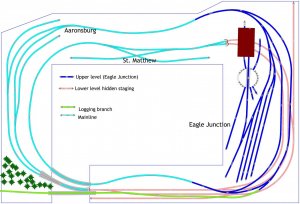
W$+N-REVISED-091313-ALL.jpg

UPDATED, 12/10/13:
Since this is the first post, I figured I'd put the most recent track plan, which is also further down in this thread:
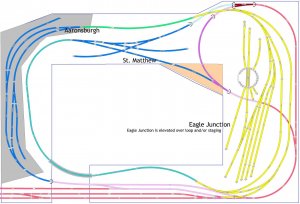
WR+N-FINAL-Grade Segments_ALL-REVISED-11-01-2013.jpg

Ignore the color-coding -- it's just to distinguish various segments of the line for purposes of elevation/grade calculation and also planning the building process.


Just in case it's useful to anyone, below are links to previous threads I started in developing this plan....

http://www.modelrailroadforums.com/...goes-track-plan-(in-broad-concept)&highlight=

http://www.modelrailroadforums.com/forum/showthread.php?32365-Trackplan-revised&highlight=

http://www.modelrailroadforums.com/forum/showthread.php?32430-Two-versions-of-one-stop&highlight=

http://www.modelrailroadforums.com/forum/showthread.php?32419-Grade-transitions&highlight=

http://www.modelrailroadforums.com/...6-Complicated-Trackwork-on-a-Grade&highlight=
 
Last edited by a moderator:
What grade did you use to drop down below and how long is the bottom length? I would like to do the same thing but I dont know if I have the distance.
 
What grade did you use to drop down below and how long is the bottom length? I would like to do the same thing but I dont know if I have the distance.

Hmmm.. well the first thing is it's still all in future tense, not past tense :) ... Actual construction hasn't started except for the benchwork.
As I've calculated it so far, I think I will be able to keep all grades under 3%, and in several places under 2%.

The overall dimensions of the layout are 11 ft., 9 in. by 8 ft. (at its widest -- you'll note that most of the top side is actually offset by 6 inches, so most of the layout is 7-1/2 feet wide).

(Did that answer your questions?)
 
Last edited by a moderator:


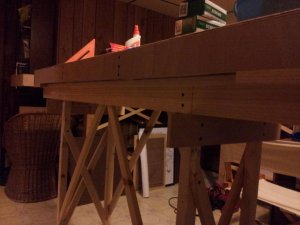
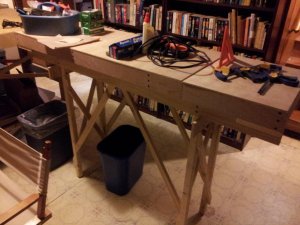
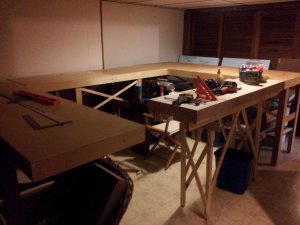
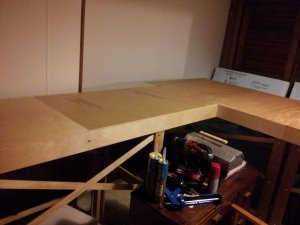
Benchwork pictures!

Not quite finished, but getting close. I've built 5 sections. The first four were configured for a completely different trackplan that I eventually grew disenchanted with when I was still in the stages of re-drawing it for my particular execution of it. Even though it was a published plan, I did not have confidence in some of the details of it. When I abandoned the plan, I was determined to not waste the time, money, and lumber I had put into building the four sections, so my starting point was making use of them.

A lot of false starts and missteps later, I came up with the general conception that became the basis of my working plan. For that, I had to build a 5th section.

20130917_112400.jpg

The first 4 sections were built using a slightly modified form of the ripped plywood benchwork that MR's Jim Hediger designed for the Rock Ridge MR project layout back in 2002. It's also the approach used in the series of "World's Greatest Hobby" videos on You Tube narrated by Michael Gross.

20130917_112448.jpg

I think that's a perfectly acceptable approach for a sectional layout, but when I decided I needed a fifth section, I opted for a different benchwork approach. This one is a variation on L-girder benchwork. It can be found in the out-of-print Linn Westcott book on benchwork (at least the 2nd edition, I'm not sure if it's also in the first one); it was also presented in an MR trackplan collection back in about 2009 or so.

The section itself also used ripped plywood (instead of dimensional lumber) for the sides and cross pieces. The L-girders are made of the higher grade of pine at Home Despot (no, that's not a typo :) ). Unlike the L-shaped plywood legs (with 2x2 dimensional lumber foot pieces) on the other 4 sections, this section just uses 2 x2 legs and 1x2 diagonal cross braces, in keeping with standard L-girder design.

All 5 sections are topped with 1/4 luan. 2-inch blue foam will go on top, and then where the track is, 3/4 inch pink foam for subroadbed, topped by cork.

20130917_112423.jpg

20130917_112440.jpg

(By the way, these pix were all taken with my Android phone, not my digital camera. Now if only that Nikon could make phone calls!)

I applied a coat of polyurethane to the first four sections and will do the same for the fifth. Then I will make sure everything is level and bolt them together. The reason for sectional benchwork, as I have probably said before, isn't so much for immediate portability as it is for the desire to make the layout movable if we ever move.

You probably can't see them easily, but there are also two small floating triangular pieces to go where sections ended up being offset from one another. Right now those are just clamped in place; I'll end up either bolting or screwing each of them to one section, after making sure they are completely level with their adjacent sections.

That's about it for now... Eventually, there will be some kind of fascia, skirting, or both, and I'm also planning backdrops. I also need to rewire the lighting in the room -- but that's another advantage to the sectional benchwork -- as long as I don't have scenery in, yet, I'll be able to take the sections apart with little difficulty and clear out the room for the electrician...
 
Wow! very nice. You have really good looking bechwork, in a short amount of time.

Question, why are you getting both Blue foam, and Pink foam in different sizes? Why not just use the 2" Pink or Blue foam. The 3/4 inch foam roadbed for the tracks seems a little too high.

Also, you should paint the foam with a light brown latex paint, before laying corkbed and track.
 
Last edited by a moderator:
Benchwork pictures!

I applied a coat of polyurethane to the first four sections and will do the same for the fifth. Then I will make sure everything is level and bolt them together. The reason for sectional benchwork, as I have probably said before, isn't so much for immediate portability as it is for the desire to make the layout movable if we ever move.

-- but that's another advantage to the sectional benchwork -- as long as I don't have scenery in, yet, I'll be able to take the sections apart with little difficulty and clear out the room for the electrician...


Hey Erik,

Wise approach, and thanks for putting up your work! A question is why use varnish and not paint?


lasm
 
Motley said:
Wow! very nice. You have really good looking benchwork,

Thank you! It's not perfect, as I am only too aware, but I think it's going to be quite suitable...

in a short amount of time.

LOL. :D The first 4 sections were built nearly three years ago. Then I got completely stuck, for a whole bunch of reasons (work, busy family life, other matters...) but in part because I had already begun having doubts about the track plan that they were intended for. So I dithered... and dithered... and dithered, until this past spring. (That's what I meant about having to conform my track to use the benchwork I already had, although in a different arrangement.)

Question, why are you getting both Blue foam, and Pink foam in different sizes? Why not just use the 2" Pink or Blue foam.
The 3/4 inch foam roadbed for the tracks seems a little too high.

Originally I was just going to use 2-inch foam, but as I got to thinking about the grades and how to construct them, the idea of a thinner foam on top for subroadbed appealed to me, because I could use it in cookie-cutter fashion.

But at this point that's actually an iffy part of the plan. I'm not tied to the second layer idea. I plan to buy several of the Woodland Scenics starter incline sets in various grades (the ones that are just the first segment, and cost about 7 bucks for a set of 4, vs. the 18 bucks for a whole run up to 4 inches or so) and to basically see how they work. If I'm satisfied with how they will work out, then I'll probably skip the second 3/4 inch layer. Because I do agree, that extra 3/4 inch between the track and the rest of the landscape would be pretty difficult to scenic, and that has been troubling me.

I will probably make the upper level portion (Eagle Junction) on 3/4 inch foam (instead of 2-inch) on top of 1/4 inch luan, because that will reduce the overall distance the grades have to climb to reach that part.

Also, you should paint the foam with a light brown latex paint, before laying corkbed and track.

Yup. Part of the plan :)

logandsawman said:
A question is why use varnish and not paint?

No particular reason, actually...

When I built the first sections, I hadn't even thought about either, but my much more experienced buddy cautioned I should varnish it to seal it. "Or your benchwork will turn into a banana!" :)

Since I did the first 4 that way, I figure I'll just do the 5th that way, too.
 
Ya I would make sure about all those grades, and do extensive testing. You don't want too many, all over the layout. Remember you need to be able to uncouple, set up trains, switch and set out cars at industries, etc. Very difficult to do this on a bunch of grades. Make sure your staging tracks have plenty of level spaces also. Not sure if you have enough run there, to that lower level. Trying to stage your trains in a grade would not be fun.

I went crazy with the grades on my layout. I had a figure 8 loop in the middle, and the outside main along the back wall was on a grade too. So like half of my layout was on grades. Too much. I just recently, cut out the entire middle section, and the figure 8 loop is gone now. Much better with less grades, and access to the inside of the layout.
 
Last edited by a moderator:
Ya I would make sure about all those grades, and do extensive testing. You don't want too many, all over the layout. Remember you need to be able to uncouple, set up trains, switch and set out cars at industries, etc. Very difficult to do this on a bunch of grades.

Oh, man, don't get me obsessing about grades again! :rolleyes::)

Seriously, yeah, I hear you! I will definitely be taking my time to make sure that the grades aren't too steep and especially are not an interference with operability.

BTW, have you ever posted a track plan for your layout? I always love checking out trackplan ideas...

Heck just this morning, I had a brainstorm for a completely different approach for this particular layout configuration. But I don't plan to pursue that one...:)
 
Ya I've posted it here around somewhere, a long time ago. But like I said, I've done some recent changes to it. My original plan had two big access holes, where the figure 8 loop was. I finally got tired of that, and cut the entire section out.


An aside: Name change is looming....

Not my name (real or screen) -- the railroad.

I've known for a pretty long time I wanted to set the freelance RR in Northern Wisconsin and spent some time just combining a bunch of not quite randomly selected No. Wis. place names. "Wolf River" came quickly, followed by a slew of other possibilities before I settled on "Nicolet" -- which is the name of a National Forest in far north central Wis. (where, among other things, a good friend of mine has a cabin that I got to spend a weekend at with my younger son a couple of years ago).

Two problems, though... as I delved more into the history of the area, I realized that the Nicolet Forest only came to be called that in the early '30s, which is when the national forest was actually established. While it's set in the '30s, the idea is that the pike is a long established one. So "Nicolet" as a place name seemed... um... out of place.

Second, I'm realizing that my basic concept is more of a short bridge route, and the "Wolf River" name is more suited to a branch or short line. So down the road I'm tweaking this stuff... I will keep "Wolf River" in the name of the logging branch, but substitute something else for "Nicolet" that would be more appropriate to the era and the fictional history.

For the main line, the name is up for grabs right now. I've been poking around on the Interwebs a bit and I am thinking that, conceptually, the old Duluth, South Shore & Atlantic (later part of the Soo Line) would be close to a real-life version of how I have envisioned the main road. There's a very well regarded book on the history of that line that I hope to get my hands on and read through to see if my initial impressions are accurate.

And if they are, then I'll probably take my cues from that -- still freelancing, still fictionalizing, but borrowing liberally from that line's history and story.
 
So, I am just thinking out loud here.
I know basically what I want from a layout. Some local operations and switching, with local freight service. Logging branch. Maybe also some local mining operation.

And some local passenger service, too.

At the same time, I would like to have a plausible justification for occasional through freight and through passenger trains. I don't think I'll amass a huge collection of big locos, but getting to see one pass through the layout now and then seems appealing.

I am pretty much set on location. I am not a Wisconsin native, but having lived here for longer than anywhere else, I have become deeply attached to it. And the northern part of the state is just very special to me... And close enough to get something to model.

I don't want to spend a lot of time doing detailed research, or painstakingly modify models to resemble a particular prototype. And having not grown up here, I can't do the Tony Koester thing of replicating the railroad of my childhood. So all that points to the basic idea of a freelance line, which I am totally fine with.

But, overthinker that I am, here's where I get a bit stuck.

Short line? Bridge route? Fictional branch of a real railroad? (Most likely the C&NW or the Milwaukee Road, but the Soo or its predecessor would be appropriate, too...) All of those have their pros and cons. I do want the whole package to be plausible, and I suppose I don't have to figure this all out now; the point is, the layout I'm building reflects my interests. But I can't keep from trying to make sure that it will also be realistic *enough*, what ever that is.

On the idea of a fictional branch, by the way, one thing I am attached to is being able to give it a name of its own. (Even though that creates extra work, having then to letter all the home road rolling stock.) Some branches do have their own names and heraldry, but is that plausible with the prototypes I am looking at? I just don't know.

The other thing I am pretty sure about is time period: the 1930s. I thought about the 20s, but I am insistent on a brewery...

So... Anyhow, I don't know what I'm asking, really... But you're welcome to try out some answers :)

From the DairyStatePhone
 
Hey Erik,


I think the easiest way to get a plausable story that you can adapt to your real life situation is old photographs.

You know what they say, a picture says a thousand words. Photos of trains from that era, especially in action, will give you a multitude of ideas (as if you don't already have enough ideas).

Here is a museum in Rhinelander, in the heart of Northern Wisconsin, that will have a wealth of information. They also have a recreated logging railroad, but that may be more fictional than you are looking for.

They were closed when we visited a few years ago, at that time open during the tourist season. I would go to the historical society as a backup.

http://www.explorerhinelander.com/pioneer-park-historical-complex/

I really like the idea of naming your railroad, branch, or switch service. With logging, you wouldn't necessarily have to get anything painted. Waaaay off in the future, I may tackle something like that.


lasm
 
I got to see that museum about two years ago... Definitely would like to go back!

With some not very systematic poking around tonight, I am beginning to think that a Fictional branch of the Chicago & North Western works as a good starting point. They had a pretty strong presence up north, by the looks of it, and they also seem to have owned at one time or another a lot of subsidiary branch lines that all had their own names. So the next step will be to bone up more on C & NW history....

From the DairyStatePhone
 
Hi DSD!

This is a very interesting thread, I am enjoying your thinking out loud. You have given me a lot of ideas and inspiration.

Originally I thought I only wanted trains and tracks, but between your ideas and GaryB photos of his layout I am thinking I want more. That is a big shift in thinking for me and something I never thought I would do.

That will be down the road but half the fun of model railroading for me is the planning.

Thanks very much DSD and everyone for all the conversation and information in this thread.
 
Glad to hear it, Louis... When I first got the RR bug in my teens, I was totally amazed and inspired by the work of the late John Allen. Not only was his modeling and scenery superb, but he also had a whimsical storyline that explained how the Gorre and Daphetid came to be. I don't feel compelled to be anywhere near as fanciful as he, but making sense of it all has always been a central part of what makes a good model railroad to me.

I see you're getting interested in recreating the RR scenes from your childhood, in a sense. There was a line that ran through my part of SE Pennsylvania when I was a kid, but I never really got into the idea of modeling it.

Interestingly enough,though it inspired two different published track plans I've seen over the years. One was a 4x8 in RMC back in the 60s or early 70s.

The other was a real, full basement layout in MR a few years back. The builder lives in NC, but had lived in the same general area where I grew up for a time before he retired. Although I was never inspired to model the place where I grew up, it was a lot of fun to see it replicated in someone else's work...

From the DairyStatePhone
 
One other recent inspiration, by the way, was reading the back-story our member Carey here has written for his Alabama Central on his website. That just pulls together the whole concept for his line very elegantly.

From the DairyStatePhone
 
Erik I have to agree, Carey or doctor as I have taken to calling him has an amazing story to go with his railroad. I enjoyed reading that immensely and I suggest everyone read that.

Myself I am not all that creative, In fact I thought I would never even do scenery, but the more I have learned on this forum the more interested I have become.

As for track plans I am always looking at track plans and playing with my AnyRail software. So far my method has been to build the bench work and to layout the track I have and make it work. I have taken ideas from many track plans. Now that my wife has told me to use the entire basement I am working on three separate layouts in 2 different scales. I have more space to use but I have not decided how to best use it.

I am fortunate to have many real rail lines to choose from in my area. I grew up near the electrified northeast corridor and the B&O, PRR freight lines. Where I live now I am close to the port of Baltimore. I am so close that I can hear the switcher's horns working when I am sitting in my back yard, I love that! When I take my grandson to school we go under the Norfolk Southern and CSX lines heading to the port. We get to see a plethora of freight!

Trains are a part of me, I loved working as a coal sampler, its a shame it did not pay more. Watching trains go by has always fascinated me and still does. I sold tires to Conrail, CSX, Bethlehem Steel and the contractors at sparrows point. I got see the hard working trains in the mill and ship yard. Seeing the trains up close and working in Curtis Bay, Gray's yard and Bayview Hump when I made sales calls was fantastic. I would often schedule my sales calls just after their lunch break so I could sit in my truck and watch the trains working as I took my lunch break and I ate my sandwich.

I have so many different scenes I could model. I think I will try to incorporate as many as I can in my imaginary train world.

One other recent inspiration, by the way, was reading the back-story our member Carey here has written for his Alabama Central on his website. That just pulls together the whole concept for his line very elegantly.

From the DairyStatePhone
 
Well... While waiting for an infusion of time as well as money, I've begun to think more concretely about the operating scheme for the railroad.

(The question of the name and the fine points of the concept await a bit more research. I am considering two alternative ideas concept-wise: a sort of parallel universe Duluth South Shore and Atlantic by another name, or else a branch of the Chicago & Northwestern. There are some books I hope to pick up or get through the library to skim through so I can decide which is more suited to my preferences in time, size, and location...)

The basic schematic (Track plan here) is this:

Hidden Staging (east end) -- St. Matthew -- Eagle Junction (yard and engine terminal) -- Aaronsburgh (I decided to add an 'h' at the end to give it a more Teutonic feel :) ) -- Hidden Staging (west end).

[The staging tracks are easier to see here.]

The trackplan doesn't show it, but I do have in mind a wye that would extend from the staging onto an additional drop-down leaf so that eventually trains could be fully turned around in staging. I did try sketching some loop designs, but didn't like the way those turned out. I also considered a second turntable in the hidden area, but decided that would be too much of a pain to try to manage.

The east end Hidden Staging represents Green Bay and other points east. The west end represents Ashland, Superior and other points west.

In the most general terms...

1) Through or limited freight trains would come in from either staging area, drop off cars in Eagle Junction destined for other stops on the layout, then depart to the other staging area.

2) Local freight trains would be made up in Eagle Junction, then drop off and pick up cars at the industries on the layout. Here I find myself considering a couple of alternatives.

Alternative A -- a local freight is made up in Eagle Junction, works just the west line from there (ie Eagle Junction -- Aaronsburgh -- Staging [turn around] -- Aaronsburgh, and back to Eagle Junction), while another local freight just works the east line (Eagle Junction -- St. Matthew -- Staging [turn around] -- St. Matthew -- Eagle Junction.

Alternative B -- a local freight still starts and ends at Eagle junction, but it works both the west and the east line: Eagle Junction -- Aaronsburgh -- Staging [turn around] -- back through Eagle Junction -- St. Matthew -- Staging [turn around] -- St. Matthew -- back to end at Eagle Junction.

B sounds a bit more interesting. As it is, there is not a lot of industry on the layout... basically, two spurs at St. Matthew and two at Aaronsburgh. So the scheme in A would basically be switching 2 or no more than 4 industries along the way before reaching staging.

With B, one could essentially double that for a single train.

But I find myself thinking, would B be a bit unrealistic? isn't it logical that EJ would be treated as a sort of mini-division point, so that the pattern for "A" would be more prototypical?

(And I guess they aren't really mutually exclusive -- I could use both schemes -- smaller turns that just work the east or west line, and other trains that work both lines.)


And then I'm thinking, maybe there isn't enough industry on this line to generate longer-term operating interest. At the same time, though, I am trying to keep the layout from being overcrowded with track. Scenery is a big part of what I want out of a railroad.

And finally, I've been toying with trying to tweak the design further so that EJ is really "one end" of the run instead of the middle. However, there doesn't seem to be any kind of logical way to connect EJ to staging, which I would like to do if it is "one end".

(I am leaving the logging branch out of this discussion because it will be the last segment built and will have its own particular patterns. The basic idea there is that full log cars will come from the branch and empties go back to it. Some fulls will go to St. Matthew, where there's to be a small lumber mill, and other fulls off layout to destinations represented by staging; empties then will come from both places back to the branch.)

I'd welcome some creative alternatives here, and even some "out of the box" thinking...
 
Last edited by a moderator:


And then I'm thinking, maybe there isn't enough industry on this line to generate longer-term operating interest. At the same time, though, I am trying to keep the layout from being overcrowded with track. Scenery is a big part of what I want out of a railroad.

I'd welcome some creative alternatives here, and even some "out of the box" thinking...


Hey Erik,

You are really putting some thought into your railroad! I think it is smart to keep your plans somewhat fluid. In the actual history of railroad, track went in and came out as industry and economies changed.

What is wrong with having an area of the layout where you have the option to change the industry or scheme? If you fill your whole area with track, as you are aware, you are boxing yourself in. That is, unless you lay track as a temporary rather than permanent activity. Shipping patterns would adjust to the economy, as well.

They put in quite an extensive pulpwood loading yard in Williams, MN (by Lake of the Woods) in 1983 to serve one market, spruce pulpwood, for only a two year period. When the mill closed down, as was the plan, the pulp yard was dismantled. I am aware of a frac sand loading facility near North Branch, MN, with the same planned obsolescence.

I find your layout interesting. lasm


Affiliate Disclosure: We may receive a commision from some of the links and ads shown on this website (Learn More Here)

Back
Top