The D&J Railroad -- From Scratch

ModelRailroadForums.com is a free Model Railroad Discussion Forum and photo gallery. We cover all scales and sizes of model railroads. Online since 2002, it's one of the oldest and largest model railroad forums on the web. Whether you're a master model railroader or just getting started, you'll find something of interest here.


I'm using the blue, 2" foam board then will cover that with aluminum screen then wall plaster over that. I will add some earth tone to the plaster before spreading it.
I will whittle some of the foam material away with a drywall saw before applying the screen over it.

]

Sounds like a good plan!!! thanks for sharing, lasm
 
Got some more of the mountain built today. Used the thin layers of plywood between the layers of foam and it seems to be working well.


0909142103.jpg
 
Last edited:


Ken,

Thanks, I was just curious as I have only ever glued (Elmers) the foam to itself, so am interested in other ways of doing things that may be better.
 
Still putting the mountains together. This is the far end of the mountain system. The portal on the left is the mainline while the single portal on the right goes to the coal facility. When I finish framing out the mountains I will put screen over it to get the actual detailed shape that I want then cover it with earth tone wall plaster.

IMG_6563.JPG
 
Last edited:
One thing I've noticed on my own layout, and seen on Youtube videos, is that plaster really enhances loco sound systems. Great echo effect -- also, a great effect if you do something to deaden the sound when the train goes into tunnels. I have several tunnels with plaster tunnel liners cast from Woodland Scenics molds. You might check this out -- for that matter, try out a test section of scenery with plaster along the track to see what happens!
 
Yes, I have tunnel liners inside the portals so when ya look in them, ya see the black rock wall. Further in I have guard rails so derailed trains don't fall off onto the floor. Those provide some acoustic effect. I also need to access the track from under the mountain for maintenance purposes. The mountain system will be big enough to stand up under.
 
I posted this before, but it didn't appear. If you live near a fair sized body of water, and there's a boat dealer in town, they get everything encased in styro - just like the blue board, but white. They'll be delighted to have you take it. I use PP to glue it together - sets up in the usual 15 minutes.


They continue to grow. The carving will soon begin. I've been studying the shapes of the desert mountains. They appear to be series of piles of dirt and rock piled up on top of each other creating pyramid type shapes laying up against the next bigger pile. The second picture below was in post 381 of this thread by JWB. It illustrates the shape of desert mountains as apposed to rocky mountains which have more of a strata look to them.

Mountains 5.jpg


mountains sample.jpg
 
Last edited:
The scenery in eastern California and Nevada is dominated by "range and basin" geology, with ranges separated fairly widely by desert basins. However, vegetation and types of erosion also vary by climate and altitude. I hesitate to get too deeply into rock types -- I studied Geology 101 in college largely to help me with modeling, but the profs were always catching me up on dumb assumptions, and then I met several other geology profs in a club, and they pretty much wiped out what I thought I knew about rocks! However, here are some good rocks on Raton Pass, which are actually pretty similar to rocks you see north of Tehachapi:
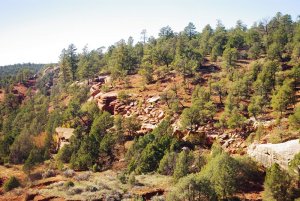
Rocks Raton Pass (2).jpg

Trees also vary by altitude and climate. In California desert areas, like near Cajon and Tehachapi, you have mostly just chaparral on the lower slopes, but once you get to higher altitudes, you can see pines, especially in sheltered gullies. In California, what grows on the north slopes of what is called the Transverse Range (including San Bernardinos, San Gabriels, and Tehachapis) is much greener than on the south slope.

My own layout is a medium-large, about as long as Ken's is wide, so I have to be a little more selective and careful in what I try to portray. I would emphasize some regional and altitude/climate difference in scenery like that, especially to emphasize that the railroad is both climbing and going places.

 
Last edited by a moderator:
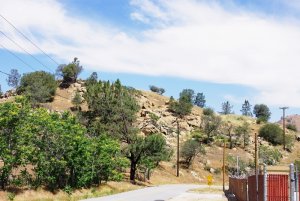
Here are some rocks and scenery near Woodford, CA, on the north slope of Tehachapi. Same general shape and color. The trees here are live oaks, while the trees on Raton are aspens, but otherwise, sort of similar. It's worth pointing out that this is the north slope, while the shot Ken quoted from me in his post above is of the south slope of the same range. Again, on a layout Ken's size, it might be worth making the difference clear.

Woodford 4 (2).jpg
 
Last edited by a moderator:
I will be attempting to model the area near Ludlow, CA and east to Needles. The mountains along that area seem to be piles of dirt rather than rock outcroppings and low level vegetation, i.e. scrub brush.
 
But no tunnels between Ludlow and Needles. . . closest ones are now gone, at Alray on Cajon Pass. UP has some on the LA&SL, and of course Tehachapi.
 
But no tunnels between Ludlow and Needles. . . closest ones are now gone, at Alray on Cajon Pass. UP has some on the LA&SL, and of course Tehachapi.

Ahhhh, but remember, this empire is straight out of my imagination. It has tunnels.
 
I had some time to go downstairs and do a little work on the mountain system. I overlaid the foam with screen then applied wall plaster. I used a paint brush to smooth it out. Coloring will come later. The sky blue wall to the left will have mountains painted on it to continue this mountain off into the distance.

mountain6.jpg
 
Last edited:


Affiliate Disclosure: We may receive a commision from some of the links and ads shown on this website (Learn More Here)

Back
Top