There are really only two things that you really should do now, that are easy to do when building the layout, laying track, etc and hard(er) to do after the fact.
1. The layout needs to be "blocked" - that is divided into sections of track that are electrically isolated from one another (both rails).
There are some simple "rules" to follow in deciding what is/is not a block.
The first and perhaps most important rule is "turnouts are never part of a block".
Generally blocks are sections of track between turnouts that are long enough to hold "a train".
However sometimes your track arrangement is such that you might have sections of track that are only a couple of feet long. While not long enough for a train it is long enough for a loco and a car or two, which can be useful at times. I have a number of such sections on my layout.
Also the computer program, Train Controller, can handle trains that occupy more then one block.
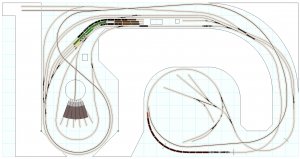
If you have a track plan I could suggest a blocking scheme.
2. The blocks should be "prepared" for occupancy detection.
Since the blocks are electrically isolated each block will need it's own set of power feeders, picking up power from the DCC power bus.
The cheapest way (and best way IMO) to "prepare" is to place a RR-CirKits occupancy detection coil on one feeder of each block. These coils are $1.75 each. (
http://www.rr-cirkits.com/description/CT-Coil.jpg).
As you can see from the picture there is a"hole" through the coil that the feeder wire goes through. Then the two connections to the coil (at some later date if desired) can be connected to a RR-CirKits WatchMan occupancy detection board using a pair of wires extracted from CATx cable.
The advantage to coils is that the power wiring to the block is totally isolated from the occupancy detection wiring. So you can "optimize" the location of your DCC power bus and block power feeder runs without worrying about the CATx wiring to the WatchMan.
The CATx wiring, if kept a decent distance away from your power wiring, is very forgiving. The wiring from multiple blocks can be run together for a good ways.
As long as you have placed one of these coils on a feeder wire to each block you will be able to add, at a future date, the wiring and electronics for occupancy detection WITHOUT having to undo any of the wiring you have already done.
If you wanted to avoid having to work under your layout to attach the wires to the coils, you could attach the CATx wiring to each coil and just run the wiring to some sensible place for future connection to the WatchMan devices. The unconnected CATx wires will have no adverse effects whatsoever.
It probably goes without saying that you need to plan on have a turnout motor, like a Tortoise, for each turnout, if you desire computer control.
Feel free to ask any and all questions you may have.
Frederick