
You are using an out of date browser. It may not display this or other websites correctly.
You should upgrade or use an alternative browser.
You should upgrade or use an alternative browser.
Wiring Organization
- Thread starter wombat457
- Start date
ModelRailroadForums.com is a free Model Railroad Discussion Forum and photo gallery. We cover all scales and sizes of model railroads. Online since 2002, it's one of the oldest and largest model railroad forums on the web. Whether you're a master model railroader or just getting started, you'll find something of interest here.


What I would suggest is that where you have two cables twist them together so they look like a single cable, I've started doing that now by connecting one end and then using a cordless drill to twist the wires together.
I do need to tidy it up a bit though!



Affiliate Disclosure: We may receive a commision from some of the links and ads shown on this website (Learn More Here)

Smudge617
Well-Known Member
Not the easiest of jobs, depending on how you do your wiring, cable ties are one way, or you can buy cable clips that stick or screw under your board.How do you keep your wiring neat and tidy and manageable?
Mine always looks like a rats nest by the time I am finished with it

RIGuyUK
Well-Known Member
I use cable clips on my layout, still a rats nest though!Not the easiest of jobs, depending on how you do your wiring, cable ties are one way, or you can buy cable clips that stick or screw under your board.
Smudge617
Well-Known Member
Mine's the same, the only way that I can see is to have an aux power line down the Centerline of the board and use choc blocks to connect your ancillary equipment.I use cable clips on my layout, still a rats nest though!View attachment 168301
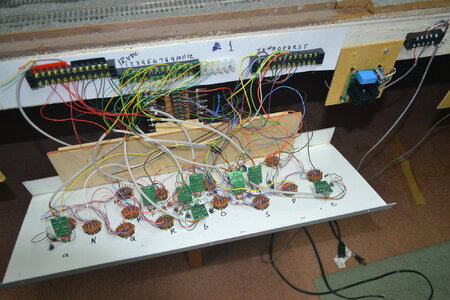
What I would suggest is that where you have two cables twist them together so they look like a single cable, I've started doing that now by connecting one end and then using a cordless drill to twist the wires together.


RIGuyUK
Well-Known Member
I used to twist wires together but had a very unfortunate incident at an exhibition where quite a large section of wiring was ripped out by the cables being caught on something, so now I keep the wires separate so the damage would be much less if it was snagged. I will be replacing the screw terminals with clip fit connections before this goes on the exhibition circuit in November.Mine's the same, the only way that I can see is to have an aux power line down the Centerline of the board and use choc blocks to connect your ancillary equipment.
What I would suggest is that where you have two cables twist them together so they look like a single cable, I've started doing that now by connecting one end and then using a cordless drill to twist the wires together.
I do need to tidy it up a bit though!
D&J RailRoad
Professor of HO
My 2,000 square foot basement empire prolly has at least 5 miles of wiring to it, keeping things somewhat organized has long since passed. My double track mainline is parsed into power blocks so the signal system will work. All turnouts are linked to DS64s or SE8C boards. The entire layout is signal controlled and then there are many illuminated buildings.
I developed a wiring schematic while I was building it years ago, so troubleshooting isn't too difficult. It's all hidden from view behind facia on the front of the layout.
I developed a wiring schematic while I was building it years ago, so troubleshooting isn't too difficult. It's all hidden from view behind facia on the front of the layout.


Iron Horseman
Well-Known Member
Well, usually a new panel is nice with bundled wire and all, but then one needs to make a change. Wap! so much for any organization.wireing organization ?? on a model rr Never
One of my old panels made of aluminum sheet I bent in my metal brake


flyboy2610
Loveably weird
I've never seen those before, Smudge. I like them, though! I use something similar, I just thread the wire through while I'm installing it.
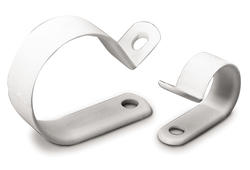
 www.menards.com
Gardner Bender® 3/4" Plastic Cable Clamp - 6 Pack
These Gardner Bender® clamps hold harnesses, cables, and tubes. The lightweight plastic construction provides resistance to high and low temperature extremes.
www.menards.com
ctclibby
Well-Known Member
I needed something to hold wire ... imagine that. Since ima cheap, I cut 1 1/4 pvc into 2" chunks, then a slot on the top so you can expand it and put wire in. Screw hole about 90 degrees from that slot. When attached, pull down ( or forward, depending ) and put your wire in it. Easy to get whatever wire out also.
Later
Later
Smudge617
Well-Known Member
I think the clip's are easier, especially if you need to either replace or want to add new cabling as they obviously just slip in from the top rather than trying to thread the cable through the clips you already have in place.I've never seen those before, Smudge. I like them, though! I use something similar, I just thread the wire through while I'm installing it.
Gardner Bender® 3/4" Plastic Cable Clamp - 6 Pack
These Gardner Bender® clamps hold harnesses, cables, and tubes. The lightweight plastic construction provides resistance to high and low temperature extremes.
Twinboystrains
Well-Known Member
If you have a bunch of wire bread ties kicking around in the junk drawer of the kitchen…staple them underneath and then twist the wires to them. If they break…grab another and repeat.
Affiliate Disclosure: We may receive a commision from some of the links and ads shown on this website (Learn More Here)