ModelRailroadForums.com is a free Model Railroad Discussion Forum and photo gallery. We cover all scales and sizes of model railroads. Online since 2002, it's one of the oldest and largest model railroad forums on the web. Whether you're a master model railroader or just getting started, you'll find something of interest here.
This is N scale. I did this test for a person on another forum who wants to model a narrow gauge railway in the Soutwestern US that has steep grades... And this person wants a steam loco that will pull passenger cars through steep grades.
This is 4.5% incline... BLI Light Mikado with 9.75" curves at the bottom, and 11" curves at the top... just to see how it performs. It did very well. After I shot this video, I increased teh incline to 5.5% and it still had no troubles at all.
Basic Ply from your local Lowes, Home Depot type store works fine.
As for the thickness - if you are going to try the cookie cutter method then I use 1/2" as it plays well when creating the grades. If your just going to use ply as your base then I'd probably go with 3/4" - a bit more solid as a flat surface.
When you use plywood you can go into and out of inclined with slight bends of the wood. The slight bends create the easement into the rise. A slight twist of the plywood going into and out of a curve creates Superelevation.
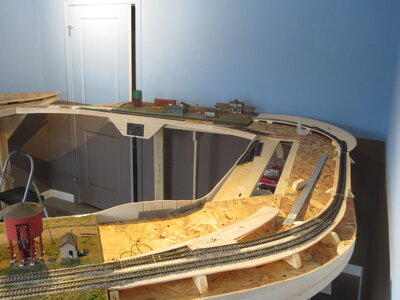
Not trying to disuade you from the foam usage, however I have always felt that plywood (or in this case 3/8" luann) gives you something more "substantial" to attach your track too, also I think automatically does good inclines:
This is all scrap lumber from other projects:
Before, this is my benchwork (HO) This is kind of messy work but knowing that the mess will be covered up with ground cover, etc.
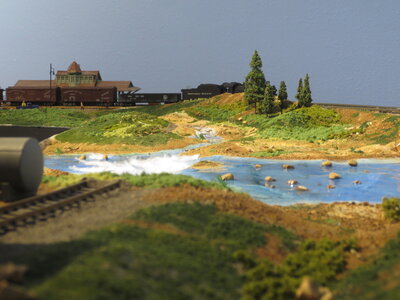
here is after, shows "south" far end after some landscaping:
note: green depot has been stationary, landscape terrain base made from window screen material and hydrocal.