ModelRailroadForums.com is a free Model Railroad Discussion Forum and photo gallery. We cover all scales and sizes of model railroads. Online since 2002, it's one of the oldest and largest model railroad forums on the web. Whether you're a master model railroader or just getting started, you'll find something of interest here.
Thanks all for the comments. Bob it is missing the light shield, it didn't have one when I upgraded it unfortunately so I'm shopping for one..... For now it's used on my "cleaning consist".
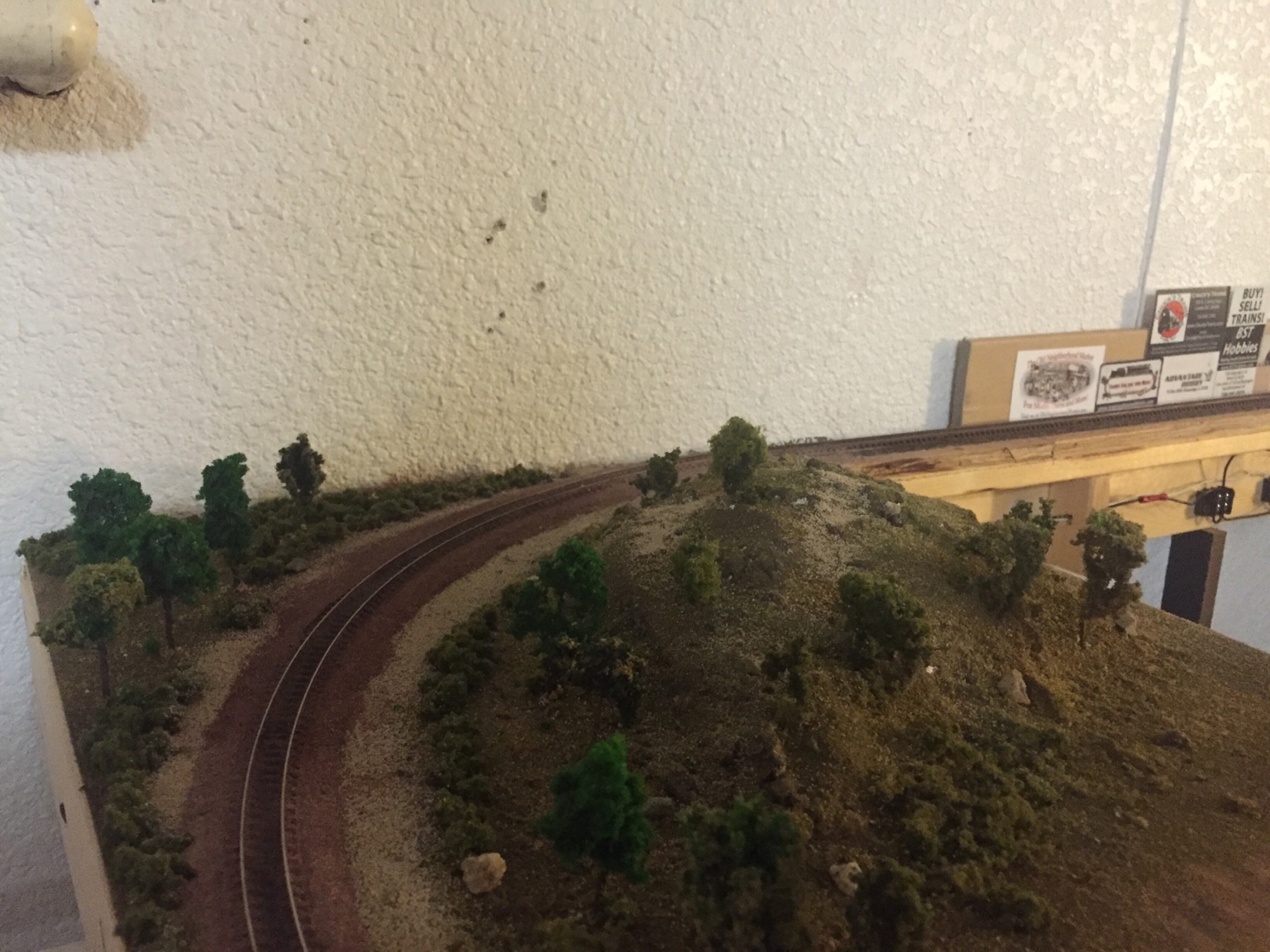
Couple shots of the areas I've been working on....
Got the other main ballasted in this area and weathered/grimed up the center of both and the sidings.....
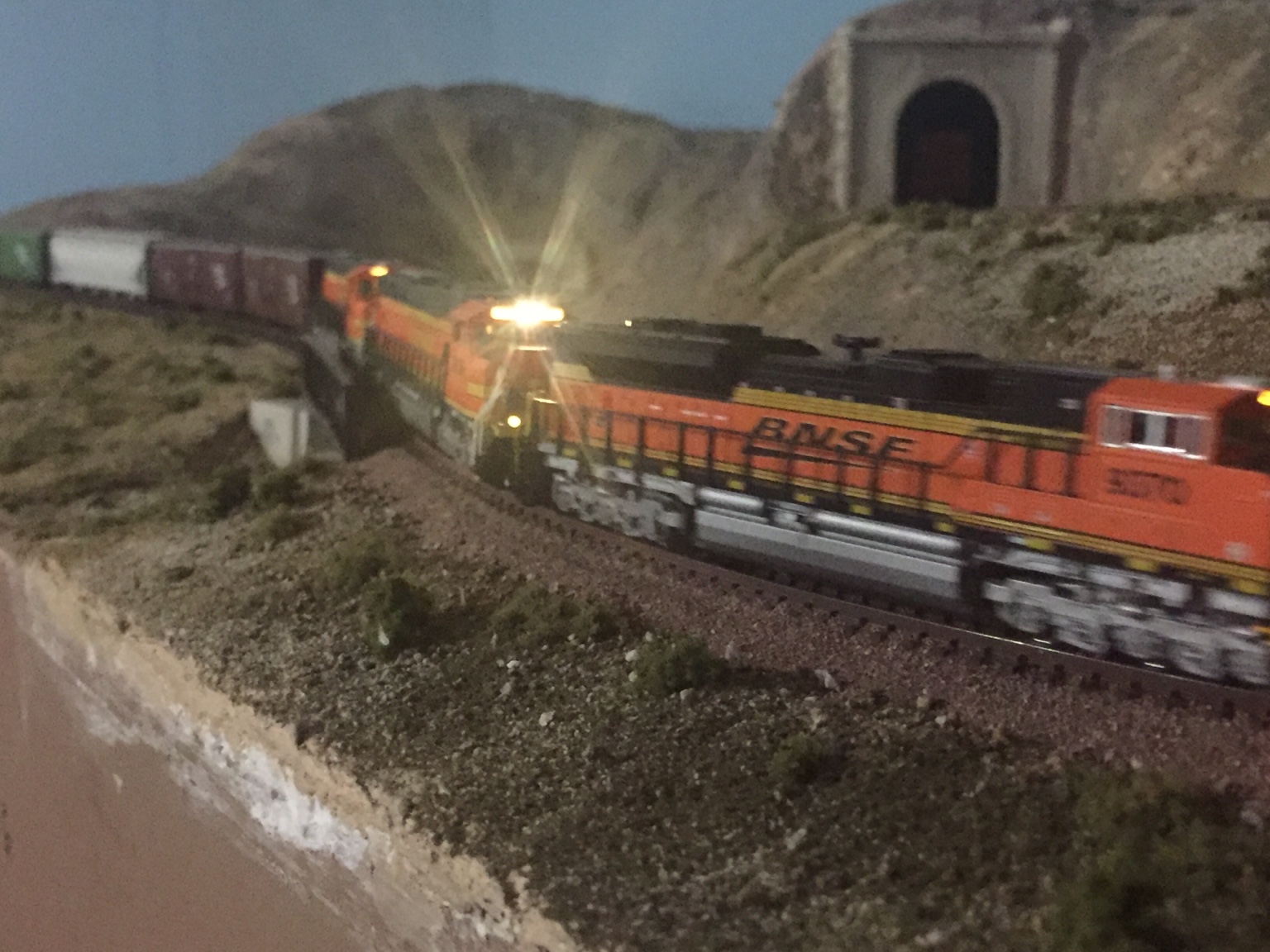
A few shots of my new SD-70's (9838 and 8862) working with SD-70 9370....
Steve, your layout looks great and the videos do too! You've worked hard and it shows, you should be proud. If you can't get a light shield for that loco, you could make one relatively easily from sheet styrene and paint it black.
Thanks Bob for the feedback, I've been looking online and seem to find all but SD-60's... That's a good idea though, I may try that too. I had thought about just painting the inside of the shell black too, not sure if that would be good or bad though. I've got two other SD-60's to upgrade to DCC, I can just rob one out of them for the meantime too.
Thanks for posting more photos. I saw a video on my phone over the weekend and enjoyed it. Can't find it again. I did enjoy running long trains when I was into N scale, but unfortunately in the late 70's, the quality of locomotives were lousy with a few exceptions.
Thanks David, you're right about having the benefit of long trains in compact spaces.... guess the trade off is you need really compact fingers to work on N scale!
Thank you kind Sir, I have an upgraded DCC controller/system on it's way (thanks Jim B). I guess I'll have to have some dual controller operating sessions once I get it all set up.
Thanks for posting more photos. I saw a video on my phone over the weekend and enjoyed it. Can't find it again. I did enjoy running long trains when I was into N scale, but unfortunately in the late 70's, the quality of locomotives were lousy with a few exceptions.
Appreciate the feedback, not sure what happened to the video links I posted, I'll post them again at the bottom of this post. N scale has definitely come along way, it's still nothing near the quality and variety of HO but there is a lot more than what there was when I first started N scale in 1997.
Lloyd, thanks for the comments. Some I built and some were already built, I did buy a few on the internet (ebay) that were already assembled or from others selling from their layouts.
Thanks for reposting the video. Don't know what happened to it. I watched it on my phone over the weekend and then was looking for it to watch on a larger format and couldn't find them. I sure give a great overview of the layout.
So this is what happens when you don't test your track with all possible locomotives....
Had mostly 4 axles and some SD-60's running for track testing, all went well and then I started building up scenery including mountains and sealing in the track. Bought a few AC4400's and for some reason they had three spots inside the mountains that kept causing them to derail ever so slightly. It was very frustrating but they are awesome locomotives so I wasn't going to hold them back from running on the layout because of a track issue.
Cut out two sections of mountains and tweeked three areas of track.
two were just joiners needing adjusting......
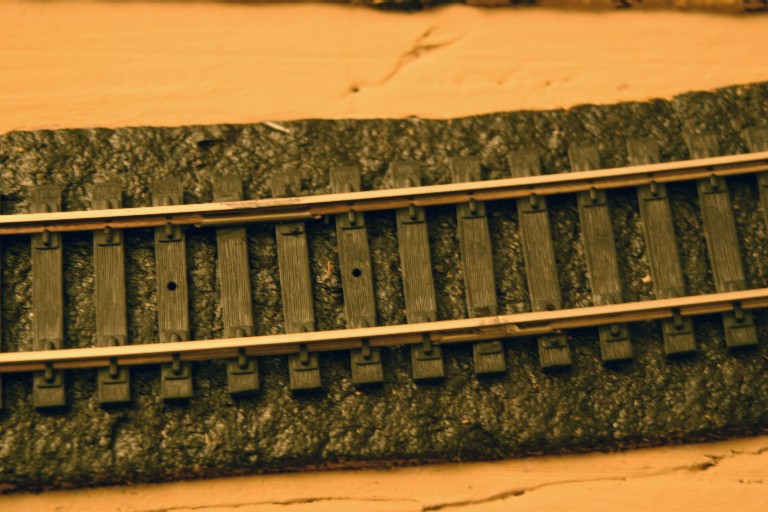
The other was a sag in a piece of track. Raised it with a piece of toolbox liner inserted and secured in place under the track to bring it level....
Fixed and running perfect now! Just need to patch the mountains up.... I was very reluctant to cut into my mountains at first but glad i did now, I used a serrated knife and it cut through them perfectly.
Always pre solder the flex track pieces in ho or n on the curves. If not the track will always kink at the joiners overtime. Also be sure track is flat. Sorry you had to find out the hard way.
Always pre solder the flex track pieces in ho or n on the curves. If not the track will always kink at the joiners overtime. Also be sure track is flat. Sorry you had to find out the hard way.
I also found out about joiners on curved trackage the hard way many years ago, but mine were not under a mountain! Definitely well worth the earthworks to sort out your problems.
Many people do that, but I disagree with that technique. I never do that. When I do solder I do it in place and avoid kinks by staggering the joiners, making certain I don't remove any ties, and making certain it is kink free and in gauge before I actually apply the heat. Pre-soldering is definitely easier, but then curving can force one to remove many ties, this can cause the gauge to narrow so one must be extra diligent in getting the ties replaced and rails fastened to them at the appropriate gauge.
This is HO but the concept is the same and I used it on N-scale track from 1969-1985.
I have soldered my curved flex track both ways. I actually prefer the second method because having track joints across from each other causes problems. I failed to do that on a curve with the ME flex and I have a kink that drives me nuts. Mainly for cosmetic reasons, its not enough to derail trains. Its on the most visible curve at the front of the layout. I hopefully spiked the track for the last time the other day. Prototype railroads avoid joints straight across from each other. If you look closely at jointed secondary trackage you will notice that the joints are offset 2'-3' from each other.
I noticed when visiting the US that rail joints are staggered, but here in the UK they are not. These days of course, almost all trackage has continuous welded rail.
Thanks for the feedback and tips on the track laying and soldering tips. I'll definitely use them for any future upgrades on the layout or any modifications I have to make. I'm also planning on a new layout in the coming years so the more tips for then the better......
Haven't done too much on the layout this week, been working on some locomotives and DCC projects. I did manage to put this short video together while running and testing trains.
A good and sad day for the SoCal BNSF layout today.....
The Good - Finally got DCC installed in one of my favorite locomotives (Kato SD-40 ATSF #5014), also replaced the wheel sets that were causing it to jump track in several spots...
The Sad - opened up three other locomotives I was planning to upgrade to DCC to find they don't have the option for the drop in decoders, I guess these were the older first generation Kato's....
I'll be retiring the following three and putting them on eBay unless someone is interested in them (PM me if so). Have two SD-40's (ATSF 5015 and BN 6338) and one SD-45 (ATSF 5300). All Kato's running great in DC.