[QUOTEI would just call it a yard. A classification yard is usually at larger facility. Here's a for instance. Take a train coming out of a large city. It may have freight going to many parts of the country. When that train gets to one of the railroads classification yards, the cars from that train will be broken down into the classification yard, usually in a hump yard where the cars will be separated onto different tracks depending on wich city ot which part of the country they are going to. These cars will then be made into a train headed to the location that the cars were sorted out for. Hope this makes sense. Old grumpy
Joe will hopefully give a better description of a classification yard.][/QUOTE]
Chet, Ken, et. all:
Ok, a yard can be loosely defined as one or more tracks used to store, receive, classify or dispatch railroad freight, passenger, or non revenue equipment...

Got that?

In a major yard, such as
Oak Island, in Newark, NJ, there is a receiving yard, a departure yard, and a classification yard, a shop yard, and a transfer yard, all under control of a single yardmaster. There is also an engine service facility with it's own related yard tracks under the jurisdiction of the Engine House Foreman. In a smaller yard, such as
Browns Yard, in Old Bridge, NJ, there are a group of multi purpose yard tracks which are used for storage, classification, receiving and departure of trains. The last track over from the "Main" is along side a road, and is used for car repair, transfer / trans loading and other purposes as required by operation. There is also a single engine storage/service facility. It is also under the control of a single yardmaster.
As you can see from my description, both facilities are considered yards, and both facilities perform the same functions, in a similar manner. For that matter
Sunnyside Yard, in Queens NY, performs the same functions for Amtrak, and NJT passenger operations. Translating that to model railroading, the only difference in yard operations is a correlation to the compromise we make when we attempt to shrink prototype operation to our scale of choice.
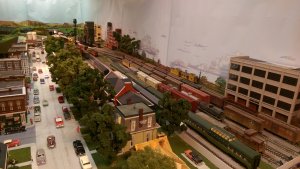
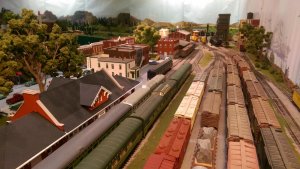
On my model railroad, for instance, the Reading Yard at South Chester, will consist of three tracks. It will function as an receiving/departure and running track, a storage track and an interchange track. The PRR Yard, will include a receiving track/departure/running track, two storage track(s), and an interchange track, plus an engine service facility, of at least one track. It will perform the same functions as the prototype yards, in a scaled down manner.
Classification is the switching of cars to place together, cars routed for a specific destination or customer. It could be a handful of locations or close to 100, depending on the location and size of the yard.
I have not tried to implement JMRI into my operation as yet, so I cannot comment on how it relates to what I described. But it should be flexible enough to work anywhere. If JMRI is used to create a scenario that reflects the operation of a prototype railroad, then it should be written to conform with standard railroad definitions. Most model railroads lack the space to have all sorts of separate use tracks, so yard tracks have multiple uses.
BTW, An interchange track is a track where cars are interchanged with another railroad, for example PRR to B&O at Bay View, (MD).



 .
.

