
You are using an out of date browser. It may not display this or other websites correctly.
You should upgrade or use an alternative browser.
You should upgrade or use an alternative browser.
New Layout for LASM
- Thread starter logandsawman
- Start date
ModelRailroadForums.com is a free Model Railroad Discussion Forum and photo gallery. We cover all scales and sizes of model railroads. Online since 2002, it's one of the oldest and largest model railroad forums on the web. Whether you're a master model railroader or just getting started, you'll find something of interest here.


Thank you LASM, I should sell my excess stuff too!
My old like-like cars (1970s) the trucks just snap in and out. I was hoping to get away with just replacing the wheels and axels. Id rather not replace the trucks if I don't have too. I am going to MB Klein in the morning and I will pick up these wheels sets http://www.modeltrainstuff.com/Bachmann-HO-Scale-42904-33-Flat-Back-Wheel-Sets-1-p/bac-42904.htm I'll let you know how they work out, If nothing else I know they fit Tyco cars.

You are right about the challenge, Chet, and that is what I am embracing. A good way to get me to solve something is for someone to say "that will be really hard".
The biggest issue is the difference in how the cars roll. Model cars operate under different realities since we do not have the same physics as the real 40 ton stuff. Also, the compression retarders that slow down the cars on the real ones don't work on the little models.
However, I did come up with an easy and effective solution and the video will be up Monday according to plans.
Be pre advised that I have already sorted cars using the hump and delayed coupling magnet, and look forward to posting the proof.
Thanks for the input!!! lasm
Secret is out. However, mine are ajustable and fit under the center of the track and raise and lower with the required amount of retardation. (is that a word?)

Affiliate Disclosure: We may receive a commision from some of the links and ads shown on this website (Learn More Here)
logandsawman
Northern Pacific history enthusiast
Thanks for viewing, Chet-- I got hooked on the M & St. Louis box cars after seeing such a variety of them on ebay. I think I have representatives from at least 7 different manufacturers, plus hoppers from 3.
Bruette
Well-Known Member
Train looks and runs great. It even sounds great too!
Have you replaced any wheels in the old Life-Like rolling stock made in the 70s? They came with plastic trucks and wheels and I am thinking of replacing the wheels with metal wheels. I was wondering if you had ever done that.
Have you replaced any wheels in the old Life-Like rolling stock made in the 70s? They came with plastic trucks and wheels and I am thinking of replacing the wheels with metal wheels. I was wondering if you had ever done that.


logandsawman
Northern Pacific history enthusiast
LOUIS: Yes I have done that and if you do the replacement, save the old ones. I just sold a batch of the old stuff on ebay, I was going to throw it but looks like I am getting a 20 dollar bill plus shipping charges!!:
http://www.ebay.com/itm/281566729889?ssPageName=STRK:MESELX:IT&_trksid=p3984.m1555.l2648
Some have a plastic pin and I pull that out and fill it with JB weld and tap a new hole and use screws to attach the new trucks. I can't remember which style the LifeLike has but some of my M & St. L cars were life like.
http://www.ebay.com/itm/281566729889?ssPageName=STRK:MESELX:IT&_trksid=p3984.m1555.l2648
Some have a plastic pin and I pull that out and fill it with JB weld and tap a new hole and use screws to attach the new trucks. I can't remember which style the LifeLike has but some of my M & St. L cars were life like.
logandsawman
Northern Pacific history enthusiast
Tony--Thanks for checking it out--no better way to show your track works than the moving train!!
 (smile)
logandsawman
Northern Pacific history enthusiast
Don't think you are seeing the first run. There are several areas I had to tweak because of derails.
It turned out most of the problems were actually either the trucks tightened down too close to the car body or rocks sticking out from near the track.
It turned out most of the problems were actually either the trucks tightened down too close to the car body or rocks sticking out from near the track.
Bruette
Well-Known Member
LOUIS: Yes I have done that and if you do the replacement, save the old ones. I just sold a batch of the old stuff on ebay, I was going to throw it but looks like I am getting a 20 dollar bill plus shipping charges!!:
http://www.ebay.com/itm/281566729889?ssPageName=STRK:MESELX:IT&_trksid=p3984.m1555.l2648
Some have a plastic pin and I pull that out and fill it with JB weld and tap a new hole and use screws to attach the new trucks. I can't remember which style the LifeLike has but some of my M & St. L cars were life like.
Thank you LASM, I should sell my excess stuff too!
My old like-like cars (1970s) the trucks just snap in and out. I was hoping to get away with just replacing the wheels and axels. Id rather not replace the trucks if I don't have too. I am going to MB Klein in the morning and I will pick up these wheels sets http://www.modeltrainstuff.com/Bachmann-HO-Scale-42904-33-Flat-Back-Wheel-Sets-1-p/bac-42904.htm I'll let you know how they work out, If nothing else I know they fit Tyco cars.
logandsawman
Northern Pacific history enthusiast
I replaced some of the snap in/out ones and filled the hole with jb weld there as well. After you do a few it is pretty easy. The biggest thing is getting the right height and that is pretty easy, too, with washers.
When it comes to replacing the wheels and axels I found out there are a lot of subtle differences in the trucks, and how the wheels fit, however not to say yours will work fine.
I was saving all the wheelsets but now made a new philosophy of replacing the trucks and wheelsets together. I can't believe it but I actually threw away a bunch of ugly looking freight cars after taking off the wheels and couplers that were good. Sometimes the couplers and trucks are worth more than the actual body.
When it comes to replacing the wheels and axels I found out there are a lot of subtle differences in the trucks, and how the wheels fit, however not to say yours will work fine.
I was saving all the wheelsets but now made a new philosophy of replacing the trucks and wheelsets together. I can't believe it but I actually threw away a bunch of ugly looking freight cars after taking off the wheels and couplers that were good. Sometimes the couplers and trucks are worth more than the actual body.
logandsawman
Northern Pacific history enthusiast
Started experimenting with the hump yard over the weekend, here is a pic with the S-12's backing down a string, I should have it perfected by the end of the weekend and post a video.
I found out that the KD couplers work a lot better with the magnet than the other brands.
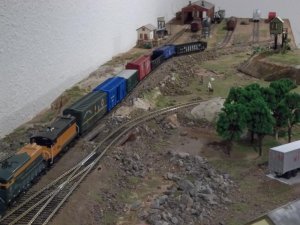
lasm
I found out that the KD couplers work a lot better with the magnet than the other brands.
lasm
logandsawman
Northern Pacific history enthusiast
Thanks, Tony, I am going to have to find something that will look good on the left and rear wall. This is the outer edge of town so rural landscape will do, the scene is too close to the wall to just put sky in, I think.
montanan
Whiskey Merchant
An operating hump yard is going to be quite a challenge. I have seen a number of articles on them in model railroad magazines over the year and they can be quite interesting. In one story a modeler was using tiny jets of air to slow cars down as a retarder. Quite interesting.
I will agree that Kadee couplers are the best. I do still have a few locomotives with off brand knuckle couplers and they are slowly being replaced with the new closer to scale Kadees.I have a few locations on my layout where industries are at the rear of the layout and have little problems at all using magnets. Sure beats leaning over scenery. The trick is to take the time to get them properly adjusted when first installing them and occasionally lubricate them with a graphite powdered
lubricant. I have some that have been in service for over 25 years and are still working trouble free.
I will agree that Kadee couplers are the best. I do still have a few locomotives with off brand knuckle couplers and they are slowly being replaced with the new closer to scale Kadees.I have a few locations on my layout where industries are at the rear of the layout and have little problems at all using magnets. Sure beats leaning over scenery. The trick is to take the time to get them properly adjusted when first installing them and occasionally lubricate them with a graphite powdered
lubricant. I have some that have been in service for over 25 years and are still working trouble free.
logandsawman
Northern Pacific history enthusiast
An operating hump yard is going to be quite a challenge..
You are right about the challenge, Chet, and that is what I am embracing. A good way to get me to solve something is for someone to say "that will be really hard".
The biggest issue is the difference in how the cars roll. Model cars operate under different realities since we do not have the same physics as the real 40 ton stuff. Also, the compression retarders that slow down the cars on the real ones don't work on the little models.
However, I did come up with an easy and effective solution and the video will be up Monday according to plans.
Be pre advised that I have already sorted cars using the hump and delayed coupling magnet, and look forward to posting the proof.
Thanks for the input!!! lasm
Cjcrescent
Master Mechanic
I've seen hump yards with models, that worked almost flawlessly, and others that wouldn't, no matter what you paid them. Ed Ravenscoff (SP) had a hump yard that was extraordinary! Not only did it work extremely well, it was curved, using air jets to slow the cars down, (I've also seen paint brush bristles used as retarders. These were removed from the brush and glued parallel to the track on the inside, and rubbed against the wheels and axles. The stiffness of the bristles and the length that was glued down determined how much the car was slowed.), but he also used horn-hook couplers exclusively. He even placed a wire that ran from the the "inside" of the coupler, via an eye bolt to the side of the car. Every car had this set up, and to uncouple, all Ed had to do was squeeze the wires toward one another and the couplers would uncouple. The end of the wire was bent to look like the end of the brake lever, that you see of every prototype car out there. As a system, Ed had a real good one.
The secret to this he told me once, (at a convention, I never actually saw his layout.) was the make of the horn hook. It had to be metal, and it had a small bronze spring the pushed against one side of the coupler, so the gathering face of the horn hook was always pushed slightly to one side. The couplers also had to be body mounts, or if truck mounted, the trucks would become offset when the train was pushed, and a derailment was almost guaranteed. The brand name that he used was Rail-Line's. They had several versions of their couplers on the market, and could be bought 2 pair to the envelope, just like KD's.
He didn't use KD's at the time as there was only one KD on the market, and those weren't that reliable. Instead of that bend in the knuckle that keeps the modern versions coupled, the knuckle was "straight faced", and side to side pressure could cause the cars to uncouple. While they did have a slight inward slant on the inside face of the coupler, it didn't help much to keep them coupled. They also didn't uncouple with magnets, there was a straight pin imbedded in the knuckle and it used a ramp to move the knuckle to one side for uncoupling. Their next coupler was known as the MKD, greatly improved, and it eventually became the KD #4.
Sorry for the Ramble, but I feel that the couplers on the engines and cars also have a lot to do with the success or failure of a hump yard, and not just how well the cars roll.
The secret to this he told me once, (at a convention, I never actually saw his layout.) was the make of the horn hook. It had to be metal, and it had a small bronze spring the pushed against one side of the coupler, so the gathering face of the horn hook was always pushed slightly to one side. The couplers also had to be body mounts, or if truck mounted, the trucks would become offset when the train was pushed, and a derailment was almost guaranteed. The brand name that he used was Rail-Line's. They had several versions of their couplers on the market, and could be bought 2 pair to the envelope, just like KD's.
He didn't use KD's at the time as there was only one KD on the market, and those weren't that reliable. Instead of that bend in the knuckle that keeps the modern versions coupled, the knuckle was "straight faced", and side to side pressure could cause the cars to uncouple. While they did have a slight inward slant on the inside face of the coupler, it didn't help much to keep them coupled. They also didn't uncouple with magnets, there was a straight pin imbedded in the knuckle and it used a ramp to move the knuckle to one side for uncoupling. Their next coupler was known as the MKD, greatly improved, and it eventually became the KD #4.
Sorry for the Ramble, but I feel that the couplers on the engines and cars also have a lot to do with the success or failure of a hump yard, and not just how well the cars roll.
montanan
Whiskey Merchant
One thing that I try to do when installing Kadee couplers is to have a small file handy. Before installing the coupler, I will file the top and bottom of the piece that goes into the coupler pocket. I then will run the file across the face of the coupler that will first strike the face of another coupler when coupling. I don't have any close up photos handy, but I found that this does help.
logandsawman
Northern Pacific history enthusiast
paint brush bristles used as retarders. These were removed from the brush and glued
.
Secret is out. However, mine are ajustable and fit under the center of the track and raise and lower with the required amount of retardation. (is that a word?)
Affiliate Disclosure: We may receive a commision from some of the links and ads shown on this website (Learn More Here)