N scale new guy questions

ModelRailroadForums.com is a free Model Railroad Discussion Forum and photo gallery. We cover all scales and sizes of model railroads. Online since 2002, it's one of the oldest and largest model railroad forums on the web. Whether you're a master model railroader or just getting started, you'll find something of interest here.


Dudepants

Member
Hey N scale friends,
As I posted in my re-introduction thread, I’m getting back into modeling after about 1.5 year hiatus (move, new baby). I’ve also decided based on the room available to me that N scale would be a better fit. I’m not looking at prototyping any particular railroad, more of an “out of my head” type layout with some operating. While I’ve been digging through the forum I’ve been trying to find what a recommended radius would be but haven’t found an answer that would suit my particular needs. I have no locos or rolling stock yet for N either. Looks like I will have about a 12’ x 5 – 6’ area to build a layout but I want to start smaller (maybe modular?) and build on it over time.

Any recommendations on what range to try and stick with for track radius? Also, can anyone point me towards a good “beginners guide to N scale” book/magazine/other source?

Thanks a lot in advance for your help, looking forward to having some fun!

- Brian
 
I would suggest using the broadest radius you can live with. Many many moons ago when I first got out of the service I was in train withdrawal and the only thing that would work for me was N scale because I was stuck in an apartment. The folks at the hobby shop suggested using flex track and to keep the curves a broad as possible. A great suggestion which I heeded. Using flex track gives you the freedom to do what you without having to be limited to working with sectional track.

I have since moved on to HO scale, starting my layout in the early 80's, starting the layout by hand laying track and completing it with flex track. I would never consider going back to sectional track.
 
The folks at the hobby shop suggested using flex track and to keep the curves a broad as possible. A great suggestion which I heeded. Using flex track gives you the freedom to do what you without having to be limited to working with sectional track.

Awesome, thanks for the help Montanan, I will definitely use flex. I used Peco with my HO layout so I'll probably stick with that brand. Can you elaborate on how tight of a radius you could run with N scale using flex track that operated well and looked good? Would 8" - 10" be way too short?


I'm not the one to really ask as I haven't been in N scale for over 30 years. 8" sounds a bit tight to me unless it would be in an industrial area and not on the main line. I had at one time when I first moved back to Montana an N scale layout with over 11 scale miles of track on the main line alone. I kept my radius as broad as possible and would guess that the minimum was probably around 15 to 16. I like running some passenger trains even though switching is my preference, but the longer equipment looks so much better on a broad radius. Not toy like. My HO scale minimum radius is 32 inches, but in just one location with most curves a lot broader.

Suggestion, Burlington Bob here on the forum is into N scale and maybe he could be a bigger help than I. He is recently back on the forum and I know he does post on Running Rears Coffee House. Look him up there and send him a PM. I'm sure he could be a lot of help for you.
 
Can you elaborate on how tight of a radius you could run with N scale using flex track that operated well and looked good? Would 8" - 10" be way too short?
Short answer - yes 8" is way too short.
Long answer - 9.75" is the N-scale equivalent of 18" radius in HO. Considering your space, I would be thinking more like 13" minimum, but attempt to get 15"-16".

Are you thinking of filling the 12'x6' space in, or going around it donut style?

I believe there are at least two "Beginners guides to N-scale" type books, but have not read either so cannot recommend for or against them.
Yup looke here. They are both pretty old ( more than 15 years old).
http://www.amazon.com/Scale-Model-Railroading-Getting-Railroader/dp/0890243476
http://www.amazon.com/Beginners-Guide-Scale-Model-Railroading/dp/0890240981
 
Last edited by a moderator:
Hey Iron Horseman,

Thanks for jumping in!

I'm thinking of doing a donut or dog bone style layout with one side butting up to a wall (12' stretch). I've had pretty good luck keeping to no smaller than 13" radius using SCARM, so thanks for giving that info. I'll try and keep to 15 - 16 with a goal of no smaller than 13.

Thanks a lot for the tips on the books, I'll check them out for sure!
 
Last edited by a moderator:
Thanks Horseman. Appreciate the input. It has been so long since I was in N scale that it is a bit hard to relate to the difference, I figure about half of HO scale for N scale radius. Broader is always better in my opinion.
 
Got some really good info from Burlington Bob I thought I'd share for other new guys like me:

Hi, Brian and congratulations on the new baby!

The best advice I could give you is to make your curves as big a radius as possible and try to stick to #7 switches (turnouts) or greater on your mainline. You can use #5 switches for industrial areas and maybe a radius as small as 11 or 12 inches for industrial sidings. For passing sidings try to use #7 switches but #10's would be the best, if you have the room.

For the space you have available, I would recommend an around the walls type of layout. This allows the best use of space without causing reach issues. In N scale a shelf 12 inches wide will allow quite a bit of scenery and track, while 18 inches gives you a huge amount of real estate. A shelf style around the walls layout is also easy to build in a modular fashion. Do a Google search for "Heart of Georgia" layout. While not the same size as what you have planned, it should give you some good ideas and could even be adapted to your space very easily if you wished.

Another resource I would recommend is to check out Model Railroad Hobbiest on the web. You can read their monthly magazine on line or download it to read anytime...........and the best part is .........it's totally free! They also have forums where you can get advice and ideas as well. Youtube has many videos on layout building and how-to's for scenery.........some are better than others but there are some very good ones, especially from Woodland Scenics.

Hope this helps you. Just remember to try to keep your curves as large as possible and try to use at least #7 switches. I use Atlas code 55 track and their flex track is very easy to form to the shape you want. If you have more questions just ask, either here or on the Forum. Everyone here will be very willing to help.

Good luck, Bob.​

Everywhere West!

"N", the Normal scale!
​
 
Hey Gents,

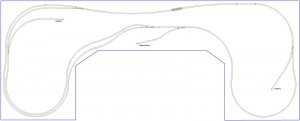
Thoughts on the track plan below? Go easy on me, I'm a beginner, ha! Here's what I know:

- Freelance rail
- N scale
- smallest curve is 13"
- Planning on using Peco flex track
- Want two industries and a loop for watching (I like watching, ha!)

Any input you have is greatly appreciated.

Cheers,
Brian

BTONScaleRail4.jpg


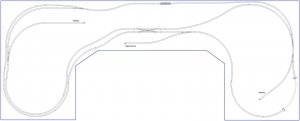
revised it a little:

BTONScaleRail4.jpg

overall dimensions are 10' x 4', left and right sides are 30" wide, center section is 20" wide. Top flat section will be butted up to a wall.
 
Just my 2 cents and experience.
I'm redoing my layout because of one major problem....... reach

View attachment 54332

As you can see, to reach the furthest corner, it's 40"
How do you intend to do any scenery in those corners, how will you fix a derailment or switch and unhook cars?

I would push those diagonal corners further inside the layout, creating 2 peninsulas
Hope this makes sense

GL
 
Ah thanks Hawkesburytrain, I wouldn't have even thought of that. Since I'll have access to all sides (except for the back side) do you think I would be ok? I have rather long arms. Maybe I'll tape out the benchwork on the floor first to see how that works.
 
My big question to you is, What do you like the most about trains? If you can incorporate that into your layout then you will stay happy with your layout. Sometimes the scale you model follows your interests. For instance my current layout is designed to provide switching and industrial branchline trackage like existed in 1925. For this I switched back to HO scale and have a relatively simple layout. This provided a nice compromise between space, detail and economy. The locomotives and accurail kits needed are relatively low cost, era appropriate cars are mostly 30-40' in length and sharper curves are manageable. Now if I modeled current railroads my 24" curves would be considered sharp, sound equipped locomotives are $200-400 a piece, traincars are often 80'+ and many cost $40-50 each. It's alot more space and cost efficient to model large prototypes in Nscale. So like I said knowing what you want starts the process of how to get there, hopefully without requiring a miracle. The problem I have with most books is that they usually don't get you to think. The time you 'waste' making a clear theme for your model railroad will payback later when you accomplish those goals.

Sent from my XT1080 using Tapatalk
 
My big question to you is, What do you like the most about trains? If you can incorporate that into your layout then you will stay happy with your layout. Sometimes the scale you model follows your interests. For instance my current layout is designed to provide switching and industrial branchline trackage like existed in 1925. For this I switched back to HO scale and have a relatively simple layout. This provided a nice compromise between space, detail and economy. The locomotives and accurail kits needed are relatively low cost, era appropriate cars are mostly 30-40' in length and sharper curves are manageable. Now if I modeled current railroads my 24" curves would be considered sharp, sound equipped locomotives are $200-400 a piece, traincars are often 80'+ and many cost $40-50 each. It's alot more space and cost efficient to model large prototypes in Nscale. So like I said knowing what you want starts the process of how to get there, hopefully without requiring a miracle. The problem I have with most books is that they usually don't get you to think. The time you 'waste' making a clear theme for your model railroad will payback later when you accomplish those goals.

Sent from my XT1080 using Tapatalk

Thanks for the reply RBMNFan, that gives me a lot to think about. Most of what I like about trains is watching them. That's why I wanted to concentrate on scenery and modeling around my layout rather than as much operations. I actually started building the frame work for the benchwork this week and i think I'm on the right path. I get the biggest kick out of building, scratch building and kit bashing buildings, etc. Really looking forward to working on them with my son.
 
I don't mean to discourage you from Nscale. I am the type of person that gets bored easily. So I build layouts taking that into consideration. The current layout allows me to learn how to work on adding details. Both finishing scenery and at some point I will detail the rolling stock. I have designed and operated many layouts, but I never finished one completely. My first interest is track layout design. My second is operations and I am working on details. When I get bored I do something different, either with the operations, or another step in the scenery or finish finalizing the wiring. One thing I recommend is having some option to add staging in the future. A switch with a track running to the edge of layout would do. A simple board with one or two tracks on it that temporarily extends the layout can add alot of bang for the space and dollars. When not in use it can either swing down on a hing or even just be a pop up thing to allow full use of non layout space.

Sent from my XT1080 using Tapatalk
 
I don't mean to discourage you from Nscale. I am the type of person that gets bored easily. So I build layouts taking that into consideration. The current layout allows me to learn how to work on adding details. Both finishing scenery and at some point I will detail the rolling stock. I have designed and operated many layouts, but I never finished one completely. My first interest is track layout design. My second is operations and I am working on details. When I get bored I do something different, either with the operations, or another step in the scenery or finish finalizing the wiring. One thing I recommend is having some option to add staging in the future. A switch with a track running to the edge of layout would do. A simple board with one or two tracks on it that temporarily extends the layout can add alot of bang for the space and dollars. When not in use it can either swing down on a hing or even just be a pop up thing to allow full use of non layout space.

Sent from my XT1080 using Tapatalk

Thanks RBMNFan, really appreciate it and you haven't discouraged me from N-scale! ha! :p I've almost got my benchwork completed and have settled on heavily freelancing the Soo line in Minnesota. I'll have a couple industries (Hamms beer for one, adapting a factory kit to look like the old Hamms building in St. Paul) and some passenger trains. Sort of late 50s era.

I like you get bored pretty easy so I hope i have both enough operations and modeling built into my plan. Since I'm going to be leaning very much towards freelancing, I'm hoping this gives me more flexibility when issues/opportunities arise. Either way, both my son and I are pretty excited, ha!
 
Any input you have is greatly appreciated.
For the original plan I was going to point out that both industries and the engine house were "trailing point" (the train backs into them) for counter clockwise running. That is good if one is only planning on running counter clockwise.

For the revised plan, you have added a reversing loop to the mix. My comment there is, "for a railfan type (mostly watching the trains run) layout, a reversing loop in the opposite direction might be desirable". That is, running counter clockwise one can run around and around, go through the reversing loop and end up going clockwise to loop as many times as is necessary. The opposite is not true. Running clockwise the only way to change and run counter clockwise would be to backup the train through the reversing loop.
 
Ah, thanks for the thoughts Iron Horseman, I think that makes sense to me. I've only just started to lay some track and I think I'll make some changes. Do you think it would add some interest by having the industry sidings facing opposite directions?


Sent from my iPhone using Tapatalk


Ah, thanks for the thoughts Iron Horseman, I think that makes sense to me. I've only just started to lay some track and I think I'll make some changes. Do you think it would add some interest by having the industry sidings facing opposite directions?
It adds operational interest. This is because trains in either direction can participate in switching moves, or because a run around move is required for switching the facing point sidings.
 
Last edited by a moderator:


Affiliate Disclosure: We may receive a commision from some of the links and ads shown on this website (Learn More Here)

Back
Top