You are using an out of date browser. It may not display this or other websites correctly. You should upgrade or use an alternative browser.
My Northern Pacific Butte Montana Layout.
Thread starterNP2626
Start date
ModelRailroadForums.com is a free Model Railroad Discussion Forum and photo gallery. We cover all scales and sizes of model railroads. Online since 2002, it's one of the oldest and largest model railroad forums on the web. Whether you're a master model railroader or just getting started, you'll find something of interest here.
The second is a look at Bill Scobie's Narrow Gauge Rio Grande Southern in Sn3. Bill has many videos that have been produced by Chris Lyon or CNLVN a Canadian videographer. Bill's layout is superb and follow the RGS from Ridgeway to Rico, the northern half of the railroad. If the video starts somewhere other than the beginning, slide the slider back to the left. Enjoy!
I wonder why these great layouts have not been featured in the modeling press? Although the videos describe layouts that are narrow gauge and scales other than HO, the value in them is that they teach how to do almost everything in Model Railroading!
Enjoyed the video. Quite a layout. Would like to see it in action.
To answer your question about the sound, I have no control at all as apparently everything has been programmed into the locomotive. Upon starting, the horn will give the correct signals both in reverse and forwand and upon stopping. The bell will sound when fist starting up and running at very slow speeds and will stop as the locomotive speeds up. I really wasn't interested in the sound, but I couldn't pass up the nicely detailed Alco. Here the Bachmann 2-6-0 that my son gave me. Again I have no contril of the sound. The two passenger cars are just about at the limit that the locomotive and pull up the two and a half percent grade.
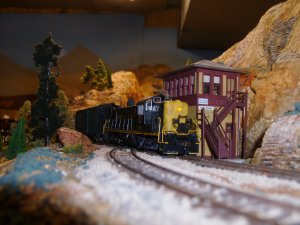
I think this is the last locomotive I have to show. This is a Bachmann RS-3 with DCC and sound. The loco came from ModelTrainStuff.com as an Erie RS-3. The Erie paint job is mostly black and so came fairly close to the Northern Pacific's paint scheme. I searched through photos of Northern Pacific's RS-3 and found that RS-3 861 had a fairly easy paint job to match. It only had the canoe end on the short hood end. The long hood end is simply black. So, the new paint was almost simply a matter of painting over the yellow parts. I changed the normal direction of travel, so forward runs with the short hood forward. The yellow used on the Erie model really did not match the yellow the N.P used, so all the yellow got a coat of a closer to N.P. yellow. I would like to add the classification lights and number boards that Northern Pacific used, if I could find them. I may just leave it the way it is. It is good runner and a fairly good puller.
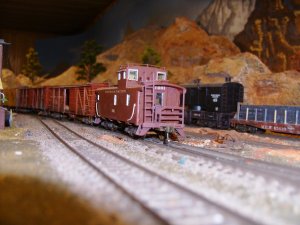
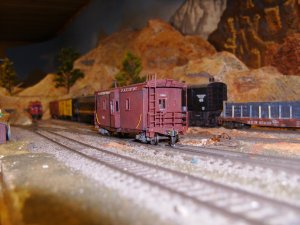
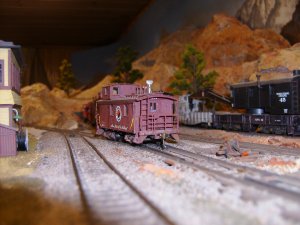
This is an Athearn 5 window Cupola Caboose kit bash. Many changes to the kit where performed to get it looking like a Northern Pacific 1000 to 1050 series steel caboose. These where the first steel cabooses that the N.P. had. It's my understanding that the crews really did not like them as in the winter they where cold! To build, I removed all the rivet detail that Athearn put on the model. Then I filled all the windows that where not in the right positions, I also had to add a small window that would have been in the bathroom. Then, the cupola on the N.P. caboose was farther forward of the position on the Athearn caboose; so, I had to move the cupola forward and fill in where the old hole was. Then, because N.P.'s cupola was as wide as the lower part of the caboose I had widen the cupola and because the N.P. cupola was taller than the Athearn, I had to add material to make it wider. The end railings had to be fabricated as the N.P.'s railings had much more railings on them. Finally the roof platforms and ladders had to be moved over to the other side. I added a man visible in the cupola and painted the caboose Mineral Brown and decaled and gave it the number 1001.
It was a fun project and took a while to complete. I have another Athearn kit, I will eventually make into a 1051 to 1100 series caboose, basically the same as I just described only the cupola is lower.
I really like the cabeese. You did a really nice job on them. I should build a few more NP cabooses as I already have enough for the Milwaukee Road on the layout.
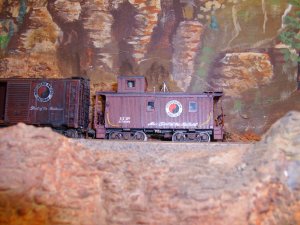
These two cabooses are Gloor Craft Models wood kits. Gloor Craft Models is no longer in business; however, I have been able to find them on Ebay and typically end up paying between $20.00 to $30.00 for a kit. In fact, right now one is selling on Ebay for $24.99 "Buy It Now". Do a search for Gloor Craft Northern Pacific Caboose. I have one more of these Gloor Craft kits to build and I also have an Ambroid N.P. caboose to build. I would assume that Gloor Craft bought out Ambroid as the two kits are the same, excepting I will have to cut out the windows on the Ambroid model. I find these wood kits to be really fun to build. The one on the left is the first one I built. and I can tell this because I put Visors over the Cupola's side windows. The cupola parts are pot metal along with the window frames, End platform steps and brake details. Again the end railings are details I scratch built from cardboard and plastic angle irons. Grab iron materials are provided and made from both brass and soft steel wire.
Yes, sirfoldalot, I guess I let the "Cat out of the Bag"!
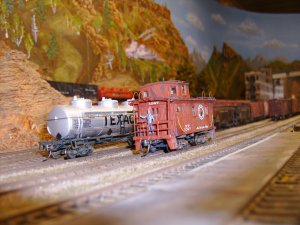
The NPRHA was offering a Bay Window wood caboose kit a couple years ago. So, I broke down and bought one. This is the only Bay Window caboose I have. This was a tad more difficult to build than the little 24 footers. As I remember, there were no metal parts for this caboose and the brake rigging was from Tichy. All of the wood kits I have built come less trucks and couplers. However, if you want real looking Northern Pacific Cabooses and don't want to pay for brass, this is a good way to get them. I don't know if the NPRHA will ever market the Bay Window again.
Just for general information - good on board sound existed long before DCC was conceived. The issue was that it was extremely expensive. I bit the bullet in 1982 and bought one of the units. I'm guessing I've got 10-20 DC (not dual mode decoder) sound equipped locos. For that matter I even have a couple of RailCommand Sound equipped units. Everyone said it was impossible so of course I had to prove them wrong. Unfortunately as soon as I had it perfected the manufacture (Phoenix Sound) ceased building the sound board I was using.
Iron Horseman, you've quoted me; but, your statements above, have nothing to do with the topic of my questions for Montanan! Many who have been in this hobby for a while know that sound systems existed long before DCC came about. I guess I don't follow your train of thought with your response. All you're seeming to state, is that you have had experience with sound previous to DCC. O.K....?
I have not had experience with sound, until DCC. Then my experience is only related to DCC operations. I did not know that a sound decoder DCC equipped loco being operated with DC would have some automatically actuated sounds. I think that is pretty neat!
The Bachmann loco that Chet has is fitted with one of their so named "Sound Value" Soundtraxx Tsunami decoders. In truth Chet, you do have control to a certain extent over them, all done with the throttle. There are CV's (configuration variables) that enable the use of speed step control as to when the sounds activate and in the case of the bell, when it starts/stops ringing. Those CV's can be set to operate in both DCC and DC whichever control system is being used. They are not usually enabled e.g. the Athearn Genesis Tsunami's I have, from the factory, but are one of the myriad (as I am discovering) effects that can be. Bachmann have just decided to do it ex factory.
As a footnote (I have musical toes, they've been known to hit some very high "notes"), whether other bands of DCC decoders have this automatic sound control ability I don't know. I have 2 ESU Loksound equipped locos and have downloaded and printed their manual, but as I'm still wading through the Tsunami options and haven't even opened it. Oh yes, and Soundtraxx has recently discontinued the version I have and replaced it with 2 others, The "Econami" and a couple of months ago the new "Tsunami2". Both have differences vis-à-vis what the F numbered buttons on my Cab control do to the old one.
I will bring up an old sound system that I was using in the late 80's, the PFM sound system. I used it only for my steam locomotives and I really liked the sound of it a lot better than DCC steam. You could adjust the whistle to different pitches and also you had so much better control of the whistle by modulating the control lever. Growing up and riding along with relatives, my uncle could tell who was the engineer on a train just how he used his whistle. The same is true today with modern locomotives.
I finally gave it up as the locomotive modules were becoming very scarce and I was having to build my own. Also, being that my layout was built for switching, a hand held throttle so much easier to use plus I can't count how many times I walked into the PFM control unit as the only place I could mount it was on the facia.
I really can do without sound. I do have a few locomotives with DCC and sound and for me after a while the sound can get a bit annoying. I will put them on the tracks sometimes when visitors come over and want to see the trains run.
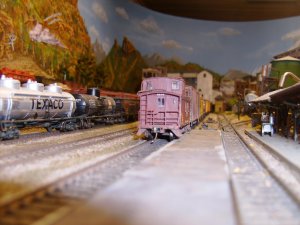
This is the last caboose I am going to show. It is an American Model Builders Laser Kit, modeled after one of Northern Pacific's 1200 series cabooses. This was the first wood N.P. caboose kits I have built and by far, the best of the wood kits I have built. Although the kit costs around $50.00, it is well worth that price. I do not recall if the brake details; or, other detail parts are plastic; or, pot metal and I don't think it matters. Most of the parts have sticky backs to aid in assembly. The kit provides all parts, including clear window material. The cupola is also wood. It builds into a very nice kit. You would need to supply couplers and trucks.
Nice looking caboose. Send it over. May have to see if I can fine one. By the way, the ground level photos are a big improvement. What you may want to do is to add some additional lighting. I have a lamp with a clamp on it that I use for additional lighting.
The Bachmann loco that Chet has is fitted with one of their so named "Sound Value" Soundtraxx Tsunami decoders. In truth Chet, you do have control to a certain extent over them, all done with the throttle. There are CV's (configuration variables) that enable the use of speed step control as to when the sounds activate and in the case of the bell, when it starts/stops ringing. Those CV's can be set to operate in both DCC and DC whichever control system is being used. They are not usually enabled e.g. the Athearn Genesis Tsunami's I have, from the factory, but are one of the myriad (as I am discovering) effects that can be. Bachmann have just decided to do it ex factory.
I do have this exact same locomotive, in fact I had the exact same Milwaukee Road Sound Value loco, which I swapped the sound chassis for my Digitrax DH123-D decoder equipped chassis for my Northern Pacific S-4 and now I have what was the Milwaukee Road chassis in my Northern Pacific loco.
For having attracted all this attention, my question really only had to do with how/why Chets loco operating on DCC was able to make horn sounds.
Nice looking caboose. Send it over. View attachment 58996 May have to see if I can fine one. By the way, the ground level photos are a big improvement. What you may want to do is to add some additional lighting. I have a lamp with a clamp on it that I use for additional lighting.
What you see is what your going to get. As I explained, I am not interested in photography and I really don't like these angular shots that don't show the subject to the best ability. Not being cranky, just stating what I think and that is that a shot from above and broadside shows this much better.