My First Layout. Questions, Updates, Comments Thread

ModelRailroadForums.com is a free Model Railroad Discussion Forum and photo gallery. We cover all scales and sizes of model railroads. Online since 2002, it's one of the oldest and largest model railroad forums on the web. Whether you're a master model railroader or just getting started, you'll find something of interest here.


BNSFnut

New Member
Hello everyone!

I'm starting to throw around the idea of making a layout for the first time. I'm pretty inexperienced in the hobby and will have lots of questions along the way, and that's what this thread is for. For me to ask away and keep everyone updated on where I'm at with the layout.

It looks like it will be a simple beginner 4x8 layout right now, but I would like to go with something a little less conventional if possible. I really want to be able to operate on my layout. I seem to differ from most beginners who want to have a layout they can loop trains around for hours, where as I want to be able to operate for hours :) So if possible I'd like to go with something a little bigger than 4x8. Any recommendations would be appreciated!

For anyone who hasn't seen my introduction post, I'm in a unique situation for a beginner modeler. My grandpa, who was into the hobby, passed away 3 years ago and has left my family with a basement filled with piles and piles of model trains. Most will be sold on Ebay, but I've been blessed enough to be able to take what I want from the collection. This includes some DCC equipment.

So if possible, I would LOVE to have my first layout be wired for DCC. I don't know if that's to complicated for a complete beginner though. I have no background in wiring so this layout will definitely be a means of learning and learning. I am very willing to learn though and know people who would love to help who may be more experienced in the different categories such as wood working and wiring.

So basically, a smaller layout set up for operations and wired for DCC is what I'm going for. Let me know what you think, is it to much of an endeavor for a beginner or should I go for it. I'll get more into track plan ideas when I get opinions. Feel free to link me to some track plans and ask questions.

Thank you for your time! Have a wonderful day!
 
Firstly, welcome to the forums and secondly the debate between DC and DCC is one of those ongoing things and a matter of personal preference. It also depends on what you intend doing on your layout. As you seem to want to operate your layout, as opposed to sitting back and watching it, I'd assume you will want more than one train running at a time. That being the case, running DCC will be the better (if not the only) option for you and will make the wiring of the layout less complicated as well.

An 8 X 4 layout is also a good starting point but, if you have the room/space, why not make your layout as large (benchwork wise) as that room/space allows? Utilizing your maximum space will give you more options and the chance for variety. Just because you have "large benchwork" doesn't mean that you have to fill that benchwork with your layout; however, will permit expansion of your initial design. Trust me, I started with a slightly smaller than 8 X 4 layout and have since expanded it to a 12' X 4' (approximately). Starting over was annoying to say the least. Had I started with what I now have, I would have saved a lot of money, time and frustration :)

In short though, your idea of starting smaller with DCC is a great way to learn and hone your skills. Therefore, I would say go for it, you will get a lot of help, advice and suggestions from the guys and girls here, all you have to do is ask. Remember also, everyone had to start somewhere so there are absolutely NO stupid or dumb questions.
 
I'm no expert, except at growing old, but I have no shortage of opinions.

On DCC: Taking your question literally, wiring for DCC isn't that complicated -- and it's a lot less complicated than the DC wiring with multiple blocks in order to run more than one train. The key difference is that there's probably a bigger up-front cost for DCC; in the long run, though, the costs of DC and DCC are said to be about the same. DCC requires you to pay a bit more up front for the basic control system, whereas for DC you can get in on the ground floor for less $$ but will be paying for a lot of components (switches to control your blocks, etc.) that you will have to install as you go along.

Another difference is that DCC equipment is a lot more sensitive in various ways, but exactly how I'm not competent to explain. I do know people worry about frying decoders and accidentally unprogramming locos and things like that, though. But I also know that by paying attn. to some very simple rules those problems can be easily avoided, so don't let that deter you.

The other cost difference involves your motive power. DCC-equipped locomotives are anywhere from about $30 to $100 more than the DC versions (in part depending on whether they also have sound). Non DCC-equipped locos may be easy to convert (especially if "DCC-ready" and already equipped with a socket into which you plug the decoder) or may require a bit of work to convert. Something you can teach yourself to do, or hire out; my sense is that the going rate for a hobby shop to do the conversion is somewhere in the neighborhood of $40-$80, but that might vary tremendously....

Since you're working with an existing inventory of equipment, and some of it is DCC, then the decision is pretty much made for you (in my opinion; your mileage may vary); I would see little reason to *not* go ahead with DCC control, especially since you know you want to go there at some point, anyway. I suppose if the only locos in the collection you really like aren't DCC, or at least DCC-ready, then you'd have to think more about it.

As to layout design... There are a lot of layout books with good ideas in them. No single layout by itself has to be perfect; you can tweak it to make it better suit your purposes. John Armstrong's Track Planning for Realistic Operation is a great place to start -- mostly just to be thinking about the most effective ways to design a plan. Two other Kalmbach books, 101 Track Plans for Model Railroaders and 101 More Track Plans for Model Railroaders, are worth paging through. And if you are a subscriber to Model Railroader magazine, they have a subscribers-only online database of plans that can be very interesting to browse -- and it's searchable by scale, size of layout, and basic configuration (island, walk-in, etc.).

And finally, I think you're really smart to want to start small -- I've always been fascinated by the number of big layouts I've seen (in Model Railroader magazine mostly) that grew from much smaller ones, and how those smaller ones were incorporated in the larger one. A well designed smaller layout can produce a lot of operations possibilities, too. If you really don't care about continuous running, for example, you could build a simple shelf payout that depicts a particular switching scene. And even if you decided at some point that you did want to do continuous running, that could be expanded to make a full loop in a relatively modest space.

Hope that helps, and best wishes to you for a hobby that can last a lifetime!


if possible, I would LOVE to have my first layout be wired for DCC. I don't know if that's to complicated for a complete beginner though.
That is the best way to go on a new layout in this day and age. I don't know where the idea comes from that DCC wiring is complicated. It is not! It is much easier than wiring for straight DC. Basically hook the two wires to the track and your done.

It looks like it will be a simple beginner 4x8 layout right now, but I would like to go with something a little less conventional if possible. I really want to be able to operate on my layout. I seem to differ from most beginners who want to have a layout they can loop trains around for hours, where as I want to be able to operate for hours
One can "operate" on any track plan. Back when all I had was a loop of track, I put three stations on it and mapped out a schedule of how many laps it was from one to the other. Then I practiced doing smooth stops and starts, and getting up to a speed where such that I would do the appropriate number of laps to get to that station on time. When I could finally afford a turnout, I added "switching" to my schedules. I had a deck of cards that indicated which car had to be switched out, or picked up. As I added more track my "schedule" got more and more complicated and sophisticated (like picking up and returning empties), but I WAS operating the whole time.

Having said that I do understand the question. There are some really good layouts for realistic operations that can be done on a 4x8 or the equivalent of a 4x8 wrapped around the room. Around a room opens all sorts of doors for good modeling and operations.

Talk to us some more about your likes and dislikes and we will be able to make better suggestions.
 
DCC is easier to install than DC eh? Now that's good news! I guess the common assumption to the beginner is it would be more complicated due to its complex nature I suppose ha ha. I've really caught a break in the finances department with my grandpa's collection. I think I'll be able to save big time. He had a good mix of older DC locomotives and modern DCC locomotives, so shouldn't be a problem there.

I have the space for a layout, but the space isn't exactly the best place to put the layout. The room is in the basement and unfinished. Cobwebs on the ceiling, concrete walls and floor, and slight flooding problems after the snow melts. So some updates may need to be done to the room before its ready to house a layout safely. My family has been working on a huge addition and re working of the house so hopefully there's some left over materials to get that going!

I don't want to be to picky about what I want on my layout, but being able to operate is definitely high on the list. Since it will be a small layout to start I would like something with maybe two industries that can be switched and are related to each other in some way. I'm leaning towards a 4x8 or similar rectangle type layout that can have a loop, mainly because my younger brother is getting into the idea and he would definitely be the "loopy" type ha ha. So maybe something bigger than 4x8 but not to big, enough to fit two related industries and a small town maybe.

I would look into a shelf-type layout if I had a nicer room to put it in, but I can just see a terrible giant spider apocalypse plaguing the layout ha ha. So if it was a table layout I could be working on the layout construction and room updating at the same time maybe.

I'm getting really excited about this :) thanks for the replies so far!
 
Something you will need to keep in mind for the future is environmental control. It won't be so critical with a really small layout, but as you expand you should ideally have an environment that maintains a fairly steady temperature and humidity. Temperature changes can cause track to either buckle or gap due to the expansion and contraction of the metal rails. Humidity changes will do the same thing, but the cause in that case is the wood that the track is built on expanding and contracting. Temperature affects metal, humidity affects wood. I learned the hard way not to let it get to either extreme. Like I said, a small layout won't really have those problems if that's what you're starting with, but as you expand you'll need to take some steps to remediate the temperature and humidity fluctuations. Depending on your environment you may need a small de-humidifier (or even a humidifier in the winter), a heater, small portable a/c unit (though maybe not if the basement stays naturally cool), etc. All these things will also make it a lot nicer to be in there working and playing on the layout too. So anyway, as you update & fix up the room just keep those things in mind also.

As to DCC it is by far the easiest to wire. It's a little more than just "hook two wires to the track", because you'll need power feeders spaced along the track to prevent voltage drop & signal loss, and also to feed power "upstream" of any turnouts, but that concept is essentially correct. Good luck with everything and hope you have a lot of fun!
 
Hello again young man!

Here is a link to the forum bookstore, "Track Planning for Realistic Operation" by John Armstrong used for $4.21 + shipping $3.99 I think. Your Grandfather may even have a copy in his inventory.
http://www.modelrailroadbookstore.c...1_Track-Planning-for-Realistic-Operation.html

I learned of it from one of the best and most experienced model railroaders on here and he recommends it to all new modelers. It is no longer in print but the ideas are great. This book is the best book I have read!


Iron Horsemen, another of the true experts on this forum, always trust what he tells you and he is exactly right about DCC. For a new layout it is simple and easy to set up. You don't have to start with a DCC controller if you keep your track plan simple to stay away from complex DC wiring the conversion to DCC will be easy. DCC wiring is by far much simpler then DC wiring once you have more then just an oval of track.


Here is another great book "The DCC Guide" second edition new for $15.07
http://www.modelrailroadbookstore.c...-Guide-Second-Edition-Wiring-Electronics.html

I have not read the second edition yet but the first was a great introduction to DCC technology and systems.

Reading is a great way to learn about our hobby.
 
It looks like it will be a simple beginner 4x8 layout right now, but I would like to go with something a little less conventional if possible.
If you have room for a basic 4x8 layout, you might have room for something a lot more interesting in the same space.

Check out the alternatives shown on this page:
http://www.layoutvision.com/gallery/

Starting about halfway down the page are a few track plans that are described as "Better than an HO 4X8" but fit in the same space. At least you might get a few ideas for your layout.

- Jeff
 
I recommend. you start by cleaning your layout area realy good because. if the been water in there there's most likly mold be a real pain you get your layout build if you can't enjoy it by getting sick or others get sick i also recommend. you place the legs of your layout on some thing that won't rot if it gets wet
 
When I was planning my layout, I read a bunch of books, talked to a lot of people, even went to a couple of shows to get ideas. My problem is that I had a completely clean slate when starting, not even an idea or requirements. These guys are completely accurate about the books and websites to reference for good ideas. My biggest suggestion is to first figure out what you want in a layout. Visit a local club, watch some YouTube videos of other's layouts. Do you want...
1. Continuous operation (sit back and watch)
2. Switching operation (much more interactive)
3. A combination of the both
4. Do you want industries to connect?
5. What industry to use (some models may take up a lot of space)
6. Freight or passenger layout? (Iron Horseman mentioned how a passenger layout could be as much fun/work as a switching layout)

There are more things to decide upon, but starting there will help. Having some of this stuff figured out will also help you decide what type of rolling stock you'll want, and what models you'll want to pay attention to. When first starting, there are a lot of options for everything, so much so that it can become daunting. My advice is to first decide what type of operation you want. Then, go from there.


I recommend. you start by cleaning your layout area realy good because. if the been water in there there's most likly mold be a real pain you get your layout build if you can't enjoy it by getting sick or others get sick i also recommend. you place the legs of your layout on some thing that won't rot if it gets wet
Excellent advice. It would also be wonderful if you could paint the cement walls. Cement is continually "sifting" dust and produces countless problems. Our club didn't paint the rock walls or cement floor when we first moved in. We regretted it and 10 years later went back and did so. Day and night difference.

Is the ceiling drywalled or finished in some fashion. An unfinished ceiling can also be the source of constant dirt sifting through the floor above.
 
Iron Horsemen, another of the true experts on this forum, always trust what he tells you... .
Well I wouldn't go that far! There are always new and different things out there, and different ways to do things. Always question and verify (in a good way) what everyone tells you. Some things might be true "in context" but not necessarily true 100% technically.

I had a hard time explaining this to another fellow on another forum. His answers are almost always 100% technically accurate but they totally obfuscate the simple answer the person asking the question is looking for.
 
For my layout I would like to have both continuous operation and switching operation, with more of a focus on switching. So leaning more towards 4x8 still. I would like a around the room setup but my room won't be able to accommodate something that wraps around the whole room. I have no problems starting small and making something that can be expanded upon in later times. I would like the building process to be fairly quick since I'll be going off to college next year.

For industries I would like either two that are related and can have cars going back and forth from each other, or one with a lot of variety and maybe an interchange track somewhere else on the layout for more operation. This all really depends on the size of layout I decide to go with. I think I'm going to try and represent a short line that services a few industries and serves as a "bridge line" to a bigger class 1 railroad. Something like that.

I'll be looking for the literature mentioned! I learn well by reading and I'm finding good info on youtube, so feel free to point me to any videos you know of or have made that I can learn from. Can be about anything!
 
I think an under-appreciated configuration (certainly, in the not to distant past, under-appreciated by me) is the 4x8 (or even 4x6 or 4x7) that then adds a branch or dog leg. You get the advantages of being able to get continuous running going early, if that's important, but also can add to your operational interest. And you can build in stages.

Besides the two "101 Track Plans" and "101 More Track Plans" books I mentioned earlier, here are two others. If you cannot find them at the bookstore affiliated with this forum, you could see if they're on Kalmbach's website. I think they still are. They are:

"102 realistic track plans" Edited by David Popp

and

"103 realistic track plans" Edited by Hal Miller.

(warning -- there is some duplication in "103" of plans that appeared in "102" -- not sure why that is...)
 
Last edited by a moderator:
Thanks I'll look into getting some literature. Does anyone know of any good free layout design software? I would like something to mess around on to create ideas.
 
Does anyone know of any good free layout design software?
There are at least four out there. XTrkCAD, formerly Atlas Right Track, SCARM, and umm ummm, can't think of the other one at the moment.

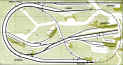
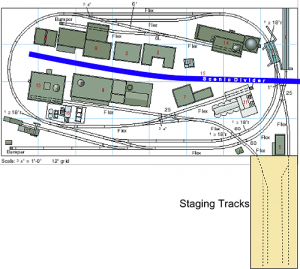
Speaking of 101 Track Plans book, When you first described what you were considering I immediately thought of plan #26. It is a point-to-point with a cut off for continuous loop running. I would ditch the reversing loop and make it into another industry or two, or three (depending on how congested you would care to make it). And also make a run around at Manville.
L26T.jpg


I also thought about recommending the Jerome & Southwestern but it is a much more 1900s than 2014. I don't think it would work well with modern equipment. Since your handle was BNSF I assumed the modern part.
 
Last edited by a moderator:
I like AnyRail and it has a free trail, but it's limited to 50 pieces of track. I bought the full version and I love it, its easy to use, its fun to just play around with making dream layouts. I can't tell you how it is in comparison to others because its the only one I have ever used.
 
I like AnyRail and it has a free trail, but it's limited to 50 pieces of track. I bought the full version and I love it, its easy to use, its fun to just play around with making dream layouts. I can't tell you how it is in comparison to others because its the only one I have ever used.

I agree. I tried some of the free ones and just never "clicked" with them. Tried AnyRail and it just worked, worked easily and worked well. Well worth the money IMO, but it also seems that folks are happy with the free ones, so I guess it's just what you're used to and/or comfortable with. I personally like how it can be customized to include or omit a variety of track/roadbed data, can draw "shadows" of the track to show clearances on the sides, and can print out in any size, up to and including 1:1 for outright gluing it to your layout and following the lines. It's made my very complex layout a breeze to build. Not sure I wouldn't have thrown up my hands and walked away by now if not for AnyRail, honestly :)
 
Last edited by a moderator:


I'm trying out Anyrail. No complaints this far ha.

Steve I like that layout. I'd change a few things to fit more to my needs but it would be a good template. I'll see if I can work on some designs in Anyrail to share on here and see what you all think.


Affiliate Disclosure: We may receive a commision from some of the links and ads shown on this website (Learn More Here)

Back
Top