Model train layouts: Diesel VS Steam

  • Thread starter Thread starter NP2626
  • Start date Start date
ModelRailroadForums.com is a free Model Railroad Discussion Forum and photo gallery. We cover all scales and sizes of model railroads. Online since 2002, it's one of the oldest and largest model railroad forums on the web. Whether you're a master model railroader or just getting started, you'll find something of interest here.


Per Montana Rail Link:

S'true, 'tis'strue but.

Tootnkumin


But what???
 
Last edited by a moderator:

Many of the steam models are not 100% accurate because to make manufacturing and sales cost effective they are designing them much the way diesel models are made. The classic are the MDC/Roundhouse and IHC engines were made. MDC made one boiler and put a 4-4-0, 2-6-0, 2-8-0 and Narrow gauge 2-8-0 mechanism under it. IHC made a 4-4-0 and 2-6-0 mechanism and then had a wagon top and camelback boiler that could fit on either mechanism. They marketed a 'standard' boiler 4-4-0, 2-6-0 (SP prototype) and a camelback 2-6-0 (NYO&W prototype). Sadly they didn't produce the camelback boiler on the 4-4-0 mechanism (a camelback 2-6-0 was a very rare engine, while pretty much every camelback user had camelback 4-4-0's).

Steamers had fairly consistent driver sizes 48-50" drivers on switchers and early 2-6-0/2-8-0 engines, 55-57" drivers on early drag freight engines and switchers (2-8-0, 2-8-2, 0-6-0, 0-8-0, 2-8-8-2), 60-63" drivers on early high speed engines and more modern drag freight engines (early 4-4-0, 4-6-0, 2-6-0, 2-8-0, 2-8-2, 2-10-2), 70-72" drivers on higher speed engines (4-4-0, 4-6-0, 4-6-2. 4-8-2, 4-8-4) and then the big stuff, 80" drivers on really high speed engines. With 4 driver sets one can model about 75% of the steamers produced and be within a couple inches of the driver diameter. That is the easy part, everything else is has a lot more variation. With some proper engineering one should be able to swap out some fairly standardized components to accommodate some of the variation.

One of the big barriers to steam in the past was the drive train. Open frame motors were so big that it was hard to fit them in smaller boilers. With modern can motors and driver trains that should not be a barrier. Another big deal in smaller steam is electrical pick up. Some of those old, terrible running old time 4-4-0's can be made into smooth running engines by improving the electrical pick up and replacing the motor. Throw in a keep alive capacitor and a small engine can run just as well as a bigger one. If an N scale GP can be made to operate smoothly, then a HO 4-4-0 can be made to run smoothly.


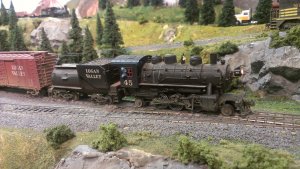
You made a good point Dave. I picked up a little 2-6-2 Prairie out of an out of state friends scrap box. It had no tender, the pilot and headlight were missing also. I brought it home and it sat in my scrap box for months. Finally I happened across a small vanderbuilt tender that looked like it could work out for the little locomotive. I have posted photos of it before and some folks thought that it may be an old Mantua locomotive. It did have to open frame motor in it.

After getting the tender I went into my box of brass castings and found a pilot, headlight and a few other detail parts. The parts were added but it ran like crap. I happened to have had a number of can motors on hand and remotored the little guy and added pickups to the tender and it was like day and night. The locomotive had constant lighting installed and was painted for my freelance railroad and being that the layout was built for switching, the little prairie was a perfect addition. The little guy still runs like a Swiss watch after being added to my fleet over 20 years ago.

IMAG0105_BURST002.jpg
 
CHET I've seen this photo before, but just wanted to say that the work is just superb! Boy those two huge sand domes should provide good traction!
 
Chet, great looking Prairie! I want one! The 2-6-2 was a fairly popular wheel arrangement with the Northern Pacific. I'm guessing; but, I wonder if yours didn't start life as a Pennsylvania Loco, the cab just has a Pennsy look about it.
 
The Tyco/Mantua "Prairie" was actually their 0-6-0, with a leading and trailing truck added.

The 0-6-0: http://d2ydh70d4b5xgv.cloudfront.ne...35-green-9dc7d058bf4d1e4c5d8ff6b982465ee4.jpg

The 2-6-2: https://id417.van.ca.securedata.net/etoysdropoff.com/merchantmanager/images/uploads/Dsc05426.jpg

Its not a model of a particular engine, just a handy repurposing of an existing engine. Think of it as a freelance or kitbash done by a manufacturer. The MDC 4-4-0 is sorta the same thing. They made a large driver 2-6-0, modelers kitbashed it into a 4-4-0 by omitting the lead driver and putting a 4 wheel lead truck. MDC basically said they could do that too, so offered essentially the same kit as the 2-6-0 only with a frame omitting the lead driver and providing a 4 wheel lead truck.
 
I know one thing for sure, the little locomotive is older than dirt. I got it sometime i the early 80's and it had been sitting around in my friends junk box for years before I got it.
 
Your kidding me? You mean a business needs to be profitable in order to stay in business and that all decisions on what to produce must be tempered by the aspirations that it not only be salable; but, make at least some profit for the company? Who said we couldn't get ed-u-macated right here on the Model Railroad Forums?
Sure! Businesses aren't the federal government! :p
 
Sure! Businesses aren't the federal government! :p


You know, after 31 years of being self employed, you'd think I would have known some of these things! However, any idiot who would think that diesel locomotives are more popular than steam locomotives today...?
 
Last edited by a moderator:


However, any idiot who would think that diesel locomotives are more popular than steam locomotives today...?
Has to be living in the past. (Thought I'd finish it for you, looks like you ran out of ink for your quill, or something :rolleyes::p
 
Good job! (I had to add more to this post, as the website wouldn't let me just say: Good job!)
 
The good old use of parentheses (makes you look as though you're talking out of the side of your mouth while whispering a confidence to the reader).
 
(Toot, So, what types of locomotives do you play with)? (I just noticed I have moved from Conductor to Engineer! Like you asked; Toot, does this move me up a pay grade)?
 
Last edited by a moderator:
(Toot, So, what types of locomotives do you play with)? (I just noticed I have moved from Conductor to Engineer! Like you asked; Toot, does this move me up a pay grade)?

This is very serious now, means I have to treat you with respect, but as far as remuneration goes, it's a bit like a line from a song that Jimmy Durante sang, I believe in response to a Presidential volunteer program in the 30's/40's that went "I'll work for you for a dollar a year, but I got'ta get paid in advance".

As for locos, anything that might have run, or runs on Montana Rail Link. The attraction being that they still have a lot of 2nd generation EMD diesels as well as the latest.
 
If you look at what comes up here where people are using photos in discussing; or, describing their layouts, it appears to me that diesel layouts exceed steam; or, transition layouts by a handy margin. It has been 60 years since most railroads dropped the fires in their steam fleet and switched to diesel. It stands to reason that Diesels would be more popular now. Do steam layouts still exist? Without doubt, they do and I believe they may never go away. However, using what ever way you feel tells the story, it is easily apparent, at least to me that diesel is more popular today, than steam.


This is a very unimportant thread, model what you like, that is what is great about this hobby! It's just one guy posing his opinion and opinions are like (what) everyone has one...
 
Last edited by a moderator:
If you look at what comes up here where people are using photos in discussing; or, discribing their layouts, it appears to me that diesel layouts exceed steam; or, transition layouts by a handy margin. It has been 60 years since most railroads dropped the fires in their steam fleet and switched to diesel. It stands to reason that Diesels would be more popular now. Do steam layouts still exist? Without doubt, they do and I believe they may never go away. However, using what ever way you feel tells the story, it is easily apparent, at least to me that diesel is more popular today, than steam.

As I posted in this thread earlier, most of the home layouts that I visit are steam. I think that some of what you are observing has to do with demographics of the modelers. The steam modelers that I see tend to be older modelers with many more years building and completing their layouts behind them, thus they are more likely to display them. They are also less likely to belong to internet forums and post pictures. I've asked this of some of them. Younger modelers only know and model diesel, but also tend to have less than complete layouts that they are not ready to display to the public. However pictures on this and other forums can be cropped to only show completed scenes or select "under construction" scenes.
Just my observations.

Willie
 
I can vouch for the fact that not many of my countrymen are on forums, there is one or two in Aus and they're not heavily subscribed to. I know from the 2 clubs nearest to me there is a heavy presence of US train enthusiasts, but I know of only one from my main club and 2 from the other that have logged in here, and only very occasionally. As I've mentioned, steam is well favoured among them, and they're not ancient blokes.


I tend towards the transition era because I like the concept and flexibility of being able to model both diesel and steam. Since I prefer freight and switching operations and I've seen and had too much trouble with bigger steamers with pony trucks I tend to stick to 0-6-0, 0-8-0 and 2-6-0 and very rarely 2-8-0 steamers and almost exclusivly the 4-wheel trucked diesels.


Affiliate Disclosure: We may receive a commision from some of the links and ads shown on this website (Learn More Here)

Back
Top