
You are using an out of date browser. It may not display this or other websites correctly.
You should upgrade or use an alternative browser.
You should upgrade or use an alternative browser.
Double Radius Turnouts
- Thread starter nemorp
- Start date
ModelRailroadForums.com is a free Model Railroad Discussion Forum and photo gallery. We cover all scales and sizes of model railroads. Online since 2002, it's one of the oldest and largest model railroad forums on the web. Whether you're a master model railroader or just getting started, you'll find something of interest here.


Is everyone talking about the same parts? The Code 100 PECO curved turnouts have about a 26-27" inner radius and a #6 frog. Since many US home layouts have minimum radii of 24" or smaller, the curved turnout would not be the limiting factor for many people.
The OP is talking about double-curved turnouts, so by definition both the diverging and primary route are curved (from PECO, Walthers, or anyone else). In Code 100, the PECO Streamline (not SetTrack, which are quite tight) double-radius is given by the manufacturer as 60"/30" radii, but I have measured the inner curve as closer to 27". These are not new. A typical part number is SL-86 or SL-87 (adding the "E" for Electrofrog)
The Code 83 part is a bit broader and also a useful component.

For the rest of this conversation we are really tripping over terminology, and Peco's descriptions of their products doesn't help. There are three different Peco curved turnouts.
Part number SL-86, SL-87, SL-E186, and SL-E187 are the "curved double radius R/H" (or L/H) are advertised with 60 inch outside and 30 inch inside.
Part number ST-244, ST-245 are the "curved double radius R/H turnout" (or L/H). They do not have an advertised radius but list a departure angle of 11.25 degrees. My own experience shows the outside is about 21" equivalent and the inside is 17.75". Just close enough to substitute for the old Atlas curved turnouts.
Code 83 - Part number SL-8377, SL-8376, SL-E8377, SL-E8376 are the "#7 R/H curved turnout" (or L/H). They are advertised as 60 inch outside and 36 inch inside.
Rant about manufacturers' using frog #s for curved turnouts deleted.
In the case of the #7 curved just above, I find those claimed radii very hard to accept as factual. I purchased six #7.5 Walthers/Shinohara Code 83 turnouts seven years ago and found that their outer radius, before I modified each of them, was about 26" and the inner was about 21". After hacking them up, I managed to pin the inner radius wide to about 24" and the outer was closer to 29".
PECO geometry is different from Walthers (which are known to be tight).
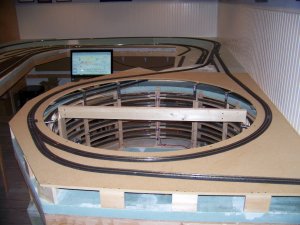
Here is one of those turnouts.
The radius of the loop is 32.5" and as you can see the turnout fits pretty well though I had to compensate somewhat.
And you can see that the outer curve of the turnout is not very curved at all by comparison.

Affiliate Disclosure: We may receive a commision from some of the links and ads shown on this website (Learn More Here)
D&J RailRoad
Professor of HO
I've used them with flex track. The radius was a bit tighter than I wanted though.

Selector
Well-Known Member
The Peco Code 100 versions, which were designed and intended to be used with their other products of that nature, are really meant for the British/EU type of railroading, particularly in scale in smaller homes. That is, the curves are tight. Not to say it won't work just fine for you, but....do your research carefully to ensure you won't have to make major alterations to your track geometry, and then will continue to be happy with it for the long ter.
I have used the Walthers-Shinohara versions, but not without hacking up the webbing under them so that I could enlarge their radii to meet their claimed radii. I actually had to invert them on a bench and slit all the tiny plastic inter-tie bits so that I could bend both routes wider. In my case I needed a minimum radius for the inner route of 28". The seller said his literature showed the Code 83 curved 7.5 should be a good fit for me. When I inserted them into my curves, I found the inner radius to be about 3" LESS than what had been claimed...hence my hack jobs of all six that I purchased. I found their #8 version to be okay for my needs, but the inner radius was still short by about 3".
As fcwilt above has stated, I also have built several types of Code 100 Fast Tracks turnouts, an experience I urge every reasonable dedicated modeller to undertake. I don't mean Fast Tracks per se, but that you learn to build turnouts using copper-clad PCB ties, solder, and whatever code of rail you need. Once I had built several regualr #8 turnouts, I knew I could build just about any customwork I would need, and did that several times over the next few years. I even salvaged a wide curved #10 that I built in place on my old layout and have it inserted on my new twin mains on my latest layout. I have built wye turnouts, and have a custom-built one on my new layout on the main. It's geometry is weird, and it would not be used on many layouts, but my ability to craft one that actually serves my purposes is what I relied on to solve my problem where it sits.
Bottom line: use what has a good reputation for build and reliability, even if it is not "DCC-friendly". You can always use a cut-off disk or a very fine scroll saw to knick the rails to gap them near the frog to isolate it, but that can be a bit of a gamble with the longer frogs on longer curved turnouts in terms of good electrical pickup, especially with poorer older engines or smaller steamers/diesels with short wheelbases. In fact, the Walthers/Shinohara Code 83 curved turnouts were not well-enough gapped to prevent shorts when my larger steamers with blind drivers in the middle axles (BLI Duplex T1 4-4-4-4. as an example) slid their metal tire surfaces over the tiny plastic spacers and made contact with two rails of opposite phases at the same time. I had to use a cut-off disk to place more gaps further away from the frog point.
I have used the Walthers-Shinohara versions, but not without hacking up the webbing under them so that I could enlarge their radii to meet their claimed radii. I actually had to invert them on a bench and slit all the tiny plastic inter-tie bits so that I could bend both routes wider. In my case I needed a minimum radius for the inner route of 28". The seller said his literature showed the Code 83 curved 7.5 should be a good fit for me. When I inserted them into my curves, I found the inner radius to be about 3" LESS than what had been claimed...hence my hack jobs of all six that I purchased. I found their #8 version to be okay for my needs, but the inner radius was still short by about 3".
As fcwilt above has stated, I also have built several types of Code 100 Fast Tracks turnouts, an experience I urge every reasonable dedicated modeller to undertake. I don't mean Fast Tracks per se, but that you learn to build turnouts using copper-clad PCB ties, solder, and whatever code of rail you need. Once I had built several regualr #8 turnouts, I knew I could build just about any customwork I would need, and did that several times over the next few years. I even salvaged a wide curved #10 that I built in place on my old layout and have it inserted on my new twin mains on my latest layout. I have built wye turnouts, and have a custom-built one on my new layout on the main. It's geometry is weird, and it would not be used on many layouts, but my ability to craft one that actually serves my purposes is what I relied on to solve my problem where it sits.
Bottom line: use what has a good reputation for build and reliability, even if it is not "DCC-friendly". You can always use a cut-off disk or a very fine scroll saw to knick the rails to gap them near the frog to isolate it, but that can be a bit of a gamble with the longer frogs on longer curved turnouts in terms of good electrical pickup, especially with poorer older engines or smaller steamers/diesels with short wheelbases. In fact, the Walthers/Shinohara Code 83 curved turnouts were not well-enough gapped to prevent shorts when my larger steamers with blind drivers in the middle axles (BLI Duplex T1 4-4-4-4. as an example) slid their metal tire surfaces over the tiny plastic spacers and made contact with two rails of opposite phases at the same time. I had to use a cut-off disk to place more gaps further away from the frog point.
Thanks for the great info. I will be using flex track and have a fair amount of leeway for adjustment. I'll just have to give it a shot and see if it'll work out for me. With the suggestions made I have an idea of a few things to keep an eye out for which will help with my decision. Thanks again......Dan
The Peco Code 100 versions, which were designed and intended to be used with their other products of that nature, are really meant for the British/EU type of railroading, particularly in scale in smaller homes. That is, the curves are tight.
Is everyone talking about the same parts? The Code 100 PECO curved turnouts have about a 26-27" inner radius and a #6 frog. Since many US home layouts have minimum radii of 24" or smaller, the curved turnout would not be the limiting factor for many people.
Selector
Well-Known Member
If so, it would be a relatively new turnout with which I am unfamiliar. I do know that Peco has launched heavily into Code 83 in the past decade or so, but was not aware that they had improved the variety in their Code 100, which used to be all curved route turnouts as of the type seen in England, and not the N. American style where the diverging route is straight through the frog and beyond. Used to be the Code 100's I saw in the Peco line had very tight curves in the 18-20" range.
I'll go see now what else they have. BTW, I use only Code 83 Streamline Insulfrog turnouts in my yards, and I like them a lot.
I'll go see now what else they have. BTW, I use only Code 83 Streamline Insulfrog turnouts in my yards, and I like them a lot.
If so, it would be a relatively new turnout with which I am unfamiliar.
The OP is talking about double-curved turnouts, so by definition both the diverging and primary route are curved (from PECO, Walthers, or anyone else). In Code 100, the PECO Streamline (not SetTrack, which are quite tight) double-radius is given by the manufacturer as 60"/30" radii, but I have measured the inner curve as closer to 27". These are not new. A typical part number is SL-86 or SL-87 (adding the "E" for Electrofrog)
The Code 83 part is a bit broader and also a useful component.
Selector
Well-Known Member
I realized at the outset that he was talking about a 'curved turnout' with double radius. When I last looked, perhaps five years ago, I could find no wider curved Code 83 turnouts in Peco than about 24" for the outer route, or through route. That must have changed. Their Code 100 turnouts, regardless of description, were at that time all tight radius and seemed intended for the European market with a curved diverging route on the 'straight' variety. I never did purchase any Code 100 Pecos because of that limitation, and opted for their newer, at the time, Code 83 straight turnouts which are very nice, if more costly than the Atlas Customline variety that was also newly marketed.
Iron Horseman
Well-Known Member
Yes, I have used all three sizes of Peco curved turnouts and have had zero problems with any of them. They work as well as a straight turnout.I'm considering using a Peco code 100 curved double radius turnout on my layout. Has anyone used a curved double radius turnout and if so did it work well for you?
For the rest of this conversation we are really tripping over terminology, and Peco's descriptions of their products doesn't help. There are three different Peco curved turnouts.
Part number SL-86, SL-87, SL-E186, and SL-E187 are the "curved double radius R/H" (or L/H) are advertised with 60 inch outside and 30 inch inside.
Part number ST-244, ST-245 are the "curved double radius R/H turnout" (or L/H). They do not have an advertised radius but list a departure angle of 11.25 degrees. My own experience shows the outside is about 21" equivalent and the inside is 17.75". Just close enough to substitute for the old Atlas curved turnouts.
Code 83 - Part number SL-8377, SL-8376, SL-E8377, SL-E8376 are the "#7 R/H curved turnout" (or L/H). They are advertised as 60 inch outside and 36 inch inside.
Rant about manufacturers' using frog #s for curved turnouts deleted.
Last edited by a moderator:
From the Peco UK site:
http://www.peco-uk.com/page.asp?id=pointplans
In theory these "plans" can be used to print out full size pictures of the products - assuming your printer is setup correctly.
In any case it's a quick way to see what part numbers make up what group of products.
http://www.peco-uk.com/page.asp?id=pointplans
In theory these "plans" can be used to print out full size pictures of the products - assuming your printer is setup correctly.
In any case it's a quick way to see what part numbers make up what group of products.
Iron Horseman
Well-Known Member
That is way cool! I wonder why they don't have the ST-244(5)s in there.In theory these "plans" can be used to print out full size pictures of the products - assuming your printer is setup correctly.
Selector
Well-Known Member
Yes, I have used all three sizes of Peco curved turnouts and have had zero problems with any of them. They work as well as a straight turnout.
For the rest of this conversation we are really tripping over terminology, and Peco's descriptions of their products doesn't help. There are three different Peco curved turnouts.
Part number SL-86, SL-87, SL-E186, and SL-E187 are the "curved double radius R/H" (or L/H) are advertised with 60 inch outside and 30 inch inside.
Part number ST-244, ST-245 are the "curved double radius R/H turnout" (or L/H). They do not have an advertised radius but list a departure angle of 11.25 degrees. My own experience shows the outside is about 21" equivalent and the inside is 17.75". Just close enough to substitute for the old Atlas curved turnouts.
Code 83 - Part number SL-8377, SL-8376, SL-E8377, SL-E8376 are the "#7 R/H curved turnout" (or L/H). They are advertised as 60 inch outside and 36 inch inside.
Rant about manufacturers' using frog #s for curved turnouts deleted.
In the case of the #7 curved just above, I find those claimed radii very hard to accept as factual. I purchased six #7.5 Walthers/Shinohara Code 83 turnouts seven years ago and found that their outer radius, before I modified each of them, was about 26" and the inner was about 21". After hacking them up, I managed to pin the inner radius wide to about 24" and the outer was closer to 29".
In the case of the #7 curved just above, I find those claimed radii very hard to accept as factual. I purchased six #7.5 Walthers/Shinohara Code 83 turnouts seven years ago and found that their outer radius, before I modified each of them, was about 26" and the inner was about 21". After hacking them up, I managed to pin the inner radius wide to about 24" and the outer was closer to 29".
PECO geometry is different from Walthers (which are known to be tight).
In the case of the #7 curved just above, I find those claimed radii very hard to accept as factual.
Here is one of those turnouts.
The radius of the loop is 32.5" and as you can see the turnout fits pretty well though I had to compensate somewhat.
And you can see that the outer curve of the turnout is not very curved at all by comparison.
Attachments
Affiliate Disclosure: We may receive a commision from some of the links and ads shown on this website (Learn More Here)