Building the Pinnacle Creek Mining & Timber Co. RR

ModelRailroadForums.com is a free Model Railroad Discussion Forum and photo gallery. We cover all scales and sizes of model railroads. Online since 2002, it's one of the oldest and largest model railroad forums on the web. Whether you're a master model railroader or just getting started, you'll find something of interest here.


I just picked up Decembers MR mag (usually we get it in the shops near the end of the issue month, but this one's late) and on P76 is the 2nd part of an article on power-routing turnouts for DCC. This part deals with wiring what they call "all live turnouts" (all tracks including the frog powered at all times). ME turnouts got a mention because of having fully isolated frogs (most don't apparently) which require powering either from a bus wire or off the rails themselves (a wire from each rail) via an SPDT switch. In the article there is shown a method using a slide SPDT switch mounted under the layout, operated by a push pull wire to the outside, with a knob to activate the slide. A .025" wire is attached to the slide vertically, up through the base board and through the point's tie bar to physically switch the points. It was mentioned that ME points do have a sprung position lock to hold the points against their respective stock rails, so that's good.

The 2 wires from the power source (bus or tracks) connect, 1 to each side of the SPDT switch and the wire from the frog attaches to the center contact of the SPDT. When installing the SPDT, make sure it's aligned so that the wires from the tracks match the direction the switch is facing. This method will both switch the points and change the frogs polarity simultaneously.


DSC04483_zps2bxeqthk.png


It was also mentioned that Caboose Industries make ground throws with built in SPDT switches if you want to avoid that push-pull knob and rod. Sprung: http://www.cabooseind.com/#!product...-sprung-w-contacts,-.165"-travel-for-ho-and-n or Rigid: http://www.cabooseind.com/#!product/prd1/3534712761/119r-rigid-w-contacts,-.165"-travel-for-ho-and-n

Even though this article was written for DCC operation, can't see any reason why it should be any different for DC.


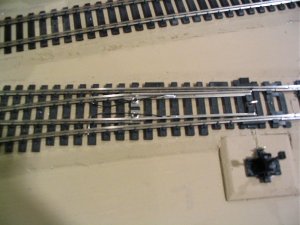
Toot, Thanks. I was especially noting this sentence: ' ME turnouts got a mention because of having fully isolated frogs (most don't apparently) which require powering either from a bus wire or off the rails themselves' I always thought I could just attach a wire to the bottom of the frog to the bus and that would be it. No? Thanks for the link. Jim:confused:
 
Let's try this:

IMG_8416_zps4rfyseg1.jpg


QUESTION: If the frog has wires soldered to the points will a DC loco go through the turnout, regardless of which way the points are aligned, without stopping? I do not care if this wiring is old fashioned, out of date, not recommended anymore, etc. Will a loco go through? Yes or no. Thanks, Jim:)

How about this:
DCC READY!

The new #7.5 Walthers switch is "DCC Ready" according to stickers on the package. The old #8 is not. What does that mean? The old switches were power-routing, using the points to power the frog. The points were connected together so both point rails had the polarity of the stock rail that the points were touching. This meant that the opposite point rail was the opposite polarity of the stock rail closest to it and metal wheels could possibly short out going through there. Since some DCC systems shut down when they see a short and need to manually reset, this is a big annoyance (I guess).

The new switches have isolated point rails so each point rail matches the polarity of the stock rail it is closest to, avoiding shorts. I suspect the frog is dead and needs to be wired if you are so inclined.

I've seen ads for MicroEngineering turnouts, also touting DCC Ready. I find this slightly amusing since Atlas CustomLine switches have been "DCC Ready" since, what, like 1957?

I avoid these problems these days by adding jumpers before installing the switches. I take a piece of black 30 gauge wire-wrap wire and solder one end to the points and the other end beneath the stock and closure rail, connecting the rails together. Problem solved. The wire becomes mostly hidden after the track is weathered.


I take the trouble to make Atlas switches even more DCC Ready. The old PMP-112 system I had at first was very sensitive to "loss of power" and the old Atlas switches had point rails attached to the closure rails with loose-ish rivets. After weathering and some wear, the points would loose connection through the rivets and, if not tightly pressed against a stock rail, became dead. So I started soldering small jumpers between the points and the closure rails. Also, the power to the point rails was routed through a metal tab that ran between the stock rails and the closure rails. After weathering with paint and suffering wear and tear, the tab could become isolated and not feed power to the points. This required tediously adding jumpers from stock rails to closure rails.

http://users.frii.com/gbooth/Trains/index.htm
turnout wiring.JPG
 

Attachments

  • turnout wiring.JPG
    turnout wiring.JPG
    46.7 KB · Views: 324
Toot, Thanks. I was especially noting this sentence: ' ME turnouts got a mention because of having fully isolated frogs (most don't apparently) which require powering either from a bus wire or off the rails themselves' I always thought I could just attach a wire to the bottom of the frog to the bus and that would be it. No? Thanks for the link. Jim:confused:

No, because, as there is only 1 wire coming off the frog, which one of the bus wires would you attach it to? The STDP switch is sort of working in reverse to what it might normally be expected to do. Instead of routing power from a single source to either of 2 receivers (same polarity to both), it's routing alternate polarities to 1 receiver, which is what is required in the frog's case to make it correspond to the position of the point (closure, to use the correct term) rails.
 
Just to comment on beiland's photo of the Caboose Ind's throw. The wire to throw the closure rails is visible on the surface as a simple connection to the throw bar, but of course the STDP switch wiring of the ones I linked to is all hidden beneath the layout. I'm not familiar with either of these turnout controls, so which one (sprung or not) would best suit your situation I'm not sure. If, as stated in that MR article, the ME turnout has got a spring, position locking feature, it may not be necessary, or desirable to have the throw also spring loaded.
 
Sorry for the double Quote there. I often have trouble with editing a post, sometimes it will work and others (of late especially) I have to Copy the revision, go back to the post and delete it, then repost the copied reply. Very time consuming. As it's a random occurrence, not sure why it happens.


Thanks Beiland, Tood, and Dan. I'm throwing in the towel on this subject. I've been working on this for days and it is driving me nuts. One turnout, two different AND separate operating systems. All along I've be trying not to use my old PECO turnouts. Dan, is right. I'm going to use an electrofrog. I've used them for four years now and NEVER had a problem running a DC or DCC loco through a turnout. I'm going to work on adding larger ties for On30 to the PECO tomorrow. I sincerely thank you all and hopefully some other soul can use the info you all have provided. Jim:)
 
I never studied the problem in depth as I figured I would wait until the day I needed to (as soon as I'm building new layout). I just figured it could not be that difficult, but perhaps I'm wrong, as I can be challenged 'electrically' very easy...ha...ha.
And I have a LOT of both types of Peco switches, figuring it should not be a big problem to convert them all over. I hope so.
 
Thanks Beiland, Tood, and Dan. I'm throwing in the towel on this subject. I've been working on this for days and it is driving me nuts. One turnout, two different AND separate operating systems. All along I've be trying not to use my old PECO turnouts. Dan, is right. I'm going to use an electrofrog. I've used them for four years now and NEVER had a problem running a DC or DCC loco through a turnout. I'm going to work on adding larger ties for On30 to the PECO tomorrow. I sincerely thank you all and hopefully some other soul can use the info you all have provided. Jim:)

WHOOOAA!!!!!!!!!... JIM...Jim, Pecos are gon'na be no different, they're still going to have to have the frog's polarity switched to match the direction of travel. The wiring and SPDT switch are wired exactly the same for both DC and/or DCC operation. The type of electrical power is not an issue. The routing to the frog is the same for both. Both brands have isolated frogs. The ME turnout already has the power linking of the stock rails, which Peco recommend in their illustration (Fig 2, Option 2). To make this simple, get one of those Caboose ground throws I linked that have the SPDT switch built in to it and just follow their instructions (I guess they do supply them with the throws, would be remiss if they didn't). I'm not sure if you are using a separate power bus on this layout or just soldering all the track connections together, whichever it is, your power source to the SPDT can come from either the bus wires or each rail of the track.

Remember, this wiring of the frog doesn't alter or affect any of the other normal track wiring, it is this frog specific.
 
JIM I have to chime in here as well.

GUYS .. STOP CONFUSING HIM MORE WITH ADDING ADDITIONAL MECHANICAL/ELECTRICAL GADGETS.

The simple way to solve this problem is for you to get:
a SPDT switch and run a wire from the FROG to the center pole on the switch

Then connect your rail power, or if you need too run an extra set of feeders from your Power Pack, to the SPDT switch.
The SPDT switch can receive its power from either the Power Pack or the main bus ... You are just powering the FROG only with this addition. The frog is the only thing you are routing power too!

 
B, Not as challenge as I am.

Dan, Always ran both DC and DCC.

Toot, I ran both for four years. You've seen the videos. A couple were DC and one at least was DCC. Never a problem with PECO Electrofrogs. FYI, I am going to purchase the SPDT throw from Caboose as well as a manual one. If their directions are okay, I understand them, I will give that a try. I'm very frustrated with this. Pretty soon my wife says she will put a name tag on me when I leave the house. Jim:eek:
 
OK, I had to go back to your original post (#3547) for the reason for the question on powering the frog, and also now, a correction from me about the Peco insulfrog having an isolated frog as built. The insulfrog frog is not isolated. It is connected to the frog via the inner stock rails (no gap near the frog) and the moveable point rails and therefore receives power (and polarity) when either of the points is closed against an outer stock rail. This way that inner point, stock rails and the frog are receiving power and polarity from the same side of the tracks as required. The disadvantage is that the opposite, open point rail is also receiving the same power and polarity as the closed one and it's point is only separated from the opposite, outer stock rail (which is at the opposing polarity) by the amount of gap between them. May not be of any great concern or consequence if none of your rolling stock's wheels bridge that gap (as you have been previously using Peco's without problem, then not on issue)

If you want to alter the ME turnout to match the Peco's electrically, then cut or remove those 2 connecting pieces between inner and outer stock rails, and connect the frog where it's gapped to both inner stock rails. This will convert it to operate in the same way as the Peco which I also note, has the frog insulated from any track, connected to it's other side (this may be the normal way of connecting the frog there anyway) The upside to this is the elimination of the SPDT's necessity.

A side result of this method is that the turnout could also be used as a power routing switch for your turntable track. If you don't power that track via a connected power bus, then that turnout can be used to isolate that TT track when the points are aligned away from it.
 
JIM I have to chime in here as well.

GUYS .. STOP CONFUSING HIM MORE WITH ADDING ADDITIONAL MECHANICAL/ELECTRICAL GADGETS.

The simple way to solve this problem is for you to get:
a SPDT switch and run a wire from the FROG to the center pole on the switch

Then connect your rail power, or if you need too run an extra set of feeders from your Power Pack, to the SPDT switch.
The SPDT switch can receive its power from either the Power Pack or the main bus ... You are just powering the FROG only with this addition. The frog is the only thing you are routing power too!


Sherrel, the only thing with just using an SPDT, is that you must move both that and the points at the same time manually or probably cause a short if you shift the switch first and the points second.
 
Thanks guys. Okay here is what I just did. I hooked up the layout for DC running. I ran my DC locos back and forth through my Electrofrog turnout with ZERO difficulties or errors.
I hooked up the layout for DCC running and ran my DCC loco back and forth through my Electrofrog turnout with ZERO difficulties or errors. Since I have run this turnout for four years and never had an issue I think I will stick with it.

I've always stated that this layout would be both DC and DCC. To that end it is wired SEPARATELY for each system. For example two sets of red and black wires come off my power track piece. One set to DC power pack and the other set to the DCC power source. I think the confusion might be you all thinking there are a black and red wire performing both functions with the flick of a switch. Not so. Two complete and separate systems. That is how I've always done my layouts.

The only reason I want to make the Micro Engineering turnout work is because it matches the rest of the track. Jim:)
 
Last edited by a moderator:


As far as the wiring of the trackwork is concerned, the type of power supplied (DC or DCC) is immaterial, they both have polarities to contend with, vis-à-vis, turnouts etc. The solutions are the same. Just that, as you have done, they must be separately applied.

I copied this bit from that Peco PDF that states the reason for considering the SPDT powered, fully isolated frog.

Option 1

Use the turnout straight from the box. In this

way the polarity of the frog is switched by

the point blades. This is the simplest option

but some locomotives with long wheelbases

may electrically short the open point blade/

switch rail and the stock rail by touching

both rails simultaneously. If your rolling

stock suffers from this problem, apply

option 2 below.

Option

Looking once again at your pic of the ME turnout and Peco's PDF underside illustration of their insulfrog turnout, the ME seems to have the open point (closure) rail quite close to the outer stock rail and an even gap over it's length. The Peco, on the other hand, is wide at the pointed end, but quite close at it's pivot, a possible "choke" contact for a long wheelbased loco. The only guaranteed way of eliminating this possibility is to use the ME with the SPDT and it's simultaneous mechanical operation, because it keeps all stock and point rails, like polarity charged at that position. Will not matter if a wheel does touch the adjacent stock or point rail together at the same time, no short can occur.


Affiliate Disclosure: We may receive a commision from some of the links and ads shown on this website (Learn More Here)

Back
Top
