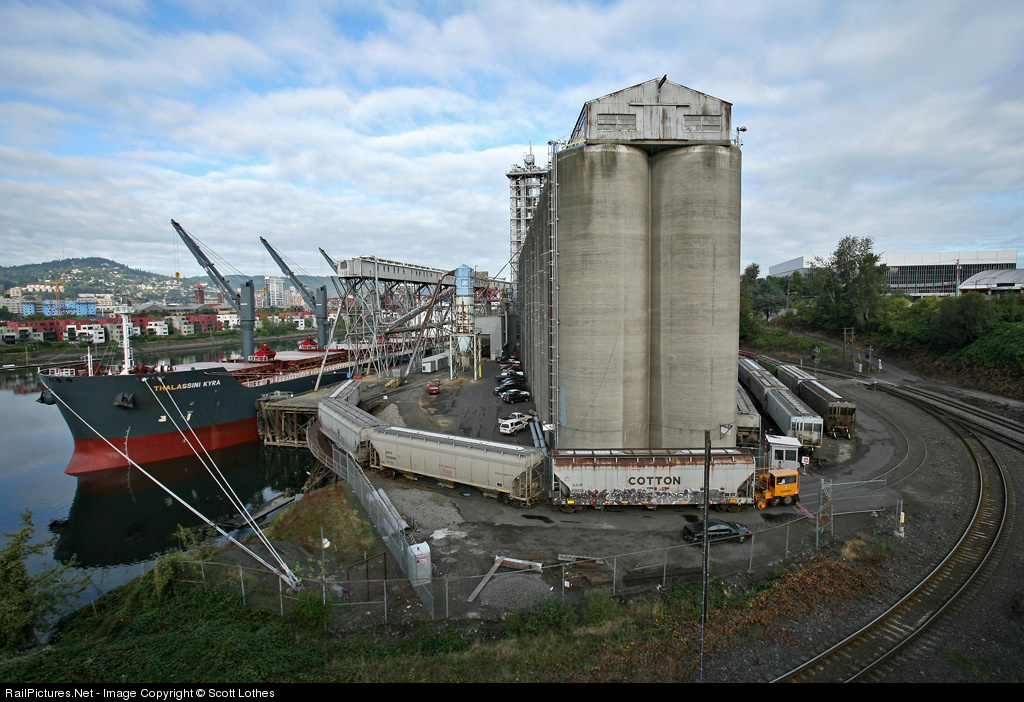
Very tight radius curve...

ModelRailroadForums.com is a free Model Railroad Discussion Forum and photo gallery. We cover all scales and sizes of model railroads. Online since 2002, it's one of the oldest and largest model railroad forums on the web. Whether you're a master model railroader or just getting started, you'll find something of interest here.


Here's ya a very tight curve on a prototype
6651.1285650079.jpg
 
Did some crude measurements on an aerial shown on another site. The radius of that curve is around 85' making it a 70 degree curve. Works out to be around a 12" curve in HO scale. The Uintah RR had 65 degree curves on 7 1/2% grade. The Los Angeles Junction Ry has an 85 degree curve & a #3 switch. So if you have things tight on your layout, there's a prototype for it. Here's a table from Freemo:
http://www.trainweb.org/freemoslo/Modules/Tips-and-Techniques/degrees_of_curve_to_radius.htm


12'' curve, wow, thats must be why they use a trackmobile, im not sure any other locomotive would like such a curve
 
12'' curve, wow, that's must be why they use a trackmobile, I'm not sure any other locomotive would like such a curve

Not true! The real Uintah did it w/ 2 narrow gauge 2-6-6-2 & the LAJ did it w/ ALCO S-2/S-4s, CF7s and now w/ MK1200Gs & BNSF GPs.
 
There was a GATX transfer facility in Carteret, NJ, that has tracks with curves so sharp that the flanges of the wheels would cut into the trainline fastened to the center frame. We are talking tank cars about 50" long. Power on the job was usually 2 GP38s.
This track would scale out to about 13" radius in HO.

There was also a grade in an adjacent FMC plant that made it difficult to handle a single loaded covered hopper coupled to a two unit diesel, on wet rail. It just did not want to move, or stop if moving.

Then there was the street railroad in Baltimore, both the PRR/PC/CR and the B&O/Chessie used rubber tired tractors with couplers and drawbars, because the curves were so tight.

There is a prototype for virtually everything "Railroad".

Enjoy!

Joe
 
Last edited by a moderator:
I posted a comment on that pic about a week ago. Its been on thier main page for about a week now. There are a few responses that have the formula of the radius listed right in the comments section. I made the same comment. I can imagine that your going to need hearing protection just because of the squealing flanges.
 
Well, instead of a trackmobile, they can use any of the various GE tonners, or a short wheelbase locomotive such as a SW series loco. As long as the locos are shorter than the cars and have the same if not better swivel-ability in the trucks, it should work.


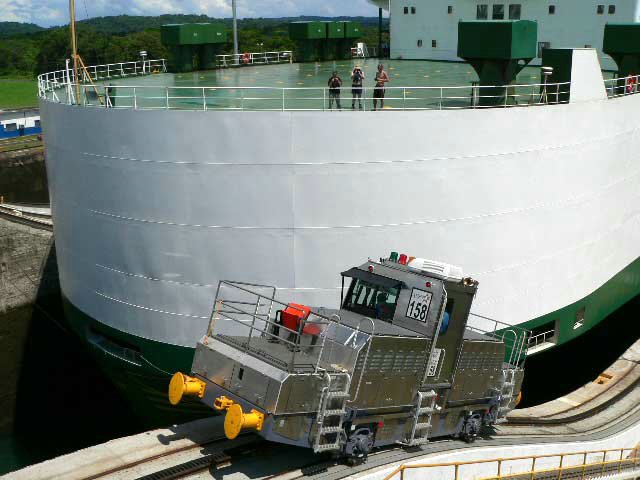
and if we talking about extreme curvature , here is some extreme Grade :)

look up Panama Canal Locomotives. these electric thingies tow the ships thorough the locks.

locomotive.jpg


284714370_2NpTG-M-1.jpg
 
Did some crude measurements on an aerial shown on another site. The radius of that curve is around 85' making it a 70 degree curve. Works out to be around a 12" curve in HO scale. The Uintah RR had 65 degree curves on 7 1/2% grade. The Los Angeles Junction Ry has an 85 degree curve & a #3 switch. So if you have things tight on your layout, there's a prototype for it. Here's a table from Freemo:
http://www.trainweb.org/freemoslo/Modules/Tips-and-Techniques/degrees_of_curve_to_radius.htm

you probably confused with some other picture. author of the pic describges:
"The loop track is approximately a 45 degree curve -- an 18-inch radius in HO scale."
 
Well yeah--but the Panama Canal tow locos have rack-and-pinion drive. With that kind of technology, what's the limit?

IMG_4051.JPG


you probably confused with some other picture. author of the pic describges:
"The loop track is approximately a 45 degree curve -- an 18-inch radius in HO scale."[/Q

Nope it's the same place. One of us is wrong w/ our measurements. But did that alot on engineering drawings & aerials at my old job.



Affiliate Disclosure: We may receive a commision from some of the links and ads shown on this website (Learn More Here)

Back
Top