Upgrading old freight equipment

  • Thread starter Thread starter NP2626
  • Start date Start date
ModelRailroadForums.com is a free Model Railroad Discussion Forum and photo gallery. We cover all scales and sizes of model railroads. Online since 2002, it's one of the oldest and largest model railroad forums on the web. Whether you're a master model railroader or just getting started, you'll find something of interest here.


Since I've been modeling after roofwalks were no longer required on boxcars, I've never put them on the cars that came with them. When they're molded on, I've left them as is. On a few of my covered hoppers, I've replaced the roof waks with see thru metal ones, but not the entire fleet, but would do it, if I had the time, or could find the kits. Some of the old Tyco cars run very well, and since Kadee came out with a coupler for talgo freight trucks many years ago, I've never body mounted the couplers.

I think the X2F coupler came about in the late 50's or early 60's, thru an industry effort to standardize on a 'simple and cheap,' plastic coupler. All the HO trains I bought before the McHenry coupler came out, came with them.

I agree that as the train rolls by, size of things like stirrups and underbody detail are less important.
 
Modeling the era when roof walks were no longer required is method of getting rid of this detail. However, in 1953, the era I model, they where still in use. I like them and feel they add interest to a freight car.

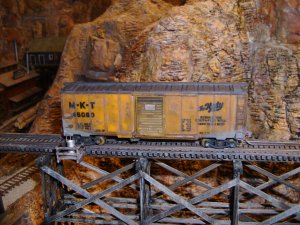
HPIM7589.jpg

Above is a photo of my Tyco MKT, The Katy, 40 foot box car which I paid $10.95, including shipping. The under-frame stated "Mantua" and I'm unsure of the connection between Mantua and Tyco. But, I remember that my original Tyco Train-Set's cars and locomotive all had Mantua as the manufacturer. This car is exactly like the car I got back in the early 1960s. So, my guess is this car is from that era, maybe even from a train-set like the one I got for Christmas so long ago! This car came with Baker style Couplers. My original car had Horn hook Couplers. I did not like the fact that this car was BRIGHT YELLOW when I got my Train-Set and so I have attempted to tone down the yellow on this car, by heavy weathering. Because of the flash on my camera, we can see that the roof walk was molded to the roof of the car, something that the normal lighting in the layout room does not highlight. I used Bettendorf T-Section Caboose trucks for this model. I will eventually get more conventional trucks for this car as I need Caboose Trucks on cabooses. I was surprised to find the weight of the car to be spot on with today's NMRA standard for weight! I don't know why I didn't like the Yellow Paint Scheme of the original car, I guess back when I got this car, I noticed that the RRs mostly used Box Car Red or Tuscan for box cars. Don't know if the Missouri-Kansas-Texas railroad actually had yellow box cars. Maybe someone here knows. For all the use it has gotten and the age this car is, it's only damage was a missing brake wheel! Removing the old molded on stirrup steps and replacing them with A-Line stirrups was the most difficult part of this conversion and it was the drilling of the small .020 diameter holes for the A-Line stirrups that was difficult.

This is the first of my show and tells on converting old fright cars for use on my layout. More to come.
 
Last edited by a moderator:
Drilling .020 holes on any car is difficult. I keep lots of spare .020 drill bits as I average only about 45-50 uses before I break one. I have a number of recent Walther's cars that came with non-installed grab irons and the modeler has to drill the holes. I find it a lot easier to add the stirups to old Tyco and Lifelike cars than adding the grabs to the Walther's cars. By the way, they are advertised as RTR, but they aren't really completed.

Willie


You know, I loved Walthers old kit cars. I haven't bought a single RTR Walthers car since they went to all RTR. Then again, the amount of RTR cars I have can be counted on my two hands, excluding the majority of the cars that make up this group! Of the five, the DL&W Athearn box car and Varney Stock car where kits. However, even they where built by someone other than myself.
 
Last edited by a moderator:
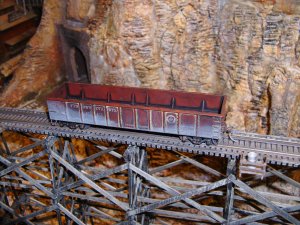
Looking through the HO Train Reference and Resource website <hoseeker.net>at Tyco products, the nearest fit for the train set I got, is listed in the 1960s catalog. This time frame sounds right to me. my set included Tyco/Mantua's 0-4-0 Booster steam loco, The yellow M.K.T. Box Car, a Tuscan colored Pennsylvania gondola and their little Bobber Caboose. I paid $9.00 including shipping for this Tyco Gondola. I have finished detailing the gondola and here is a photo:

HPIM7593.jpg

The gray bounce spray weathering shows up too bright in this photo. In ambient lighting it is more subdued. Other than the weathering and replacing the stirrup steps and wheels, this car is as it was sent to me. It came with Kadee couplers on it and sprung trucks. I am going to fill it with a load ash and cinders and it will be in engine service, being loaded at the ash pit, then cycled off layout.
 
Last edited by a moderator:
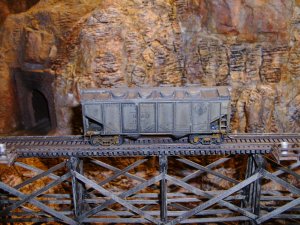
HPIM7596.jpg

Here is the Revell Covered Hopper I purchased on Ebay for $14.00, including shipping. In this case, Revell put the date that the mold was made, which was 1957. So, I know that this Car was manufactured sometime after that date. This car had Talgo Trucks with Horn Hook Couplers. I was able to clip-off the coupler mounting shelf from the trucks. Then I clipped off the Stirrups and replaced the plastic wheels with metal ones. I mounted Kadee coupler pockets to the car body with machine screws and weathered the car with rust and my acrylic washes. For some reason, Revell never had brake details on this car. I added a triple valve, reservoir and brake cylinder under the hopper body onto the white metal chassis, on the "B" end. I did not paint the roof of the car with Grimy Black, so the fact that the roof walk is molded on is more noticeable on this car.


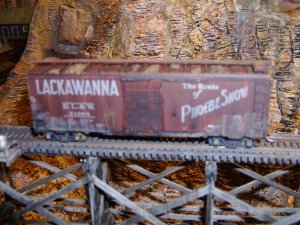
HPIM7595.jpg

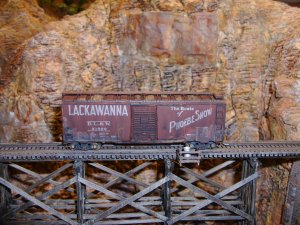
Sorry that this photo is blurry! The details on the cliff in the back ground is good, though. I remember buying the first iteration of this car when I was about 11 years old. I loved it because it was the right color for a box car, Tuscan; or, Box Car Red. I paid $11.28 for this car off Ebay. $5.00 for the car and $6.28 for shipping. This car came with Baker couplers soldered to the car weight. I attempted to remove the couplers with my soldering gun; but, must not have had adequate wattage as I could not get the solder to melt. So, I tossed the weight and attached couplers in the trash. This car has a separate roof walk; so, I didn't need to camouflage the molded on walk. A difference between this car and other Athearn cars I have built is this one has metal sliding door rails. All the rest of the Athearn Cars I have built have plastic door rails. I had to build up on the underside to get the Kadee Couplers to come out at the proper level. Since the car had soldered on Baker Couplers, the molded Athearn coupler box had been clipped off. This car has new Kadee trucks installed. These trucks are different than other Kadee trucks I have used. The trucks are split at the bolster and come with their own screws. The idea being with the little part that the screw goes through centers the truck direction when the car is picked up to be placed on the track. This system seems like more work than it is worth. I weathered the car using my watered down acrylic wash process and I added a bit more rust than I usually do. I may attempt to re-shoot the photo at some point.
 
Re the centering screw. Never seen one like that myself, but it'll be an idea that someone came up with, but proved to be just to gimmicky to be worthwhile. Now if someone could control body mounted couplers so that they always stayed over the center of the track all the time, THAT would be worthwhile.
 
Now if someone could control body mounted couplers so that they always stayed over the center of the track all the time, THAT would be worthwhile.
My guess is that the full sized railroads would like that too! This may explain why the NMRA's (N2F?) Horn Hook Couplers lasted as long as they did!
 
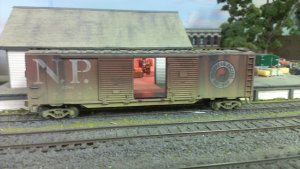
here is what started off as what I would call junk. While visiting some friends in Missouri, one of their club members had a box full of old freight cars. They were all pretty ragged. I saw this Northern Pacific double door box car which had only one horn hook coupler on it and trucks with no wheels. He wanted two dollars. I offered him a quarter. Deal. The only reason I was interested in it was because it was NP equipment. There were also a couple of spots where paint had been dripped on it. Kadee couplers and new trucks were put on it and it got a bit heavier weathering than I normally put on equipment to hide the dripped paint. That car had received a lot of positive comments.

IMAG0095.jpg
 
I like it!! That's about the minimum amount of weathering that my equipment gets. I like 'um dirty! Is the tan dustiness bounce spray? Do you know who manufactured this car? Thanks for the information on other discounters, Chet!
 
HPIM7597.jpg

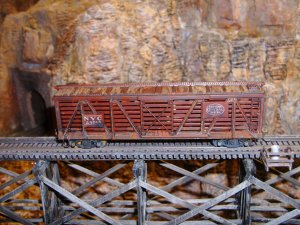
This is the last of my "Upgrading Old Freight Equipment" show and tells. This one turned out the worst looking under the intense light of a camera flash. This is a Varney Stock Car. I paid $7.95 for the car and $3.85 for shipping with an $11.80 total for this car. This is the same car I had when a kid that I could not get to stay on the rails, not knowing that all it needed was weight. I see that the previous owner(s) didn't understand this problem either, as nobody has ever added weight to the car. I'm unsure when Varney closed up shop, I know that Bowser must have bought the tooling for some/all of Varney's Steam Locomotives, as I bought Bowser's "Old Lady" consolidation back in the 90s. On Ebay today, there are still 13 pages of Varney Rolling Stock Equipment for sale. The list shows quite a few Varney "Ready to Roll" cars, so ol' Gordy saw the writing on the wall about kit building back before Varney went out of business. I have a very soft spot in my heart for Varney products!

This car was pristine when I got it, there was no weathering; or, paint that had been added. It came with the old N2F NMRA Couplers and sprung trucks. Of course I mutilated the trucks, attempting to remove the old plastic wheels and add metal wheel sets. Since I prefer one piece plastic trucks, this car was given a couple of new Kadee split bolster trucks. I added weight to the interior to bring the car up to NMRA's recommended weight. I weathered the car and it is ready to go. The one thing I do not like about this car is the roof. Varney molded the roof to fit over the car sides, so the car's roof is the widest part of the car. This is not very scale, my guess is that Varney was attempting to capture the look of the Mather Stock car. This flaw is very noticeable, at least to me.

Having completed the Up-Grade of my older freight equipment, I wanted to see how everything looked being pulled around the layout. I put the five cars that where a part of this project on the track, hooked up my Alco S-4 and added a caboose, so I could pull the train around and found I had a short! Since I had just run the railroad and everything was working fine, it was apparent that the problem had to be with one of the upgrade project cars. So, one at a time I took cars off of the track and found that the short was in the Pennsylvania Gondola. Adding metal wheels to a metal truck had caused the problem!

So, the purpose of this project was to see if what most of today's modeler consider to be junk, can be made to look presentable on a layout. For my purposes I have to say, the answer is a resounding yes! In fact, where I to be getting into the hobby today, this is what I would be using to fill my rolling stock roster. I love Accurail's car kits! However, the last one I bought was close to $18.00 in price!! Of the five cars I bought to fulfill this project, the highest price I paid was $14.00. I found the modifications I did, to be fun to do and at a minimum savings of $4.00 per car, this tickled my other interest and that is in saving some money!

I know that many of today's modelers are far fussier than I am about detail. That is just fine, we all make our choices. Paying $45.00 per car would make me look for another, cheaper hobby, especially when all those tiny details are practically unnoticeable when the car is rolling by in a consist of however many freight/passenger cars your locomotive can pull!

I had fun with this project. Isn't that what a hobby is for?



Affiliate Disclosure: We may receive a commision from some of the links and ads shown on this website (Learn More Here)

Back
Top