Track plan ideas

ModelRailroadForums.com is a free Model Railroad Discussion Forum and photo gallery. We cover all scales and sizes of model railroads. Online since 2002, it's one of the oldest and largest model railroad forums on the web. Whether you're a master model railroader or just getting started, you'll find something of interest here.


glefebvre

New Member
Hi all,

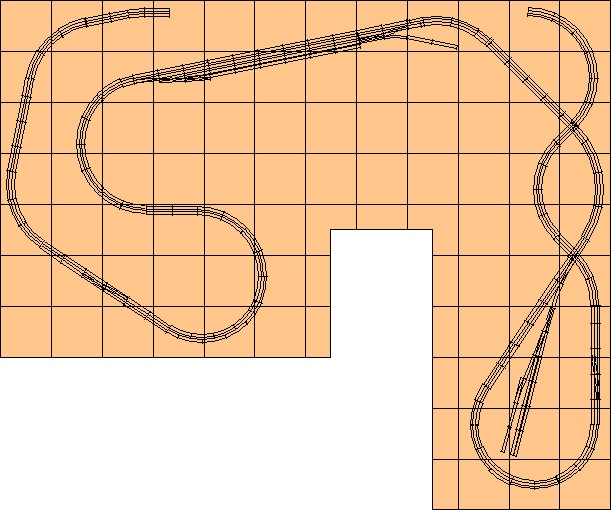
I'm new the forum and model railroading. I've been playing with AnyRail and have come up with two plans. The are very similar to each other. Any help with this would be appreciated. This will be an N scale layout with Kato track. Want to run passenger and freight/coal. Time frame 50's - 60's. Is the plan good or bad? What would improve it? Will be using DCC.

Thanks,

Gary
 
How big of an area do you have for this layout?

Your plan doesn't allow for access to all the tracks. You should be able to reach a maximum of 30" to any part of track. In addition, buildings and scenery to reach over to the tracks.

There is no rail yard? A good 5 or 6 track yard will help when operating trains, so that that your trains have somewhere to go, after picking up/dropping off cars at your coal mine, and other industries.

What you need to do, is think about an operating pit in the middle, and the benchwork along the walls of your room. Have a drop down access bridge that will allow you to walk into the pit.

Another thing, are you aware that you have a reversing loop section, that needs a DCC auto-reverse module?

What DCC system will you be getting?
 
Last edited by a moderator:
It will be free standing layout, probably in the garage. There is an open area between the Mine and Power Plants area. I've added a rail yard and fueling station. I'll look into the DCC auto-reverse module. I have a MRC Prodigy Express system.


The yard tracks in your latest plan look very short. Also, not sure if Kato makes the right angle crossing for the branch line crossing the curve, on the right side.

Are you trying to represent anywhere in particular? I'm also not sure what the vertical lead off of the turntable is supposed to represent. Real railroads do things for a purpose, as buying the real estate, track, switches, etc costs money.
 
Yeah, I thought the yard was a bit short also but couldn't find a good way of lengthing it. The branch going to the mine will be going up and over the dual track.

Not trying to model anything in particular, just wanted to make it interesting enough to enjoy. The vertical lead off of the turntable was a run around track to the branch line and to the left is the fueling station.

I am open to suggestion on how to make it better.
 
You have plenty of room on the top side there, for nice sized rail yard.

I made some changes to your plan here....

Plan%252045.jpg
 
You should look into building a modular layout. You have the space for 2 4foot modules back to back with turns at each end. The add the branch lines as modules later. will allow for expansion and changing interests and move ability.
Steve
 
I've been playing with AnyRail and have come up with two plans. The are very similar to each other. Any help with this would be appreciated. This will be an N scale layout with Kato track. Want to run passenger and freight/coal. Time frame 50's - 60's. Is the plan good or bad? What would improve it? Will be using DCC.
1. Well what I see is both plans are basically a double track loop. In that regard I like the 2nd one much better because it does not have tracks that just run parallel with the sides of the board. If you like watching trains just run and roll around the track the second one will be more interesting for a longer period of time. As it stands your operations consists of running a passenger train from the station around in loops and back to the station, and running a coal train from the mine to the power plant. I think that will get old really quick.

2. Are you opposed to having the mainline go over some grades? I think you could get some more interesting arrangements going. Perhaps a water wings arrangement, or a diagonal figure-8 the bottom track could be used for staging.

3. I am in the opposite camp from Motley. I think most model railroads are over yarded and under staged. Unless one really likes drilling a train (back and forth and back and forth and back and forth) yards are a huge waste on a small layout. My last N-scale layout had zero "yard" but three staging tracks. A stage is simply a place to park trains when they are not in use. This is more important for passenger train oriented layouts, as passenger trains look goofy just sitting around.

4. There is only 1 "passing track" between the double track main line. It will be much more interesting operationally if there are more crossovers.

5. There are two huge massive industries needing a specific car type (hopper) and no simple onesy twosy box car type industries. In the 50s the 40' box car was just starting to be phased out as the primary car. There were 40' box cars everywhere. You have no place for them.

6. The way the branch comes off the main track is strange. Motley's version is much more realistic. A branch usually comes off one side of a siding.

7. Locomotive facilities look great but consume mass quantities of layout space. Perhaps removing the round house and replacing it with a diesel shed?
 
The are very similar to each other.
And this isn't similar. Just something else you could do for a main line rather than a boring christmas tree loop. The possibilities are actually endless. Mostly an idea to help break out of the "thinking inside the loop." There are hidden straight tracks across the top under the others. Much longer main line in the same amount of space. One could put staging tracks there or break from there and have stub ended staging. I had the passenger station with two tracks on that inside diagonal track lower left to upper right. One could still put the power plant inside or over the blob on the lower left. That still leaves lots of room for other smaller industries. On the other hand something like this would be much harder to build since it requires up and over work instead of just nailing track to a flat board.
ForGary.jpg
 
Last edited by a moderator:


I am in the opposite camp from Motley. I think most model railroads are over yarded and under staged.

I agree with Horseman. The layout I've just started has one small yard, and only because it supports the operation I plan to have. In fact, when I went from paper to plywood, I reduced the number of yard tracks by one.
OTOH, my staging yard has twelve tracks; it would have more if I had the room.

The staging yard, in addition to providing storage for trains not in use, also represents "the rest of the rail network" beyond my layout. Goods coming from and going to industries on my layout come from or go to staging, representing "somewhere far enough away to justify shipping by rail."

Just my opinion, this is a hobby, after all, and we're all free to choose what we want.
 
I really don't understand the argument for too large of a yard? For the OP, or other layouts? How is a 4-5 track yard of the length I drew, too much? It sure doesn't take up that much space, or overwhelm the layout.

I agree with the staging, you can never have enough staging. But some people, like the OP, may not have enough room for staging.

Given the choice of either a nice sized yard or staging, I'll take the yard every time. Rail yard operations are very interesting, and can keep you busy for a long time, and you have a place for your rolling stock.

And if you don't have any room for staging, the yard can represent different locations. One session can be UP North Yard. And the next session it can be UP South Yard.
 
I reworked the plan with Motley's suggestions, created a new plan from Iron Horseman's suggestion and created more of spaghetti layout.
 
Oh ya baby, I really like the first one now. Much better. The second one isn't too bad either, very interesting.

The third one, holy smokes batman, way too many crossings, there is no way a real railroad would ever build that many crossings. Very unrealistic.
 
I really don't understand the argument for too large of a yard? For the OP, or other layouts?
Yes. Both.

How is a 4-5 track yard of the length I drew, too much?
A good yard usually has 1 classification track for each major destination. The destination can be another town, a large industry, or the "next yard". So If a layout has 6 towns (switching areas) the max a yard would need is 6 classification tracks. Many real small time yards only have two tracks. Cars for east-bound trains and cars for west-bound trains. This layout in particular has 2 industries which support each other. Unit trains from mine to power plant doesn't require any yard. Even if one pretends there is another town somewhere that wants coal there is no need to "classify" the coal so 1 yard track should be plenty. It is basically just a track to hold the coal from the plant until a train headed that direction comes by to pick it up. Even then that assumes there is sufficient volume so that the train headed in that direction doesn't just stop at the coal mine and pick up the cars itself.

Rail yard operations are very interesting, and can keep you busy for a long time, and you have a place for your rolling stock.
Yes if one has real classification work to do. I operate on one layout where the Cheyenne yard keeps one hopping! Arrivals/Departures on a schedule and better keep the main clear for the Thru and passenger. Get the wrong cars into a local train and that engineer is going to be very angry and/or have to do a lot more work than if one gets his train blocked properly. On the other hand on a layout similar to this, classifying a train from one imaginary off-layout destination to another imaginary off-layout destination is just an exercise in shuffling cars because there are no consequences if it is done wrong.

That is actually why I don't like the yards at the Greeley Museum. Yard work consists of take 10 cars, remove 10 cars. The tough train is 282/281 regional where the orders are for 6 pigs and 6 reefers to send to the next yard AND the pigs taken off have to be put into the track in the right direction so they can be unloaded. Nothing challenging in that ......
 
Last edited by a moderator:
Yes. Both.

A good yard usually has 1 classification track for each major destination. The destination can be another town, a large industry, or the "next yard". So If a layout has 6 towns (switching areas) the max a yard would need is 6 classification tracks. Many real small time yards only have two tracks. Cars for east-bound trains and cars for west-bound trains. This layout in particular has 2 industries which support each other. Unit trains from mine to power plant doesn't require any yard. Even if one pretends there is another town somewhere that wants coal there is no need to "classify" the coal so 1 yard track should be plenty. It is basically just a track to hold the coal from the plant until a train headed that direction comes by to pick it up. Even then that assumes there is sufficient volume so that the train headed in that direction doesn't just stop at the coal mine and pick up the cars itself.

Yes if one has real classification work to do. I operate on one layout where the Cheyenne yard keeps one hopping! Arrivals/Departures on a schedule and better keep the main clear for the Thru and passenger. Get the wrong cars into a local train and that engineer is going to be very angry and/or have to do a lot more work than if one gets his train blocked properly. On the other hand on a layout similar to this, classifying a train from one imaginary off-layout destination to another imaginary off-layout destination is just an exercise in shuffling cars because there are no consequences if it is done wrong.

Nothing challenging in that ......

So by your definition. A model railroad of any size, may it be large or small. If you have lets say 20 freight cars, but no room for a warehouse, then the modeler should not "own" or operate any freight cars?

For example. I own autoracks, double-stacks, box cars, center beams, gondolas, flat cars, hoppers. All these cars I have no industries or towns for on my layout. But I sure have fun making up and sorting trains on my 5 track rail yard. I also store rolling stock off the layout. Before I built my new extension room layout with staging, I used my yard as a fiddle staging area.

Some modelers say that the rail yard is the most important part of the layout.

Nothing challenging in sorting cars? How about incoming trains being split off to other "destinations off the layout". The challenge is to get the right cars correctly sorted, for the next mainline trains to depart. Without a decent sized yard, this would be impossible.

Why is there is HUGE section about Rail Yard design in the bible John Armstrong's book Track Plans for Realistic Operation.
 
Last edited by a moderator:
The third one has tunnels with over and under crossing. There is no direct track crossing track.

You don't have enough room for getting the required clearance at a 2% grade. If you go over a 2% grade you will have problems with locos getting up steep grades.
 
So by your definition. A model railroad of any size, may it be large or small. If you have lets say 20 freight cars, but no room for a warehouse, then the modeler should not "own" or operate any freight cars?
what does that have to do with anything?

For example. I own autoracks, double-stacks, box cars, center beams, gondolas, flat cars, hoppers. All these cars I have no industries or towns for on my layout. But I sure have fun making up and sorting trains on my 5 track rail yard.
How do you decide how the trains are to be made up and broken down?

I also store rolling stock off the layout. Before I built my new extension room layout with staging, I used my yard as a fiddle staging area.
Ah in other words a visible staging yard.

Some modelers say that the rail yard is the most important part of the layout.
And some say it isn't.

Nothing challenging in sorting cars? How about incoming trains being split off to other "destinations off the layout". The challenge is to get the right cars correctly sorted, for the next mainline trains to depart. Without a decent sized yard, this would be impossible.
Yes one can do that but all I am saying that it becomes exactly that sorting cars. The cars have no real destination so the cars just go into staging to come back from a different destination. In fact I am writing software for one layout that is doing exactly this. Reclassifying the cars in staging to make them come out pretending like they are from a different destination.

Why is there is HUGE section about Rail Yard design in the bible John Armstrong's book Track Plans for Realistic Operation.
They are interesting to design and build. There is a whole lot more to them than just a bunch of parallel tracks that newbies seem to think they are. Many real railroads don't have much in the way of "yards". Take the Moose Lake and Belfast. The closest thing they have to a yard is 1 track at the end of the line that doesn't serve a specific industry. Or how about the Louisville & Wadley. Their "yard" is a single track that is basically the interchange with the Central of Georgia & the Wadley Southern. The smaller the layout the less need there is for realistic "yard" operation, they can get much more operation from industires. My club that had a small layout 26x34 or so and was designed with two huge classification yards. It had only 9 other towns to classify , so as we actually got into operations one yard was shut down. We actually split the one yard and operated it as point-to-point

But in all I think you missed a huge statement in one of my earlier messages. I said something like, "unless you are one that enjoys drilling a yard".

 
Last edited by a moderator:


Affiliate Disclosure: We may receive a commision from some of the links and ads shown on this website (Learn More Here)

Back
Top