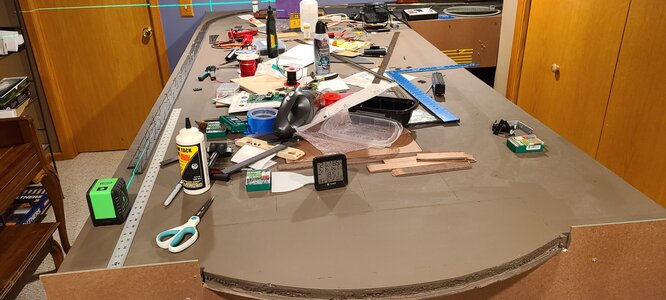
I used cork roadbed when I first built my layout 40 years ago, which I nailed to the plywood base, then nailed the track into it, I think with brads long enough to get through the track, roadbed, and into the plywood; I'm not sure how long they are. I'm getting ready to tear it and the track out (right now it is sectional Atlas track from 40 years ago and has never had a locomotive run on it). I'm also slightly altering the track plan, so I figured I may as well start fresh. I found the cork to be easy enough, I have some 18" and 22" radius curves, and it was never an issue to bend the cork around them.
As I did when I first put down the track, I'm planning on using cork roadbed again, and nailing it and the track down once again, no adhesive. I don't know if adhesive was popular 40 years ago. With the Atlas sectional track I used, it was simple to do since it came with holes in the ties spaced out every so often, which they still do. This time around, I'm going with Peco track and turnouts, and still plan on using nails (brads, tacks, whatever you want to call them), drilling holes in the Peco ties as I go.
I don't know if foam substrate was as popular back then as it seems to be now. What's the reason to use adhesives on both the track and the roadbed? It seems to be the way everyone is going about it these days. The only negative I can think with nails is some people claim it will increase the noise because the nails will transfer vibration to the plywood. I have a hard time believing it's enough of a difference to hear.
Are there other compelling reasons for using foam, cork, and adhesives, compared to just cork directly on plywood, and everything nailed in place? It seems it will be much easier to make changes, just pulling nails rather than scraping glue.
Another consideration in my case is because of timing and budget, I am planning on going very simple with DC at first, and just powering what are the two mains (what are essentially figure eights with overpasses). Simple enough that I will just have two powerpacks, one for each main, and just two pairs of wires, one for each pair of tracks. So, I will be pulling things up in the future to add switch motors, frog juicers, block detection, DCC, etc etc, as, and if, the budget allows.