
You are using an out of date browser. It may not display this or other websites correctly.
You should upgrade or use an alternative browser.
You should upgrade or use an alternative browser.
tiny lamp post
- Thread starter BigE
- Start date
ModelRailroadForums.com is a free Model Railroad Discussion Forum and photo gallery. We cover all scales and sizes of model railroads. Online since 2002, it's one of the oldest and largest model railroad forums on the web. Whether you're a master model railroader or just getting started, you'll find something of interest here.


I would put one of the provided resistors on one of the leads and then connect it to a 12V power supply. If it doesn't work flip the wires off the power supply.

These resistors are 670ohm. I started in electronics before I got into computer science. I know how to read the color codes.
I wired one of them up with a resistor and put it on about 9v. Still going bright and strong and not a bit of warmth to it.

Affiliate Disclosure: We may receive a commision from some of the links and ads shown on this website (Learn More Here)
logandsawman
Northern Pacific history enthusiast
Put the resistor on any wire, one per lamp post. Use a 9 volt smoke detector battery (we used to call them transistor radio batteries). Touch each lead to figure out which is + and which is -, you will know when the light works, and mark.
This is how I got mine working. You can wire them to the DC accessory on the back of your transformer. If the polarity of the transformer isn't marked, you can check that with one of the lights or a meter. I had to figure mine out because they weren't marked + or -.
My LED lights were marked somewhere on the package with a voltage. It was the only english writing on there.
This is how I got mine working. You can wire them to the DC accessory on the back of your transformer. If the polarity of the transformer isn't marked, you can check that with one of the lights or a meter. I had to figure mine out because they weren't marked + or -.
My LED lights were marked somewhere on the package with a voltage. It was the only english writing on there.
Iron Horseman
Well-Known Member
LEDs don't have a traditional ohm rating or a voltage rating, they are diodes.I got these today - pack of ten.
No instructions but included some resistors. Don't ask. I don't know what ohms they are.
They are LED - at least suppose to be. Any ideas on wiring them up?
I would put one of the provided resistors on one of the leads and then connect it to a 12V power supply. If it doesn't work flip the wires off the power supply.
Markus_Bane
New Member
Do you have a photo or the LED's and resistors?
NEVER apply 12V to an LED in the REVERSE polarity! That is way beyond specs and is practically guaranteed to destroy the device! Also, NEVER apply any voltage directly to the LED in either polarity without a current limiting resistor of some sort, even a voltage as low as 2 Volts with "unlimited current" will destroy the device! Finally, most LEDs are intended to be operated from a DC supply and and will not survive AC.
That being said, generally 3 to 5 volts in the reverse direction is considered safe (two 1.5V batteries in series or one of the
3V coin cells will do the trick. A 1K (1,000 ohm) resistor will limit the current to just a couple of milliamps and will be enough to light the LED in the forward direction. A 100 ohm resistor from 5V will limit current to around 30 milliamps and is generally beyond the specs for most LEDs.
If the LED is specified to have an internal current limiting resistor and you have determined the proper polarity you can
apply various voltages. The brightness is directly proportional to the current. For any given current limiting resistor you
can vary the applied voltage to vary the brightness. Likewise, for any given supply voltage you can vary the value of the current limiting resistor to vary the brightness.
For LEDs without an internal current limiting resistor there is a "Forward Voltage" specification typically ranging from around 1.5 to 3.0 volts. (Red is generally in the area of 1.5 volts). If you're running from 12VDC you can calculate the resistor value by subtracting the FWD voltage spec from the 12V and divide by the desired current. Conversely the applied voltage minus the FWD voltage spec and divided by the resistor value will give you the resulting current.
Generally speaking, a doubling of current will double the brightness, about one f-stop. From a 12 volt supply one LED will cause a certain brightness for any given current limiting resistor. Two LEDs in series will see only a small variation in current with that same resistor value. (12V-1.5V)/resistance -vs- (12V-3V)/resistance is only a 10.5:9 ratio. Even 4 LEDs in series would only result in a 10.5:6 ratio. From a 5V source, two LEDs in series would vary the current for any given resistor value by 3.5:2 and you would need well over 6V to light a 4 LED series string.
Resistor values of 220, 470, 1K, 2K, and 4.7K are common and will give you a wide range of brightness from any LED and a variety of supply voltages. Be careful with the lowest two values, they can cause excessive current with just one LED from a 12V supply.
That being said, generally 3 to 5 volts in the reverse direction is considered safe (two 1.5V batteries in series or one of the
3V coin cells will do the trick. A 1K (1,000 ohm) resistor will limit the current to just a couple of milliamps and will be enough to light the LED in the forward direction. A 100 ohm resistor from 5V will limit current to around 30 milliamps and is generally beyond the specs for most LEDs.
If the LED is specified to have an internal current limiting resistor and you have determined the proper polarity you can
apply various voltages. The brightness is directly proportional to the current. For any given current limiting resistor you
can vary the applied voltage to vary the brightness. Likewise, for any given supply voltage you can vary the value of the current limiting resistor to vary the brightness.
For LEDs without an internal current limiting resistor there is a "Forward Voltage" specification typically ranging from around 1.5 to 3.0 volts. (Red is generally in the area of 1.5 volts). If you're running from 12VDC you can calculate the resistor value by subtracting the FWD voltage spec from the 12V and divide by the desired current. Conversely the applied voltage minus the FWD voltage spec and divided by the resistor value will give you the resulting current.
Generally speaking, a doubling of current will double the brightness, about one f-stop. From a 12 volt supply one LED will cause a certain brightness for any given current limiting resistor. Two LEDs in series will see only a small variation in current with that same resistor value. (12V-1.5V)/resistance -vs- (12V-3V)/resistance is only a 10.5:9 ratio. Even 4 LEDs in series would only result in a 10.5:6 ratio. From a 5V source, two LEDs in series would vary the current for any given resistor value by 3.5:2 and you would need well over 6V to light a 4 LED series string.
Resistor values of 220, 470, 1K, 2K, and 4.7K are common and will give you a wide range of brightness from any LED and a variety of supply voltages. Be careful with the lowest two values, they can cause excessive current with just one LED from a 12V supply.
Last edited by a moderator:
Markus_Bane
New Member
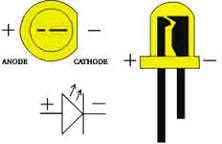
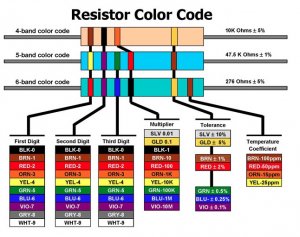
This is the easiest way to know the polarity of your LED, and this is how you read the colors on your resistors. My guess is the resistors provides will be 1k brown/black/brown with a silver stripe.
That's what I asked if you had a photo of them
That's what I asked if you had a photo of them
Last edited by a moderator:
BigE
Active Member
This is the easiest way to know the polarity of your LED, and this is how you read the colors on your resistors. My guess is the resistors provides will be 1k brown/black/brown with a silver stripe.
That's what I asked if you had a photo of them
View attachment 49621View attachment 49622
These resistors are 670ohm. I started in electronics before I got into computer science. I know how to read the color codes.
I wired one of them up with a resistor and put it on about 9v. Still going bright and strong and not a bit of warmth to it.
logandsawman
Northern Pacific history enthusiast
So the longer one is +. That saves me some effort. Thanks.
Affiliate Disclosure: We may receive a commision from some of the links and ads shown on this website (Learn More Here)