ModelRailroadForums.com is a free Model Railroad Discussion Forum and photo gallery. We cover all scales and sizes of model railroads. Online since 2002, it's one of the oldest and largest model railroad forums on the web. Whether you're a master model railroader or just getting started, you'll find something of interest here.
Thanks to all for the advice on which DCC to use still have not made up my mind. Now I am haing a problem with Atlas rail Joiners.How in the heck do you get the two rails together when using Flex track.Is there a video or book on this subject. Thought this RR stuff would be easy HA!HA!
If you have used the flex track to go around a curve, you will have to cut off the rail on the inside of the curve. You can use a Atlas track saw, a Zona or Xacto saw, a Dremel tool with a cutoff blade, or Xuron Rail cutters. After you cut the rail to lenght, you will need to file the end and bottom of the rail to remove any burrs before you can get the rail joiner to slide on.
If the joint occurs in a curve, I leave a couple of inches of the 1st piece untacked down. I pull the track into position and cut the rail to length. Let the track go back straight. Join the 2nd track and solder the rails and rail joiners together. Then continue laying the track around the curve. This way there will not be a kink at the joint.
Thanks to all for the advice on which DCC to use still have not made up my mind. Now I am haing a problem with Atlas rail Joiners.How in the heck do you get the two rails together when using Flex track.Is there a video or book on this subject. Thought this RR stuff would be easy HA!HA!
make a notch under the rail in the tie where the rail joiner is to go. When going around a curve the inside rail will get longer (since it has shorter distance to go). Do NOT cut it off. Slide it into the next piece of track. Notch the ties at the new place where the rails met. Never let a connection of both rails be directly across from one another. That way the solid rail on one side will help prevent a kink on the other joining rail.
Also always use brand new rail joiners. If a joiner must be removed for some reason replace it with a new one. It also helps to make the rail joiners as short as possible. Long bottom "tabs" makes the required notch bigger and consequently harder to do.
Flex track on a curve is the only place I solder rail joiners.
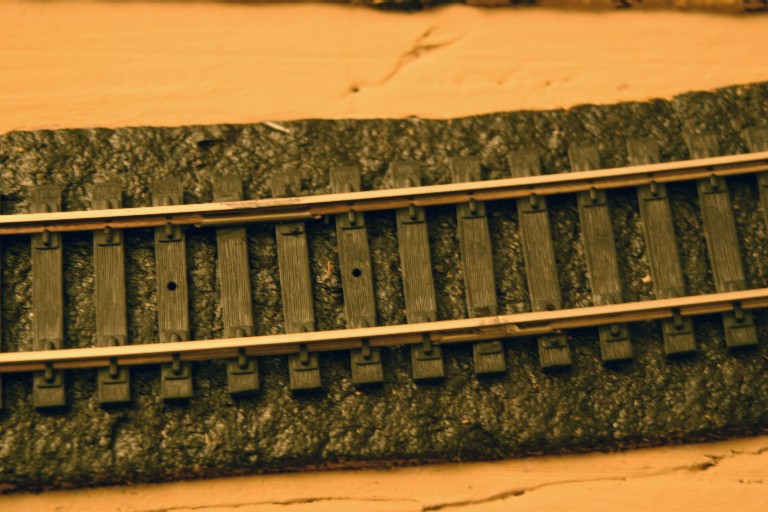
This picture is of HO track but the same principles were applied to my former N-scale track. No ties are removed and "filled in", no rails are cut, and there are no kinks. Well obviously in a full circle a rail will eventually have to be cut, but that is missing the point. Work slowly and carefully.