Short RH Peco Turnout Derailment Problem

ModelRailroadForums.com is a free Model Railroad Discussion Forum and photo gallery. We cover all scales and sizes of model railroads. Online since 2002, it's one of the oldest and largest model railroad forums on the web. Whether you're a master model railroader or just getting started, you'll find something of interest here.


BasketballRick

New Member
Hi Folks, Thought I'd voice my dismay after having finished installing my layout's FINAL yard, only to discover that the very first turnout...... a Peco short number 5 is causing my ten wheeler steam locos to derail as they enter the yard, which in turn is making the entire yard inoperable. I know what you're thinking, "waiting until the entire yard trackage was finished before test piloting it'.....was poor form. I've been so depressed, I've refused to go near the layout for the past three days. I've since learned that various Peco short turnouts can be randomly problematic. I began the yard throat with the short turnout because I wanted the "angle" thus created to allow more room for the five track yard.
 
If it's not being caused by the length of the locomotive and the turnout angle, you're going to have to get in there an analyze what is happening when the locomotive crosses the turnout.

Start with a bright light on the drivers and get down to eye level and run the locomotive as slow as it will move across the turnout. As soon as a wheel starts to lift from the rail, stop. That is where you will have to determine what the problem is in order to solve it.

If the turnout angle is too steep for this many drivers, a wheel is likely trying to climb out of the gauge as the front and rear drivers are pressed against the inside of the rail. If the angle is too much, it's going to climb out.
 
Have you done anything to try to figure it out? I’d start with checking the gauge of the track and wheels. Next I’d look for vertical variations, humps, bumps or twists. Let us know what you find.


It is likely to be one thing more than several things, but in reality it can be 5-10% of one or two other factors, and then the comparative rail heights across from each other, or the gauge of the points rails (I'm assuming the problem is when the loco enters from the points end?)

I have encountered this problem, and if it isn't a gauge problem on the locos, or that the loco's built-in lateral motion in the divers is insufficient, meaning the driver wheelbase is too long for the curvature afforded to it in the turnout, or that the coupler is horsing the loco out due to extreme angles (usually the tender derails before the heavier loco), then it's going to be a dip in the center of the turnout, near/at the frog, or there is improper support under the turnout and something, maybe a piece of stray ballast, has gotten under one of the ties and is forcing one rail to rise up. On a curve, a low outside rail more than a full mm will cause a derailment outward.

This assumes both points lie flush, vertical, and tightly against the stock rails when thrown. Even a very small gap will cause picking of the points if the wheel gauge is slightly wide.
 
At exactly what place is the locomotive derailing? Do the lead truck wheels derail first, causing the drivers to come off the track? After checking the above things, you might try slowly pushing the engine into the turnout and see where and what happens. What about the wheelbase of the locomotive drivers? Are the front two drivers closer together than the third set? Are the second set flanged or blind? Have you tried any other locomotive, or if you only have the one, trying to push a long car to see if that derails similarly?
 
Thank you, Everyone! Advice much appreciated. I will get busy and see if I can discern the problem and then report back. I do believe the wheels are coming off the track right on top of the plastic frog but I'm not absolutely certain. First off I'm going to ensure that there are no impediments of any kind between the opposite side guard rail and the outside rail itself. Then I'll do the same thing with the frog. I haven't ballasted this area yet but that's not to say that it's not possible for some foreign material to be clogging things up. I will also measure the flanges on some of my locomotives as they're older rather than newer (the turnout is code 100). Thanks again,
 
After some careful examination, I think my problems derived from a number of small issues instead of just one big one.

I put on my magnifying glasses and sure enough there were indeed tiny, tiny bits of ground foam (grass) stuck in the bottom of the guard rail. I scraped them out and then ran a flange test with my Mark 4 gauge. It seemed to slide through ok.

Then I successfully ran a locomotive (2-6-2 Camelback) through the turnout and it remained on the tracks. But it bumped a bit going over the frog.

After repeated runs over the plastic frog, I decided to try and file down the thickness of the "black frog plastic" But I wasn't very successful. Did not try my dremel with a cutting tool yet. (ANY ADVIVE ON THAT?)

But success for the locomotive didn't mean that the tender made it through the turnout unscathed. It derailed about half the time. So I tried adding weight to the tender and that stopped it from derailing. Then I ran an engine/ tender/ passenger car train through the turnout several times both directions with no resultant derailing, but the locomotive does seem to noisily smash its way through (over) the frog.

I'm thinking that possibly my collection of older camelback locomotives have deep flanges (causing them to contact the plastic Peco frog) My NMRA measuring gauge is a Mark 4 and I don't think it provides a measurement for the actual depth of a wheel flange.

Regardless, although it may be a bit noisy as the wheels come in contact with the frog, I'm now able to utilize the yard itself.
 
What code is the Peco turnout? If it is Code 100, they are technically NOT HO scale, but English OO scale. The space between guard rails and the stock rail on the OO Code 100 turnouts are a bit too wide, causing HO scale wheels to sometimes "pick" the point of the frog. The solution is to add a shim (IIRC about .010-.015" to the inside of the guard rail, between the guard rail and the stock rail, so wheels are pulled away from the frog. If the Peco turnouts are Code 85, they are made to American standard HO scale, and don't cause the problem.

As far as the wheels dropping down too far approaching the frog, you might fill in the bottom with some material and then carefully file the material down until the problem disappears. Of course, as you said, if the flanges on some of your rolling stock are the old "cookie-cutter" size, it might be better to swap the wheel sets for newer ones.
 
You can purchase a package of maybe eight needle files of various descriptions for just a few dollars at your local hardware store. Very worthwhile investment on my railroad. There is one like a tiny bastard that can be used to pare the plastic down in the flange paths if that would help with longer flanges. Or, for the dropping wheels, you can inlay thin strips of styrene and that will go away. You can also glue thin strips of styrene along the guards to tighten up their gauge a bit.
 
Thanks, Trailrider. The turnout in question is definitely code 100. I had absolutely no idea that if code 100, they actually conformed more toward 00 scale. The shim that you described (IIRC .010-015") is available online perhaps??....... and if obtained any advice on how to install it?

As to changing out the wheel sets. That might be above my current skill-set pay grade. :) :)


Thanks, Selector Appreciated
I will pick up some needle files tomorrow.

Big snow storm here in Ontario on Friday night, I foolishly thought winter was over plus then on Saturday we got ten hours of freeing rain. Unbelievable. So, we stayed hunkered down at home all day. Raining now and above freezing all night, so that should take some of it away.

So needle files and I also plan on trying to eyeball the width of the locomotive's flange and compare it to the space within the guard rail. If I think I can fit it in, I'll definitely try to inlay your suggested thin strip of styrene with a couple of drops of regular glue. (Regular glue...right?) Trailrider suggested the same solution. I'd never heard of it before but know about it now.
 
Thanks, Selector Appreciated
I will pick up some needle files tomorrow.

Big snow storm here in Ontario on Friday night, I foolishly thought winter was over plus then on Saturday we got ten hours of freeing rain. Unbelievable. So, we stayed hunkered down at home all day. Raining now and above freezing all night, so that should take some of it away.

So needle files and I also plan on trying to eyeball the width of the locomotive's flange and compare it to the space within the guard rail. If I think I can fit it in, I'll definitely try to inlay your suggested thin strip of styrene with a couple of drops of regular glue. (Regular glue...right?) Trailrider suggested the same solution. I'd never heard of it before but know about it now.
The NMRA steel plate gauge is a must for anyone who wants to have success long term in the hobby. It's only a few bucks, but it actually has several useful gauges on its edges. One is for the flange path for what the NMRA calls RP-25 flange lengths on typical modern HO wheels. It's very useful. I got one within weeks of joining the hobby, and I can lay my hands on it in a second. It's literally on my layout all the time.
 
You're right. I should have bought a Mark 5 at the train store the other day when I had the chance. $27.50 bucks Canadian and I thought to myself, "The heck with it." But I don't believe my Mark 4 includes a Flange Length although it does have a Flange Path. It is indeed the Flange Length that I need to be checking, on these old locomotives that I'm running. They are noisy when rolling over the frogs on some turnouts but not others. I'll pick up a Mark 5 this week. (Still considering filing down the height of the plastic on the offending frogs.)
 
Persistence is key, and your knowledge will build. I’ve been at it, off and on, for 40 years, and I still find new failure modes. It gets easier to find bugs, the more you learn. Remember to never overlook the obvious.

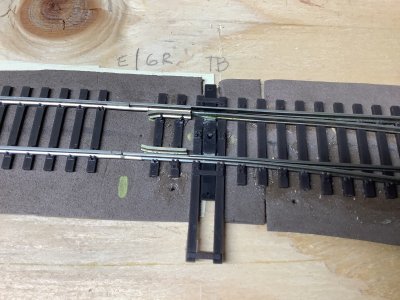
Here’s an example. Recently I had an occasional derailment when diverging on a Walthers #6R. A real head scratcher. I finally realized that the point rails were out of spec, too wide. So a flange would catch on a point rail. I didn’t want to rework the points or replace the turnout, so I fit a couple of short guide rails. That seems to have solved it; time will tell.
 

Attachments

  • image.jpg
    image.jpg
    1 MB · Views: 172
Persistence is key, and your knowledge will build. I’ve been at it, off and on, for 40 years, and I still find new failure modes. It gets easier to find bugs, the more you learn. Remember to never overlook the obvious.

Here’s an example. Recently I had an occasional derailment when diverging on a Walthers #6R. A real head scratcher. I finally realized that the point rails were out of spec, too wide. So a flange would catch on a point rail. I didn’t want to rework the points or replace the turnout, so I fit a couple of short guide rails. That seems to have solved it; time will tell.
Good idea, Dale. I wouldn't have thought about supplemental guide rails. And thanks for responding.
Cheers, Rick
 
Hi Folks, Thought I'd voice my dismay after having finished installing my layout's FINAL yard, only to discover that the very first turnout...... a Peco short number 5 is causing my ten wheeler steam locos to derail as they enter the yard, which in turn is making the entire yard inoperable. I know what you're thinking, "waiting until the entire yard trackage was finished before test piloting it'.....was poor form. I've been so depressed, I've refused to go near the layout for the past three days. I've since learned that various Peco short turnouts can be randomly problematic. I began the yard throat with the short turnout because I wanted the "angle" thus created to allow more room for the five track yard.
Keep at it. If nothing works, a Walthers switch is a good fix.


Affiliate Disclosure: We may receive a commision from some of the links and ads shown on this website (Learn More Here)

Back
Top