Rivet counting Vs Fun

ModelRailroadForums.com is a free Model Railroad Discussion Forum and photo gallery. We cover all scales and sizes of model railroads. Online since 2002, it's one of the oldest and largest model railroad forums on the web. Whether you're a master model railroader or just getting started, you'll find something of interest here.


where are you on this

  • total crumudgeon

    Votes: 1 1.8%
  • sort of a perfectionist

    Votes: 13 23.2%
  • doing the best with what you have

    Votes: 27 48.2%
  • really don't care

    Votes: 16 28.6%

  • Total voters
    56
  • Poll closed .
I think it's different for all of us. The " nit picky " guys may get their enjoyment by super detailing everything. I can dig it. I.m content riding the fence. I appreciate details but I can settle for good enough.
 
Here's my humble opinion... Model railroading creates an impression. There is no way in small scales that we can duplicate a miniature anything down to the last nut and bolt. As was pointed out, most of us don't even have a scale mile of track on our layouts. What most of us try to do is create an impression of a prototype whatever-it-is-supposed-to-be. If I want to model the Denver Zephyr, there is no way I can get a ten or twelve car train that wouldn't look ridiculous...six cars, most of them '72 foot "shorties" with a pair of E-units is all I can manage. My kitbashed Burlington 2-10-2's won't stand up to a magnifying glass examination versus a photo of a prototype M-2a. (That's why I number them a little outside the range of the prototype class. This locomotive was built by the Burlington shop for use by my subsidiary, the Grashhook, Galesburg & Western Division of the C.B.& Q. or the C & S.) But they run well, and my scenery looks pretty good, especially to guests, even those with their own layouts. My time, the dexterity of my hands and the visual accuity that isn't quite as sharp as 60+ years ago (when I started in HO), and wouldn't permit me to rivet count if I wanted to. So count me among the "good enough" crowd.
 
Last edited by a moderator:
Legend has it the term "rivet counter" came into being after Lionel released their scale O Hudson, which was touted as being the most accurate model possible. An individual counted the rivets on the tender, and pronounced there were not as many on the model as on the prototype.
Another story has to do with the same engine, same tender, only says there was a row of rivets missing on the tender.


Legend has it the term "rivet counter" came into being after Lionel released their scale O Hudson, which was touted as being the most accurate model possible. An individual counted the rivets on the tender, and pronounced there were not as many on the model as on the prototype.
Another story has to do with the same engine, same tender, only says there was a row of rivets missing on the tender.
That is interesting. I wonder if there is some way to confirm or disprove such an interesting tale.
 
Sometimes misunderstood

I spend a lot of time researching things. I will also point out where things deviate from the prototype. I occasionally get heat for this.

My approach is that being a model, it will never be 100% accurate. My models aren't 100% accurate. Far from it. But I feel that you should know and understand what the prototype does and did so you will know what corners you are cutting. My feeling is that if you are going to take the time to do something special, it takes the same amount of time to do something closer to prototype as it does to do something unprototypical. It doesn't hurt to know what the prototype did, even if you don't have the space or time or skills to do it now, you can capture the essence, use the time you do have or learn the skills you need. I enjoy growing in the hobby. I see it as a challenge to myself (not a competition with others). If I don't challenge myself to do better, to have better details, more accurate cars, better quality craftsmanship, then I'm not satisfied.

I am in the process of designing a new layout. I will have to leave out a whole bunch of stuff that the prototype had. But I know what I am leaving out, I know what I am keeping, I know a lot about how the various parts worked together, and I know what I need to add to make the parts I have work together.

I have access to a lot of information through experience and a lot of research. If somebody has a question, I have no problem sharing what I've learned. If you're stupid enough to ask, I'm stupid enough to answer. 8-)

Since I have a lot of experience I will also tell people if stuff doesn't look like its going to work. If you have a switchback with a two car tail serving a 15 spot track, I'll tell you the switchback is a problem, because it is. If other people think that's mean, tough, I would rather have the person knowingly make a decision to incorporate that, understanding the risks, than to rubber stamp a "Great plan, looks like fun!" reply. Most of my comments aren't opinion, they are geometry and engineering. If we didn't have 'rivet counters" we would still have generic cars. It is because of the rivet counters that we have the variety of cars that we have and the detail on those cars.

Obviously others don't feel this way. The "do what you want" crowd can be just as harsh and just as counter productive as the people who are rigid "rivet counters". My feeling is that if the person offering the opinion or commentary points out a deviation from prototype and offers a suggestion to correct, improve or to mitigate the deviation then they are offering constructive criticism.
 
Oftentimes it's not so much the message itself [that something is incorrect] but how it is delivered.

I model the steel industry, and a close friend of mine is a well-known author of railroad historical/technical articles. He was at one of my op sessions, and said the following about one of my structures: "I see you used the standard Walthers coke oven kit. If you added-in a second set of ovens, that thing would look perfect." He then mentioned that he had enough of the required pieces in his scrap box that I could use if I wanted them. So instead of feeling insulted, I was inspired to upgrade my coke mill - and got several weeks of enjoyment out of the project.
 
I wouldn't dream of being critical of other modelers. That stuff ended for me by 30 or so (and the occasional dinosaur kept us on our toes). I want to encourage everyone. This is a forum, we don't know who we are communicating with. It might be a child doing his best, or possibly an adult with a childs skills looking to impove, or gawd forbid an adult who's damaged doing the best they can.

I want everyone to have all the fun they can with model railroading, no stress, lotsa mess and tons of smiles.
 
This thread is yet another example of why I enjoy this forum so much. This is by far the best place I have found to learn about trains and not just model trains.

You guys are great and I enjoy your points of view almost as much as the knowledge and experience you share with me and everyone who reads these posts. There are so many great post on this thread that I won't even begin to point them all out!

I may be about as far from a rivet counter on the spectrum of model railroaders as one can be, but I admire them none the less. I don't see rivet counters as a negative aspect of the hobby, on the contrary I believe they enhance the hobby.

I just recently bought a 2011 Lionel SD60 and I was amazed at the detail. I had to see all the detail with a magnifying glass! Comparing that to my 1974 Lionel GP 20 I can see how far the hobby has come, I think it's great! If you look at the original price of the GP 20 and adjust for inflation the SD60 was close to the same price, but to me it's 100% better and it has Legacy command controls!

I still don't have a Legacy command base, but we all know about supply problems and having to wait for one thing or another. That is a topic for another thread all together. One I'd rather not participate in anyway. Every thing in life has negative aspects, I would rather focus on the good things. I don't have any control over the negatives most of the time anyway so why worry about them.

In my opinion this really is the world's greatest hobby and there is room and products for everyone. We all benefit from the rivet counters, I don't see their comments as negative or critical, I see them as educational and informative. Sometimes they don't say it in the most gentle ways, but I don't believe that most of them are trying to be negative.

Thank you everyone for educating and informing me, I really enjoy it!


I would like to clarify. When I started this thread I in no way meant to imply that I thought any one way to enjoy the hobby was any better than any other. I can appreciate all of them. Maybe I worded it poorly. I was just curious as to how others enjoy it . I feel by some of the responses likematbe I made "rivet counting" out to be a bad thing. Not what I intended. Id nobody counted rivets , what would our models look like? Thanks for all the response, Mike.
 
I think after you get beyond an individual piece of equipment, accurate modeling is not really possible. I believe we are artists. Much like a painter, but with an added dimension. We still have a frame and a story to tell. If we are a realist, then the rivets are there. Some of us are more concerned with the smoke and lights and the setting and general feel. Either way we are limited by space and time to depict our world. Maybe there's a Picasso amongst us. I think he might not care about correct detailing. Oh, and it's all good.
 
Hey People,


I don't see myself as a rivet counter, but I do like when my models have almost correct dimensions and proportions. I can live with no rivets simulated and finer details, like tiny vents, decal, and similar missing.

As mentioned, we never can get every tiny detail into our small models (HO N Z scales etc etc).

I also can live with compromises such as cut open pilots (as my RTR GP38-2s) longs couplers (to enable tight turns) and the sought.

I tend to go for brands like Atlas Trainman, Athearn, Accurail, Bachmann and Walthers.

Many who have seen my trains always do comment on how real they look anyway:). I always did wonder how they would comment on brands like Atlas top end lines, Kato, BLI, Proto 1000/2000 and the sought:rolleyes:.


DE
 
I am not a rivet counter. What I try to achieve is a realistic looking locomotive, freight cars and cabooses. I freelance, therefore there's not too much to comment on. Almost everything I run is weathered and I get a lot of comments on how real everything looks because it's "dirty, just like the real ones". Most people who do visit my layout would have no idea of how close my equipment is to prototype. Besides, the only person I am trying to please is myself.
 
Forum:

My HO scale model railroad is called the Milwaukee Northern Railroad and is "loosely" based on the Milwaukee Road set in Wisconsin. While the Road is the Milwaukee Northern, the majority of my locos are Milwaukee Road diesels, but the SOO, C&NW and WC have trackage rights. You may even see a DMIR or BNSF loco on lease. The Milwaukee Northern motive power is limited to two "patched" locos a Rock Island and SOO locos and two older steel refrigerated cars used for local deliveries.

While I follow most prototypical practices, coal was discovered near Wausau, Wisconsin which provides some smaller unit coal hauls. Ore trains will pass over the Milwaukee Northern rails.

My era is 70's to 90's, but cabooses still rule on most trains.

My opinion is as long as everything "looks" right, its your railroad and a GP-9 and a 38-2 will fit together in operation. The buildings, scenery, background and details will set the theme and can become almost timeless. The trains becomes the action by running in the urban and countryside settings.

Yes, accuracy in the motive power and rolling stock is important, but rivet counting stops at that point. I trust that the manufactures have done their best to re-create the prototype in their models.

Enjoy the hobby, after all its your layout.

Thanks.

Greg

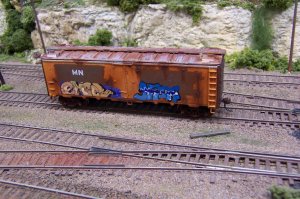
Patched Reefer MN #2.jpg

One of the two Milwaukee Northern's pieces of rolling stock....while of 1940's or early 50's vintage, the car sat idle on a siding in Chicago for almost twenty years before the Milwaukee Northern purchased the car at auction. The rail "art" while not from the car's early years, is the result of sitting unprotected in an urban environment.
 
I answered the poll "really don't care" yet that doesn't fully capture my approach. I think just about everything I've thought about on the topic has been covered on this thread, and like others have said, it's great to see people take such a calm and non-doctrinaire approach. The absence of defensiveness tells me that most folks here are mature and secure enough to engage in thoughtful dialogue instead of insisting it's "my way or the highway."

I would have no qualifications to insist for others what they should do and wouldn't dream of trying to do so. As I develop my own layout, which doesn't have a real life prototype, my philosophy is to go for as plausible an approach as I can but give myself some slack as well. Since I want a brewery, I've ruled out modeling during Prohibition -- you could call that a form of "rivet-counting." (I briefly considered an "alternate universe" approach in which Prohibition was never passed, but that actually seemed like too much mental work!)

In deciding I would probably use 50-foot Roundhouse Overland passenger cars as my home road's primary passenger fleet, I wanted (and got) some reassurance that they would plausibly fit in a 1930s short line setting. I also have tweaked the concept just enough to make it plausible that there would still be some logging (by the 1930s, a lot, *but not all*, of N. Wisconsin's logging had been played out).

And my track plan requires a tunnel, but I have it on pretty good authority that there probably weren't any RR tunnels in the particular part of the state where I've set my fictional line. So I'll have to decide whether I will 1) disguise the tunnel entrances with buildings or landscaping, 2) assert that, well, tunnels didn't exist here but there's no fundamental reason they could *not* have existed, or 3) shift the basic fictional line's location so that it would run in a portion of the state where there *were* RR tunnels. I'm probably more likely to choose 1) or 2). So that's the form my personal rivet counting takes, and it's just for me -- I don't choose to make it a contest by which I judge others.
 
I am definitely NOT a rivet counter! With that exception, I think I would fall into the other categories, depending on what I am doing. Layout and design needs to be interesting but I do the best with what I have.

The trains themselves (including rolling stock) are what they are when they come out of the box; although, I do try to buy the most realistic I can.

The scenery is where I place most of my focus and to that end, I try (within my limitations) to get the most realistic appearance as possible.
 
All great responses. You got it right DSD, this is a really great forum. I have enjoyed all the responses so far. Oddly I find a little of my approach in most of them. I like my models to be realistic as I can make the, but my skill/wallet has me "pick a place to stop" so to speak. I model the depression era too DSD. I built a mountainside distillery instead of a brewery. It's disguised as a mine. Food for thought. Maybe disguise it as a grainery or something. Makes a cool story.


Guys...Rivet counting is fun! Just don't use it to make yourself and others miserable and don't use it to denigrate other people's work. Follow those simple rules and it's just building the most accurate model you can build.


Affiliate Disclosure: We may receive a commision from some of the links and ads shown on this website (Learn More Here)

Back
Top