
Reverse Loop isolation.

ModelRailroadForums.com is a free Model Railroad Discussion Forum and photo gallery. We cover all scales and sizes of model railroads. Online since 2002, it's one of the oldest and largest model railroad forums on the web. Whether you're a master model railroader or just getting started, you'll find something of interest here.


Tom Rambo

New Member
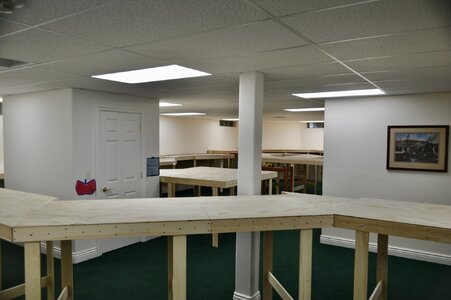
I'm back to HO model RR after a 45 yer absence. I got hooked on multi-state motorcycle riding. All of my riding buddies have "aged out". 2022 was probably my last multi-state M/C adventure. I have the first phase of my benchwork completed, thanks to the nice ladies at Sievers. I'll try to attach a photo of part of the benchwork.

In my past layout, I did my reverse loop with a toggle switch (memory says it was a DPDT). I may do the same this time, or use an auto reverse module...Decision later, but I need three answers now, as I lay the track:
1. Can I limit the length of the isolated section to...(a) The length of my longest connection of multi-locomotives (about 4'), or (b) The maximum length of a lighted passenger train I may run (maybe 8' - 12')?
2. With the auto reverse modules is it necessary to do the old fashioned isolation at two places on the loop? If the module senses a short, then flips the polarity, why won't only one isolation of the rails work?
3. In "olden days", I staggered my isolation cuts by about an inch or so, to help with rigidity of the tracks. Is that still a good idea, or will it cause problems if I use an auto reverse module?

Being a very old retired mechanical engineer, I understand answers in numbered outline form, like my questions format. I get lost in long narrative answers.

Will I get an email telling me that I have answers?

Thanks,
Tom
 

Attachments

  • 04.jpeg
    04.jpeg
    282.8 KB · Views: 176
Hello Tom, welcome back to the hobby after a long absence. I used to ride motorcycles too, but slowly gave it up, due to a variety of reasons that would all sum up to "aging out", now that I think about it. 😜

I'll try to answer your questions..........
1. If you want to run passenger trains with lighting, then yes, you should plan on insulating for the longest train you plan on running. And even further if you have the room for it.
2. With either DC or DCC, you will need to insulate two places on the loop. One place won't cut it, even with an auto reverser. With just one location insulated, any locomotive or lighted passenger car would immediately short out upon spanning the insulated joint.
3. I'm not sure about staggering your insulation joints. I would think this would be okay even with an auto reverser, but have never tried it. Hopefully someone else will chime in with some experience for this one.

You should get an e-mail telling you of any replies, unless you disabled it while setting up your preferences when you registered.
Hope this helps. :)👍
 
In my past layout, I did my reverse loop with a toggle switch (memory says it was a DPDT).
Yes, DPDT.

1. Can I limit the length of the isolated section to...(a) The length of my longest connection of multi-locomotives (about 4'), or (b) The maximum length of a lighted passenger train I may run (maybe 8' - 12')?
Longest lighted passenger train is the short answer. Or longest train period, if you are using either a. metal wheels or b. lighted caboose.

2. With the auto reverse modules is it necessary to do the old fashioned isolation at two places on the loop? If the module senses a short, then flips the polarity, why won't only one isolation of the rails work?
Yes, because with only one set of gaps or insulated joiners of the rails it is not an isolation. In a loop, the power comes through the loop and around the "back side".

3. In "olden days", I staggered my isolation cuts by about an inch or so, to help with rigidity of the tracks. Is that still a good idea, or will it cause problems if I use an auto reverse module?
If your track really needs it, it is OK. It will not cause a problem with an auto reverse unit, because the unit will reverse when the short happens on one wheel, the other wheel, or both at the same time.


That worked better than I expected. Thanks to both of you for giving me complete and concise answers. Either of you live in CA?

Two new questions came up today:
1. All I have right now is my old MRC Throttlepack. I can run my old loco with it, but can I safely run a new DCC loco with Sound? Doesn't matter at this point if the sound wouldn't work. My concern is not to damage a new DCC loco and it's sound module.
2.To decide what DCC controller (throttlepack) I should get, please tell me the normal amperage draw of large steam and diesel locos. I'll then consider how many I want to run at one time, and choose a proper throttlepack.

Thanks,
Tom
 
I believe most DCC decoders are dual mode, run with DCC or DC. Some may only be DCC, some can do DC, but you may have to configure the decoder first to use DC. Usually sound decoders will not allow you to play every sound. Modern HO scale locos draw at most 1 amp. Best to find out what decoder is in the loco and then look up the details for that decoder, power draw and DC functionality.
 
That worked better than I expected. Thanks to both of you for giving me complete and concise answers. Either of you live in CA?

Two new questions came up today:
1. All I have right now is my old MRC Throttlepack. I can run my old loco with it, but can I safely run a new DCC loco with Sound? Doesn't matter at this point if the sound wouldn't work. My concern is not to damage a new DCC loco and it's sound module.
2.To decide what DCC controller (throttlepack) I should get, please tell me the normal amperage draw of large steam and diesel locos. I'll then consider how many I want to run at one time, and choose a proper throttlepack.

Thanks,
Tom
Nope, N.E. Kansas for me.

1. Yes, you can safely run a DCC loco, with or without sound, using your DC Throttlepack. A decoder can be programmed to run on straight DC, or not (and it's a very easy programming step to set this up). I would imagine that a factory-installed decoder would be programmed to allow for DC operation. If not, then you would either have to wait until you get a DCC system, or else have someone else use theirs to enable the DC operation for you.
2. I have an NCE ProCab-R system on my N-scale home layout with the 5 amp power supply, as does both our local N-Trak and HO-scale train clubs. This is perfectly adequate for N-scale and HO-scale layouts. Although NCE also offers a 10 amp power supply, this should be used for O-gauge only, as it has the power to fry N-scale and HO-scale locos should a short-circuit occur. I believe that modern day HO locos with sound would probably pull no more than around a 1/4 amp per loco, if even that, but just kinda' guessing at this. Modern day electric motors are quite efficient, but adding sound will use more power.
 
Thank you both for the help. I guess I'll Actually have to read (imagine that) the manual that comes with the DCC locos I purchase.

Do you know the answer regarding using a DCC power park to run my old plain DC locos, without causing damage to EITHER my old locos, or the DCC pak?

Tom
 
A DCC power supply puts out AC current. Which of course will NOT run DC locos. The decoder in a DCC loco will rectify the AC current back into DC to run the motor. The decoder will even switch the positive and negative current flow to the motor in order to allow forward or reverse operation of the locomotive.

If you put a plain DC loco on a track powered with DCC, the loco will sit there and buzz and not move. That noise is the DC motor trying to change direction 60 times a second, which will do nothing more than heat up and burn out the motor after a few to several minutes. However, the DCC power supply will probably survive unscathed.
 
1. All I have right now is my old MRC Throttlepack. I can run my old loco with it, but can I safely run a new DCC loco with Sound? Doesn't matter at this point if the sound wouldn't work. My concern is not to damage a new DCC loco and it's sound module.
DCC decoders are such that you can put any power to it as long as it is not over voltage and it will not damage it. When DCC was brand new, our club was running CVP Railcommand (approximately 13V fixed DC with a 3.5V carrier signal over the top). A visitor came down and threw his DCC loco on the tracks thinking that was what we were using. There was no damage to the loco.

Many (most) DCC decoders come from the factory with what they call "dual mode" decoders designed to run on DC or DCC. You will have to get the throttle up to about 40% before anything will start happening though.

FYI - The opposite is not true. Putting a DC locomotive on DCC track will buzz and hum and eventually ruin the magnets in the motor. The fellow we call "Running Bear" (RIP), did actual experiments to time how long it took to destroy various locos. Short answer is not long.

2.To decide what DCC controller (throttlepack) I should get, please tell me the normal amperage draw of large steam and diesel locos. I'll then consider how many I want to run at one time, and choose a proper throttlepack.
A bigger current draw will be sound vs no sound. In general though, I usually count 250 ma per loco, and 500 ma per sound unit when sizing my power supply. That is an over estimate, but I would rather be over than under.

The only way to tell for certain is to put the loco on the track and actually measure how much power it consumes.

P.S. Also from Colorado/Kansas. I am a volunteer at the Colorado Model Railroad Museum in Greeley, and just getting my feet wet with the local NMRA and clubs here at my "new" house near Wichita Kansas. It is amazing I have this big house and the wife won't let me have any of the empty bedrooms for a layout.
 
Last edited:


Affiliate Disclosure: We may receive a commision from some of the links and ads shown on this website (Learn More Here)

Back
Top
