Rail history

ModelRailroadForums.com is a free Model Railroad Discussion Forum and photo gallery. We cover all scales and sizes of model railroads. Online since 2002, it's one of the oldest and largest model railroad forums on the web. Whether you're a master model railroader or just getting started, you'll find something of interest here.


Hutch

Well-Known Member
I decided to switch things up this morning. Instead hobby railroads, I began watching history videos. Since I don't know a thing about real railroads and locos, I think this might help to at least start understanding the names printed on the sides of these toys. So I started with this History of American Railroads. Followed up with The Failure of the SPSF Rail Merger. I think the first one needs to be watched again, but the second one was pretty interesting as well.
 
I decided to switch things up this morning. Instead hobby railroads, I began watching history videos. Since I don't know a thing about real railroads and locos, I think this might help to at least start understanding the names printed on the sides of these toys. So I started with this History of American Railroads. Followed up with The Failure of the SPSF Rail Merger. I think the first one needs to be watched again, but the second one was pretty interesting as well.
A "this day in Railroading History" thread would be fun. We just missed a big one though. March 2nd 1970 was when the Burlington Northern merger happened.


I find railroad history fascinating, while going through Dad's stuff I found a 1920 Great Northern timetable in like new condition, as well as a 1917 timetable for Northern Pacific. Just reading the timetables and noticing all the stops and towns, some which no longer exist, is remarkable to me.

Why these were saved, I'll never know, however one of them says plainly on the cover to recycle the timetable and not throw away. Whew!!!

In addition, I have seen several old movies where rail life is more or less the "background story". As usual, no titles come to mind. Just some of the images of the scenes.

Dave
 
I find railroad history fascinating, while going through Dad's stuff I found a 1920 Great Northern timetable in like new condition, as well as a 1917 timetable for Northern Pacific. Just reading the timetables and noticing all the stops and towns, some which no longer exist, is remarkable to me.
Those would be so interesting. It is fairly easy to find information on the schedules of the big name trains, Broadway Limited, Super Chief, Empire Builder... But much harder to find information on the hundreds of milk runs, mixed trains daily, and locals, all across the US. For example the Santa Fe train #67 and #68 mixed daily local from Wichita to Pratt KS has so much character. I've seen some similar trains on the Burlington in Iowa. Include the whole country and there are probably 1000 trains a day that are hardly anyone knows about. Wow, what wonderful modeling fodder in that.

All I know of the NP is the North Coast Limited, and the Mainstreeter. GN is the Empire Builder, Western Star, International, Badger, and Gopher. There had to be so many more.
 
Some railroads will have Wikipedia synopses about a particular line, and if you check through the footnotes (that's what they are for, right?) you can often find a more detailed source which explains a particular road's history in greater detail. Sometimes a magazine article, and--if you are lucky--even a book.

The road I follow most closely actually commissioned just such a history itself, and OF itself as a company. They gave the author access to many, even deep-in-the-back-of-the-closet stuff...and gave him carte blanche. No holds barred--call it as you see it about us now, what we were then, and how we got here in the first place. I still think that absolutely brilliant of them. Very helpful to me too, not just as a person interested in railroad history, but as a modeler too.
 
On my many romps off the beaten path in Northern California I enjoy coming across old right-of-ways. When I get home some I can find on maps, some using google earth and others nothing. On the former Ocean Shore Railroad south of San Francisco I have traced most of the ROW. There are places along the abandoned ROW of the Northwestern Pacific that are remote enough and in sketchy areas that I have avoided. Still enjoy finding long forgotten traces of logging roads in the north coast area. Before I was born there was a Southern Pacific ROW with trestles crossing city streets 1/2 block from my boyhood home. It was removed in the 1940s but my Dad remembered it. The history is fun, trying to find out what it used to be.


I'd like to see one of those time tables.
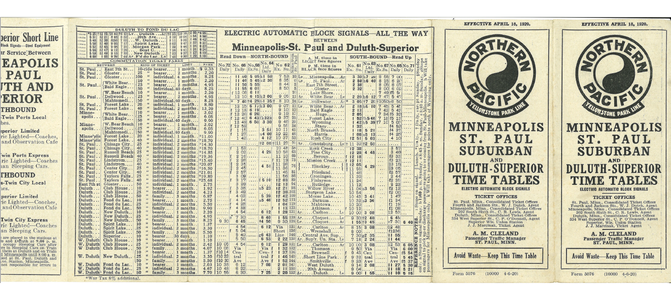
Then Northern Pacific timetable attached, date is 4/18/1920. Note message on front "avoid waste-keep this timetable" Who would have thought?

NP timetable 4.18.2023 .png

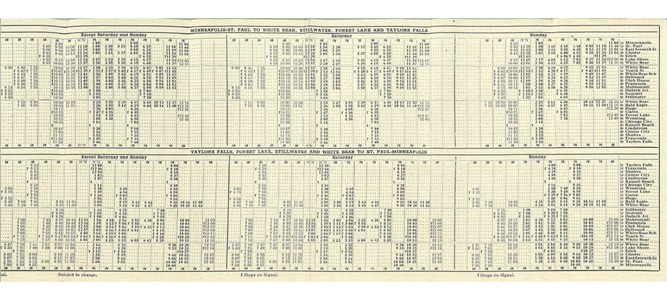
NP timetable - local p. 2.png

The towns on the Duluth Superior includes many familiar stops to me, including my hometown and some on my layout

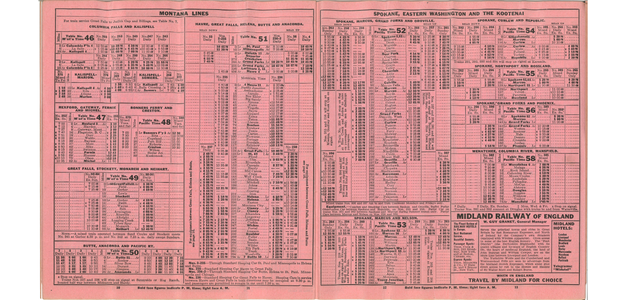
The Great Northern timetable has 39 pages but I just printed the front and a center page with an advertisement for a European railroad:

GN timetable 8.18.1912.png


Here is a sample page with an interesting ad lower right

GN timetable p 30, 31.png

Dave LASM
 
On my many romps off the beaten path in Northern California I enjoy coming across old right-of-ways. When I get home some I can find on maps, some using google earth and others nothing. On the former Ocean Shore Railroad south of San Francisco I have traced most of the ROW. There are places along the abandoned ROW of the Northwestern Pacific that are remote enough and in sketchy areas that I have avoided. Still enjoy finding long forgotten traces of logging roads in the north coast area. Before I was born there was a Southern Pacific ROW with trestles crossing city streets 1/2 block from my boyhood home. It was removed in the 1940s but my Dad remembered it. The history is fun, trying to find out what it used to be.
Agreed. I also enjoy using Google Earth tracing old roadbeds here in the Midwest, and occasionally in other areas as well. Sadly though, I've noticed that even in the last 15~20 years, the leftover roadbed scars in the landscape are slowly healing up (especially in sparsely populated areas), and in some place are making it virtually impossible to trace intermittent sections of a rail line.

About the only other way to help is to have old maps or time tables showing which towns the the route went through, and sometimes (but not always 😞) kinda' helps trace the old route through the countryside.

 
Agreed. I also enjoy using Google Earth tracing old roadbeds here in the Midwest, and occasionally in other areas as well. Sadly though, I've noticed that even in the last 15~20 years, the leftover roadbed scars in the landscape are slowly healing up (especially in sparsely populated areas), and in some place are making it virtually impossible to trace intermittent sections of a rail line.

About the only other way to help is to have old maps or time tables showing which towns the the route went through, and sometimes (but not always 😞) kinda' helps trace the old route through the countryside.
I agree, when these satellite images first came out it was fun to trace old rail lines. Getting harder and harder every year, but I say especially in populated areas. In the early 1990s (America on line era) The old C&S bridge across I-25 in Denver one could easily see the former right of way too and from it. Now it is all gone and is invisible due to new development right over the old right of way.

Even out in Kansas more and more farmers are braving excavating the heavy rock roadbed foundations and plowing them up into their fields.


Affiliate Disclosure: We may receive a commision from some of the links and ads shown on this website (Learn More Here)

Back
Top