ModelRailroadForums.com is a free Model Railroad Discussion Forum and photo gallery. We cover all scales and sizes of model railroads. Online since 2002, it's one of the oldest and largest model railroad forums on the web. Whether you're a master model railroader or just getting started, you'll find something of interest here.
Hi all. I have been looking on this fourm for awhile. I am finlely starting my layout. My question is how do i wire a turn-out to keep it from shorting out? I will be useing atlas code 80 with a nce phpro. I have had this stuff for about a year or 2. Like i said i am finaly getting to start. Sorry about the spelling my spell check don't work. I appreseate all the help i can get..
I use the power routed Frog for turn-outs on a DCC system. I use Tam Valley Frog juicers to power to Frogs which switch the frog polarity automatically. Works great. http://www.tamvalleydepot.com/support/frogjuicers.html
I hopped on today to have the same question answered. I'm using Bachmann EZ track and am trying to figure out the wiring for my turnouts too. I believe the EZ is code 80 as well, but do they have insulated frogs? Also, what is an insulated frog?
I have already diverted one loco without issue. Hoping it's not just dumb luck that it didn't already short.
An insulated frog is one that has no juice going to it. The down side of it is that a short loco will stall on it unless you can wire juice to it that will change polarity with a slide switch or tortoise machine.
Maybe not using just a plain old "what is an insulated frog" instead of what you typed, wouldn't draw the embarassing question from grand children here. Thanks.
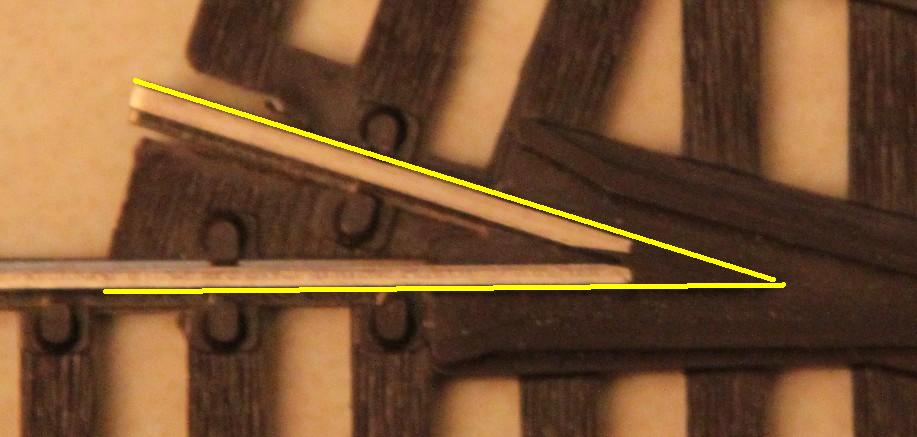
Backing up one step. The "frog" of a turnout is that little point where the two rails come together right before they cross.
The picture below is a turnout frog (ignore the yellow lines that was for another question someone asked). In the picture notice the two rails do not actually meet. They get close and then are replaced with plastic. The plastic insulates the two rails from touching each other. This is an insulated frog. A hot frog would be one where there is no plastic and the metal of the two rails actually join in a point. This picture is an HO turnout but the concept is not scale specific.
Hey elsner i would really go with kato unitrack there is a big difference the kato trak may be expense but it is worth it
I have never encounterd problem with the kato track
OK, at the risk of going off-topic, just wondering - - if you paint the plastic tip of the a frog that is like the one in the above picture with a silver - colored paint, say, would the paint conduct electricity and cause a short circuit between the adjacent rails?
if you paint the plastic tip of the a frog that is like the one in the above picture with a silver - colored paint, say, would the paint conduct electricity and cause a short circuit between the adjacent rails?
I am an all wired frog fanatic, you need to up your wiring/soldering mad skilz. Lay down your trackwork, think of the 2 tracks as opposing currents, if they touch you short, follow your eyes around the rails and look for where they may meet, then you start dremel tool cutting gaps where needed, then hard wire the rails properly.
Your turnouts should have switch machines that have relay style contacts do you can power the frog rails properly.