ModelRailroadForums.com is a free
Model Railroad Discussion Forum and
photo gallery. We cover all scales and sizes of model railroads. Online since 2002, it's one of the oldest and largest model railroad forums on the web. Whether you're a master model railroader or just getting started, you'll find something of interest here.
On my small train layout I am debating which way I should lay something out which will depend on how I choose to operate it. I'm looking for some advice as to what the most prototypical way to run trains would be. The layout is meant to represent the end of a branchline. I'll try to show this using Paint. Here is the first scenario. Trains will come out of staging (track in top left) and continue onto track 1. When the rear of the train is clear of the switch it will reverse into the yard (labeled as 4). Then the caboose will be taken off by a yard switcher from the escape track and the engine will disconnect to go to the engine srvicing area leaving the cars to be switched. When a train is assembled a caboose will be tacked on the ladder end of the yard (towards bottom of picture) and a loco will attach using the escape track. The train will then reverse out of the yard then proceed forward to the staging area mentioned earlier. Or I could run this way. Trains will come out of staging (track in top left) and take the switch right onto track 2. When clear of the switch connecting tracks 2 and 3 it would back up onto track 3. When clear of the switch connecting tracks 3 and 1 it would run in the forward direction into the yard (track 4). Then the loco would use the escape track to go to servicing and the caboose would be taken off and stored. This would leave the cars to be switched out. When a train is assembled a caboose will be tacked on the ladder end of the yard (towards bottom of picture) and a loco will attach using the escape track. The train will then reverse out of the yard then proceed forward to the staging area mentioned earlier. I'd appreciate any assistance.
Thanks,
conrailocs
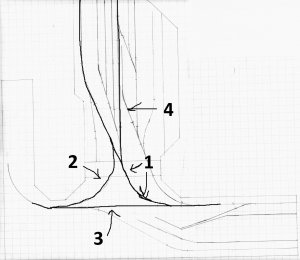
The first option is much more straight forward. It seems like all option 2 does is add two more direction changes to the whole train on both entry and exit.
I don't think a prototype railroad would configure track like this. This looks more like two former railroads that merged. They only kept the yard of the one and the branch (staging) of the other.
What are trying to do? Not what moves but what is the train doing? It sounds like you are bring a train out of staging, reversing ends, then heading back into staging.
or....
Does a train come out of staging, drop its cars, pick up another cut of cars (from industries in the area) and head back to staging? Does the train from staging do the industry switching or does the switcher?
This is how I would switch it assuming the train out of staging drops it inbound train and picks up an outbound train and the switcher switches all the industries.
I would bring the inbound train down short of the #2 switch in #1, cut off the power and then run the engines down #1 to the bottom and then back into #3 to the tail and back up into #2 and hold. The switcher would come out onto #1, couple into the train and pull it down to the right, cutting off the caboose. The train would be shoved into the available yard tracks. The switcher would then get the caboose and double the outbound train out of the yard. While its doing that the road power would pull out of #2 onto #1. The switcher would assemble the outbound train and shove it up towards the road power. The road power would back onto the train and get an air test. It would then depart to staging. The switcher would take the inbound train switch it up and switch the industries.
To answer your question the locomotive coming from staging will do no switching. A yard switcher will work the yard and a separate loco will switch the industries. The branch off the the left will make sense. It goes to serve a steel mill. The area in the bottom left will contain many industries.

Affiliate Disclosure: We may receive a commision from some of the links and ads shown on this website
(Learn More Here)


