Need advice on what HO scale double crossover to use

ModelRailroadForums.com is a free Model Railroad Discussion Forum and photo gallery. We cover all scales and sizes of model railroads. Online since 2002, it's one of the oldest and largest model railroad forums on the web. Whether you're a master model railroader or just getting started, you'll find something of interest here.


inTRAINing

New Member
I've got a layout with an inner and outer oval. I plan to use a double crossover to connect the tracks. Do you guys have any suggestions on which name brand to buy and from what supplier? I saw a Walthers on modeltrainstuff.com but it had poor reviews. By the way it doesnt need to have electronic switches. Thanks
 
Hello


For track cross-overs, you can use the brand ATLAS. They are good in handling when you are in USA, if you are in Europe, then you can use the cross-overs supplied from PIKO.

In atlas, there are many types of crossovers depending on the angle between two tracks


----CHANTY
-----HO SCALE
 
When it comes to HO double crossovers, your options are very limited. Only Walthers and Shinohara make them. Walthers are garbage. Shinoharas are supposedly better, but are still pretty finicky and very complicated to wire.

Why not consider two sequential crossovers instead? It's more prototypical, will be more reliable, and much easier to wire up and tune. I went through the same headache just recently. Ended up going with two separate crossovers made up of four turnouts.

See here:

http://www.modelrailroadforums.com/forum/showthread.php?t=30366

And here:

http://www.modelrailroadforums.com/forum/showthread.php?t=28046

Hope this helps!


Thanks. I agree with the 4 turnouts. I thought of this after I posted and your response confirms it. May cost a little more but from what I gather it'll be more reliable and easier to wire.
 
When it comes to HO double crossovers, your options are very limited. Only Walthers and Shinohara make them. Walthers are garbage. Shinoharas are supposedly better, but are still pretty finicky and very complicated to wire...

Kinda hard to call Walthers dbl crossovers garbage, when Walthers are Shinoharas.

If you want a dbl crossover and don't want to spend the money for Shinohara/Walthers, use 4 Atlas #6 turnouts, (2 lt hand, 2 rt hand) and a 19` crossing.

There won't be any special wiring needed either.
 
For track cross-overs, you can use the brand ATLAS. They are good in handling when you are in USA, if you are in Europe, then you can use the cross-overs supplied from PIKO.

In atlas, there are many types of crossovers depending on the angle between two tracks

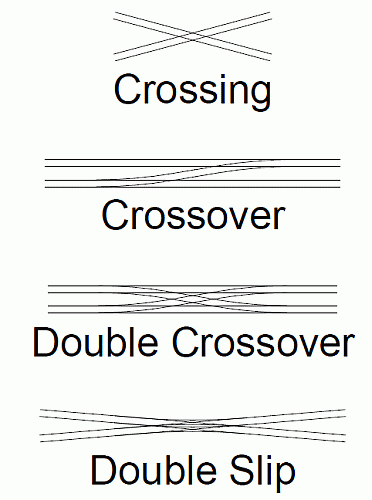
You may be confusing crossings and crossovers. Atlas does not offer a double crossover as the Original Poster was seeking. Here is how the words are typically used in American English:

xing_xovr_slip.gif
 
My Walthers/Shinohara #6 Code 83 double crossover is marvellous. Works like a hot damn. I used it just three days ago to show a young boy how they work. According to my daughter and son-in-law, who were looking after him that day, he has talked about nothing since.
 
My Walthers/Shinohara #6 Code 83 double crossover is marvellous. Works like a hot damn. I used it just three days ago to show a young boy how they work. According to my daughter and son-in-law, who were looking after him that day, he has talked about nothing since.

Was it your Grandson?
 
Kinda hard to call Walthers dbl crossovers garbage, when Walthers are Shinoharas.

The newer Code 83 DCC-Ready ones that Walthers markets under its own name these days are garbage, in my experience, even if made by Shinohara for them. The ones marketed by Shinohara and which can still be found today, seem to be much more reliable, albeit a bit harder to wire. As always, others' experience can always vary.


The newer Code 83 DCC-Ready ones that Walthers markets under its own name these days are garbage, in my experience, even if made by Shinohara for them. The ones marketed by Shinohara and which can still be found today, seem to be much more reliable, albeit a bit harder to wire. As always, others' experience can always vary.

Our club has a Walthers/Shinohara code 83 dbl crossover as well, and like Crandell's it works extremely well. Wiring it was a breeze.
 
Not belabor this, but my crossover is on my lift-out bridge at the entrance to the loft housing my new layout. It is not specially wired. It is soldered at all eight rail ends to short lengths of flex that extend it to the ends of the bridge. There are four 1/2" screws under the wide flange comprising the wooden deck of the bridge, and the feeders are wrapped around those screws for continuity, forked, and work their way up grooves (for clearance at the bridge abutments) to the rail tips at the flextrack extensions at the ends of the wood. You can see the arrangement in this photo. Note the inverted metal brackets on which the screws sit, acting like real bridge shoes. Power goes via feeders to the inverted steel brackets, up through the screws (which can be turned in or backed out individually to get perfect sitting posture on those inverted brackets), to the feeders wrapped around the screws, and up the wire yokes to the rail ends. The double crossover gets no power directly and has no additional wires other than as it left the factory.

Did I say this system works like a damn? Reliably?

DSCF2372res.png
 
Somewhere in between. I started by drawing up a #8 turnout using an AutoCAD clone. Then I flipped it and flopped it to get 4 identical turnouts, placing them so that the crossover tracks were straight, and that pretty much made made the diamond fall out of the design automatically, with just the guard rails to add.

After doing the drawing, I printed it out and glued the paper onto a piece of 1x4 board. That's what I used to cut and fit the rail sections, as I knew that it was going to be a tedious job and it was more comfortable at the bench. Once it was done, I took the rails up and relaid them at the actual worksite. So no, I didn't use any jigs or guides, but I didn't just start in there with the spiking pliers!
 
Thanx John. I laid mine out with a ruler and a pencil. I drew center lines and then the "rail lines" and followed those. They are #6 turnouts. I may relay to #8 if I can develop the room for it.
 
The only thing you have to be aware of about power routing double crossovers, is that all four points need to be set the same way to prevent shorts. I just wired all four of my tortoise machines to one switch. It is a shinohara double crossover by the way, and it works perfectly.
 
The only thing you have to be aware of about power routing double crossovers, is that all four points need to be set the same way to prevent shorts...

That's why with any power routing turnout, proper gapping is a must! I have 16 gaps in mine. It's been in place almost 2 years and has worked like a charm since it was built.


Ohh thanks for the confusion caused

Few questions to all on this thread

1. Can junctions (turnouts) be made automatic with decoders. If yes, which decoders can i use and any website, company providing these decoders

I made a Walthers GP9M digital by hardwiring it but how turnouts can be dcc... Help required......

2. How can ROCO models be made dcc ready. Any procedure will be useful, any video or site showing the info


Affiliate Disclosure: We may receive a commision from some of the links and ads shown on this website (Learn More Here)

Back
Top