I have an old HO brass steam engine that I'm remodeling and having problems with loose screws on some of the drivers. Rather than tap for new screws I need some advice on what is a good glue to hold these screws in place but still be able to unscrew them without a lot of pressure. They're about 1-72 and approximately 1/8" in length.

You are using an out of date browser. It may not display this or other websites correctly.
You should upgrade or use an alternative browser.
You should upgrade or use an alternative browser.
Loose screws on drivers
- Thread starter spever
- Start date
ModelRailroadForums.com is a free Model Railroad Discussion Forum and photo gallery. We cover all scales and sizes of model railroads. Online since 2002, it's one of the oldest and largest model railroad forums on the web. Whether you're a master model railroader or just getting started, you'll find something of interest here.


Affiliate Disclosure: We may receive a commision from some of the links and ads shown on this website (Learn More Here)

marriedshades
Member
Teflon plumbers tape a little hard to wrap on smaller screw helps tighting things up without glue i done it twice and didnt have any problems will admit the screws i used were larger.
logandsawman
Northern Pacific history enthusiast
If you are talking about a hole that got worn too big, I would fill it with JB weld epoxy (one drop). First cover the back of the hole with scotch tape and lay the model on the side so it doesn't run out. Let it get good and solid, wait 24 or 48 hours, and then drill an undersized hole in the weld being careful not to ream out any more of the brass.
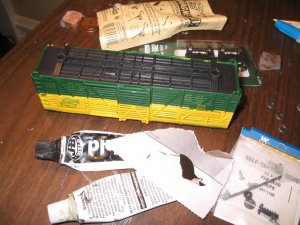
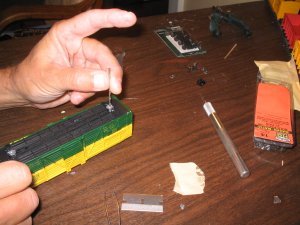
Here is a picture of a large space that I filled in and tapped for upgraded trucks:
Do not overtighten when putting your screw in. I have found that this stuff really holds.
lasm
Here is a picture of a large space that I filled in and tapped for upgraded trucks:
Do not overtighten when putting your screw in. I have found that this stuff really holds.
lasm
Last edited by a moderator:
Cjcrescent
Master Mechanic
I would try the Loctite first. It will be your best bet for a quick and easy repair. For it to work best, the driver's crankpin hole has to be totally grease free. So, be sure to remove any old lubrication. Simply filling and drilling, then tapping a new crankpin hole can be very difficult to do correctly, as the crankpin holes have to be 100% accurate, or there will be a bind in the mechanism due to the hole being in the "wrong" place.
If that doesn't work, I would contact Greenway Products, http://www.greenwayproducts.com/index.html to see if they have the correct replacement drivers, if the driver threads are totally gone, and the Loctite doesn't hold sufficiently. I've bought new drivers from them several times and the products are top notch.
If the threads have been totally stripped, I would try this technique with it, but only if all other suggestions have failed and you feel comfortable attempting this. I have used this technique, once and it did work, but do this ONLY if nothing else has worked and this is a last resort!
First, remove the drivers and siderods from the frame, if they are not already. Then clean them in a degreaser like Ronsonol lighter fluid. Do not use soap and H2O. (crankpin screws and the axles in brass locos are generally made of steel, and will rust, quickly, if wet!!)
Then "paint" the entire screw with a vegetable oil. "Paint" the associated siderod for the driver with the oil as well. You want the parts coated in the oil, but not enough that some oil will pool, or run off the part. A petroleum based oil could interfere with the epoxy curing correctly. Over this put just enough epoxy to coat the threads, without disturbing the oil. This is done by "dipping" just the threads into some epoxy. Dip the screw into the epoxy only about a 1/3 the length of the threads. Place the side rod for that driver, and the screw back into the driver at this point. The crankpin screw will spread the epoxy to the rest of the area. Remove any epoxy overflow on both sides of the driver as best as possible. Let cure for 24 hours. The coating of oil will prevent the epoxy from attaching to the screw, and will allow you to remove the screws easily. If by some chance the epoxy doesn't release the screw, with the siderod in place already, the loco will at least be ready to run when totally reassembled.
Now you see why I said only use this technique as a last resort. There is a chance that if the epoxy gets into an area where there is no oil, you could glue the crankpin into the driver permanently.
If that doesn't work, I would contact Greenway Products, http://www.greenwayproducts.com/index.html to see if they have the correct replacement drivers, if the driver threads are totally gone, and the Loctite doesn't hold sufficiently. I've bought new drivers from them several times and the products are top notch.
If the threads have been totally stripped, I would try this technique with it, but only if all other suggestions have failed and you feel comfortable attempting this. I have used this technique, once and it did work, but do this ONLY if nothing else has worked and this is a last resort!
First, remove the drivers and siderods from the frame, if they are not already. Then clean them in a degreaser like Ronsonol lighter fluid. Do not use soap and H2O. (crankpin screws and the axles in brass locos are generally made of steel, and will rust, quickly, if wet!!)
Then "paint" the entire screw with a vegetable oil. "Paint" the associated siderod for the driver with the oil as well. You want the parts coated in the oil, but not enough that some oil will pool, or run off the part. A petroleum based oil could interfere with the epoxy curing correctly. Over this put just enough epoxy to coat the threads, without disturbing the oil. This is done by "dipping" just the threads into some epoxy. Dip the screw into the epoxy only about a 1/3 the length of the threads. Place the side rod for that driver, and the screw back into the driver at this point. The crankpin screw will spread the epoxy to the rest of the area. Remove any epoxy overflow on both sides of the driver as best as possible. Let cure for 24 hours. The coating of oil will prevent the epoxy from attaching to the screw, and will allow you to remove the screws easily. If by some chance the epoxy doesn't release the screw, with the siderod in place already, the loco will at least be ready to run when totally reassembled.
Now you see why I said only use this technique as a last resort. There is a chance that if the epoxy gets into an area where there is no oil, you could glue the crankpin into the driver permanently.
Last edited by a moderator:
logandsawman
Northern Pacific history enthusiast
Let us know what works for you. Seems like a repair attempt would be better than throwing the thing away and getting a new one. I have heard of loctite creating an insurmountable bond.
I know the JB weld is not going to wreck anything as it can be scraped out with a needle. There is usually a little play if your stuff isn't perfect, like to the 1/64th".
Carey is the expert.
I know the JB weld is not going to wreck anything as it can be scraped out with a needle. There is usually a little play if your stuff isn't perfect, like to the 1/64th".
Carey is the expert.
Affiliate Disclosure: We may receive a commision from some of the links and ads shown on this website (Learn More Here)