Loco getting stuck on switch

ModelRailroadForums.com is a free Model Railroad Discussion Forum and photo gallery. We cover all scales and sizes of model railroads. Online since 2002, it's one of the oldest and largest model railroad forums on the web. Whether you're a master model railroader or just getting started, you'll find something of interest here.


If it's only happening to one loco or car, a wheelset out of gauge too wide sounds most likely. You'll need an NMRA gauge to check the wheels. If it's happening with several locos/cars, then check the tips of the moveable points to make sure one (or both) are closing nicely against the recess/es in the stock rail/s (not bent), or, that there is nothing stuck in the tracks between them, stopping them closing. Finally, check the action of the switch to make sure it's moving freely, not halting or binding before closing.


It's odd it happens on one of the switches but not the other. I'll play around with it, wish I had another switch to swap out.
 
As the engine passes through successfully on the 2nd time through, it would seem that it pushed the points open on the first time round (trailing points), therefore stiffness/resistance in the point action looks likely. Had the train been going the other way, a derailment probably have occurred. (leading points)
 
Do you have a functional Knuckle Coupler on the front of that engine? If so, the wire that comes down from it may be sitting too low and catching on the trackwork on the turnout. I had an engine that would almost de-rail every time it traversed a turnout because of that. If it is, just take a pair of pliers and bend it up a little bit.

Something to look at.
 
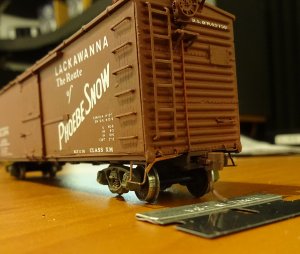
almost all the new cars and locos I have bought "ready to run" suffer from coupler-droop. They snag on switch frogs unless I shim the trucks and rebuild the coupler boxes. My simple gauge is this common razor blade. If the car cannot roll over the fat part of the blade without contact I won't put it on the track. This all assumes RP-25 wheel flange dimensions - no old style "pizza-cutter" cheap plastic wheels.

COUPLER-TEST.jpg
 
Detz:

One uncommon problem I seen on my layout was the turnout was not completely level and had a slight rise in the turnout at the frog which cause derailments. Rolling stock didn't derail nor all locos. I retplaced the turnout and I believe the problem was a manufacturing defect.

Also, check the gap on the frog rails, could be a clearance problem.

Thanks.

Greg


I would agree...you need an NMRA track/wheel gage, AND, presuming your rolling stock has Kaydee or similar couplers, a Kaydee coupler gage. If your local hobby shop doesn't have these, you can order them from Walthers. Second, I would turn your locomotive around and run it backwards across that turnout. If it stalls with the driving wheels at the same spot, then it may well be poor electrical pickup. If these are Atlas turnouts, the likelihood is you will have to replace the turnout, especially if a similar Atlas turnout does not cause the problem. Another thing to try, to see if it is the coupler actuation pin (aka the "gladhand"), is simply to push the locomotive through the turnout by hand, with the power off. (It will slide on the rails. Once or twice will NOT hurt anything.) If you feel the loco hang up at some point, you can check if it is the coupler pin. You can bend the coupler pins up a bit to clear the track. (Micro-Mart has a special pliars with a curved jaw that is designed to bend these coupler pins.)

 
The loco wheels continue to turn, i.e. slip when the loco is in the turnout while going straight through it. When it comes from the diverging track, it doesn't hang up because the push rod cylinders don't reach far enough to drag on the solenoid box. I think the drag line of the push rod cylinder can be seen along the edge of the solenoid box.
Have you checked the clearance between the solenoid box and the push rod cylinders? Have you come back to check your thread on this issue?
 
As you've raised that point before Ken, I was prompted to have several more looks at that video. It seems the loco sticks at a point where the wheels would be just contacting the hinge of the point rails and it's approaching from the straight through track. At the last part of the vid where the loco passes through from the diverging track, the turnout hasn't even been switched, it's still in the straight through position and remains there even after the loco has passed through??????
 
And yes, he doesn't seem to have been back to check the answers. A bit of a habit developing?
 
When ya watch the video, the loco moves forward very slowly as the wheels slip. If the coupler pin was hooked on something, it would "stop" the train. If the moving rails of the turnout were out of gauge, the loco would lift up or drop down and derail and you would see the rocking of the loco as it left the rails. The wheels continue to roll even though the loco is moving forward very slowly for a moment there and when the push rod cylinders reach the end of the solenoid box, the loco resumes its speed.
 
It's certainly not loosing electrical contact, and whatever is resisting needs closer examination while it is to find out what. A bit of close, careful observation needed.
 
Looking at the video several times, it seems to me that the locomotive is getting high-centered...sometimes. This could be due to either, a) the top of the frog or other part of the turnout sticking up a bit, or b) something on the bottom of the locomotive is hanging down. I had a diesel loco that had the bottom of the plastic truck gear box cover that was just a tad too low, and a turnout frog that was sticking up just a tad too high. I sanded a little amount off the bottom of the truck, and haven't had a problem since. The engine would not completely stop, but would hesitate just enough to be visible. I also seated the nail holding the frog to the sub-roadbed just a little. That helped.
 
having built lots of complex track work, they key is always....smooth track, no dips, lumps or bumps. A dip in the middle of this turnout will raise the driver wheels. A warp of the switch if the selenoid gets raised may bump the engine. You have to get your eyes down level with the track and watch the action as the engine moves over. I've had to sole lots of issues in slow motion, including a short on an engine only on a curve. (side rod hitting driver, spacer fixed)
 
look for front steps on the engine hitting the selenoid. Other issues, narrow guard rails squeezing the wheels. NMRA gauge finds that quick. Run your engine the other way, same thing? I've had low front steps also, having to bend the chassie up or something to raise them.


And yes, he doesn't seem to have been back to check the answers. A bit of a habit developing?

Hmm, maybe he found the answer and doesn't need the help or advice any longer...? Perhaps he is ill and just hasn't been on. There is another option, but that wouldn't be a nice thing to suggest.


Affiliate Disclosure: We may receive a commision from some of the links and ads shown on this website (Learn More Here)

Back
Top