Keeping locos on the table

ModelRailroadForums.com is a free Model Railroad Discussion Forum and photo gallery. We cover all scales and sizes of model railroads. Online since 2002, it's one of the oldest and largest model railroad forums on the web. Whether you're a master model railroader or just getting started, you'll find something of interest here.


Resqnu

Member
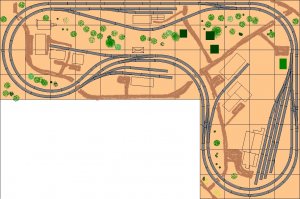
I want to install something around the edge of the table in case of a derailment. Areas of the outer track are close to the edge and I don't want $$ locos crashing to the floor. My initial thoughts are thin plexiglass or some type of wood mounted 1"-2" high would keep the locos on the track. I want to keep it low, so not to block my son from interacting with the track. I'm attaching my layout so you can see the outer tracks near the edge. Anyone have any ideas??
 

Attachments

  • RESQNUv2 w scenery.jpg
    RESQNUv2 w scenery.jpg
    294.8 KB · Views: 310
I use Masonite inside the tunnels of my layout so in the unlikely event of a derailment or collision of some sort inside the tunnel, the trains don't go to the floor. Using Plexiglas may be more of a problem than you think. It's difficult to work with, i.e. drilling or cutting and if you use the thinner stuff, it can crack or break with little pressure from the kids hanging on it or leaning against it. For some reason, kids love to hang onto the edge of tables or layouts and hand from it.
The height of the barrier doesn't have to be more than an inch unless you are running your trains at a scale 200mph or more where momentum carries them over a 2" high barrier. Usually on a derailment where the train is being pulled, the cars will just drag the derailed truck along until you notice it. If the train is being pushed, the cars will accordion to the point where the loco won't move anymore if the cars push up against an obstruction. I'm sure there is the rare instance where cars push up and over a barrier but for the most part, they just stop.
 
Thanks, I can see the cons of using plexiglass. I'm glad to see that I only need 1" height, as I don't want the edge too high. I will look into Masonite. Mainly trying to keep the Locos from falling.


Sent from my iPhone using Tapatalk


I use plexiglas with no problems when you drill holes go slow and not to close to the edge 1/2" away atleast drill a little bit bigger then the screw and dont over tighten, thats when you will crack it.I use small rubber or nylon washers between the screw and plexi. it looks a lot nicer then wood or masonite.
 
We use plexiglass at the club and it is quite durable. Just follow the above suggestions for mounting. We also have public open houses and seldom lose any pieces to kids.
 
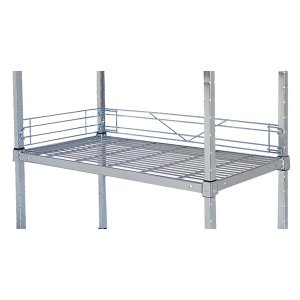
Something a friend of mine uses is the chrome edge strips from store shelves. A local K-Mart refitted their entire store and he bought a ton of it to go around his layout. It sits about 2-1/2 inches high and you can see right through it because it's made of a wire frame. I've attached a picture for reference. You'd need to figure out how to attach it to the layout, but it's very sturdy and much more durable than plexiglass would be. It can be found online too, just do a google search for shelf ledge or shelf edge.
ledge.jpg
 
You can use 3/16" thick plexi and will find it plenty strong. As it must reach higher above the operating surface, it must also be thicker, so 3/16" should not be used above about 10" high above the nearest rails or structures.

I will probably use plexiglass at some point to front the needed protection on my yard module. It will be clamped and drilled, and held into place by the same short wood screws that support the fascia.


My method is unorthodox, but scenically effective.
At the areas where the track is perilously close to the edge, I simply build a berm out of plaster, and cover it with grass and shrubs/trees. Trains will hit the berm, and ride along it until they grind to a halt. If you do it right, it looks like the track is in a small cut with a ditch between the ballast and the berm.
 
That's what I do Gomez, put scenery if you can you and most of the time I never run my trains fast enough to derail that's not saying they won't. Hope that help's.

Chris,
 
My method is unorthodox, but scenically effective.
At the areas where the track is perilously close to the edge, I simply build a berm out of plaster, and cover it with grass and shrubs/trees. Trains will hit the berm, and ride along it until they grind to a halt. If you do it right, it looks like the track is in a small cut with a ditch between the ballast and the berm.

I like this idea.
What material can be used for creating a small Berm? Some places I only have an 1"-1/2 from the edge. Looking for something thick enough to build up the edge applying with a putty knife or the like. I don't run mine fast enough to fall of the table if/when then derail either. Just want a safety just incase. Don't want to see a $$ loco hit the floor.


Sent from my iPhone using Tapatalk
 
Resqnu:

I've not seen this idea mentioned, but you could copy the D&RGW narrow gauge system practice by installing one guard rail on the outside of the outside running rail on certain curves. To me they look kinda cool too. And if I remember correctly these guard rails are generally rust/dust-colored (no traffic on them).

DougC


Affiliate Disclosure: We may receive a commision from some of the links and ads shown on this website (Learn More Here)

Back
Top