
Is it common to find stock in different paint schemes?

ModelRailroadForums.com is a free Model Railroad Discussion Forum and photo gallery. We cover all scales and sizes of model railroads. Online since 2002, it's one of the oldest and largest model railroad forums on the web. Whether you're a master model railroader or just getting started, you'll find something of interest here.


Warpiper

Member
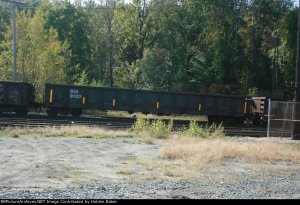
Is it common to find rolling stock of a rail road in a different paint schemes not of its own? I ask because as I start collecting rolling stock (mostly from eBay) I like to research them and see what the history is behind them. I lean towards the Boston and Maine, 70's-80's paint scheme (blue) but recently came across an orange gondola, BM 9023. Reading several websites, the the gondola's colors could be black or gray depending on when they were in service but never saw where they might be orange. The first picture is of the orange gondola on eBay and the second picture is of the actual gondola taken back in 2011.

BM 9023 gondola HO.jpg

BM 9023 gondola.JPG


Oh, I'd also like to ask if models like the TM State Collection cars, the Kellogg cars, the Baby Ruth cars, and others ever existed in real life or if they were just made for novelty/collecting purposes. Haven't found any information on that yet but I could see them as mobile billboards. Thanks.
 
I'm not up on how the Boston and Maine operated; but, is it possible that the orange was their chosen color for Maintenance of Way equipment?
 
Sure, railroads changed paint schemes at various times and different runs of cars might have different schemes.

The MP had two runs of 65 ft mill gons, one in red and one in black with white grabirons (completely non-standard). They were all built at the same plant in Mexico. Why the two colors? The NdeM railroad owed the MP money (for horsepower hours for using MP engines) so they paid back the MP in gondola cars. The NdeM was buying the same type of gon that the MP was buying so they diverted part of a run to the MP. The NdeM colors were black with white grab irons, so the gons were is standard MP lettering but NdeM colors.


It is not unusual to find paint scheme for which a particular prototype never painted a given freight car. Sometimes companies paint to provide variety for a model and recoup some production costs and spread it across a variety of paint schemes, some of which may be prototypical and some of which may have never existed in real life, or may have existed but not on that freight car. I prefer to check models against historical photographs these days before buying; that way I can have some assurance that it isn't a fantasy model. If you buy a model on impulse, it may turn out after much research that you'd never find anything in real live ever existed or you might get lucky. Suddenly I'm hearing a quote by Dirty Harry - do you feel lucky? OTOH, it running models that match the prototype closely is not important, and it isn't for some, then it just depends on what you are into.
 
Is it common to find rolling stock of a rail road in a different paint schemes not of its own?
Yes, all the time. And even at the same time. Cars from one paint scheme would be running for years after the next one came out.

Oh, I'd also like to ask if models like the TM State Collection cars, the Kellogg cars, the Baby Ruth cars, and others ever existed in real life or if they were just made for novelty/collecting purposes.
No, in general those were all just painted for novelty purposes. The real railroads have done a few novelty things but they are few and far between. Billboard rail cars were banned by the Interstate Commerce Commission in 1937.
 
Many of the "Reefers" are fantasy paint schemes, but there were also a huge variety of real billboard reefers. As Iron Horseman notes, they were banned in 1937, so if you're sticking to the prototype, you have to lock your layout into the mid to late 1930's or earlier.
 
I'm not up on how the Boston and Maine operated; but, is it possible that the orange was their chosen color for Maintenance of Way equipment?

Hi Mark,

Thanks. I'm not sure about the color of maintenance of way equipment but everything I've seen or read so far indicates the colors were black, gray, red with yellow strip for some engines, and blue after the mid 1950's.
 
Sure, railroads changed paint schemes at various times and different runs of cars might have different schemes.

The MP had two runs of 65 ft mill gons, one in red and one in black with white grabirons (completely non-standard). They were all built at the same plant in Mexico. Why the two colors? The NdeM railroad owed the MP money (for horsepower hours for using MP engines) so they paid back the MP in gondola cars. The NdeM was buying the same type of gon that the MP was buying so they diverted part of a run to the MP. The NdeM colors were black with white grab irons, so the gons were is standard MP lettering but NdeM colors.

Hi Dave,

Thanks, that's good to know. I'm not sure what the B&M did but I would love to find out.
 
It is not unusual to find paint scheme for which a particular prototype never painted a given freight car. Sometimes companies paint to provide variety for a model and recoup some production costs and spread it across a variety of paint schemes, some of which may be prototypical and some of which may have never existed in real life, or may have existed but not on that freight car. I prefer to check models against historical photographs these days before buying; that way I can have some assurance that it isn't a fantasy model. If you buy a model on impulse, it may turn out after much research that you'd never find anything in real live ever existed or you might get lucky. Suddenly I'm hearing a quote by Dirty Harry - do you feel lucky? OTOH, it running models that match the prototype closely is not important, and it isn't for some, then it just depends on what you are into.

Hi riogrande,

Thanks. That makes sense. I can see collecting both prototype and fantasy. If I ever get the room I wouldn't mind having both! LOL.
 
Yes, all the time. And even at the same time. Cars from one paint scheme would be running for years after the next one came out.

No, in general those were all just painted for novelty purposes. The real railroads have done a few novelty things but they are few and far between. Billboard rail cars were banned by the Interstate Commerce Commission in 1937.

Hi Iron Horseman,

Thank you for the history lesson, I appreciate it. :) I was kind of half joking about billboards but had no idea that they were banned. Now I'm curious to see what some of those billboards looked like.
 
Last edited by a moderator:


Many of the "Reefers" are fantasy paint schemes, but there were also a huge variety of real billboard reefers. As Iron Horseman notes, they were banned in 1937, so if you're sticking to the prototype, you have to lock your layout into the mid to late 1930's or earlier.

Hi Bob,

Thanks. I might just have to model that era once I can get some more room. It would be interesting to have a collection of billboard reefers. :D
 
Billboard rail cars were banned by the Interstate Commerce Commission in 1937.

Well technically they weren't banned, its just that customers didn't have to accept them for loading. Private refrigerator companies and companies with leased cars that were used exclusively in their service continued to use billboard cars (Tropicana, Swift, Armour, Union Carbide, Dow Chemical, grain elevators, etc). Customers complained that Union Refrigerator Co. would paint a car for Budweiser, then spot it for loading at a Miller brewery. Miller didn't want their beer in a Bud car. The ICC agreed with them. After 1937 if URT supplied a Bud car to a Miller brewery, they didn't have to load it, which made the specially painted cars not very useful. On the other hand, Swift owned their own reefers and so the only thing loaded in a Swift car was Swift products so they were happy with the advertising. Union Carbide owned a fleet of covered hoppers and so advertised Union Carbide products on the cars. Because it was their cars that only carried their chemicals, they liked the advertising.
 
We;; technically they weren't banned, its just that customers didn't have to accept them for loading.
Yeah if we really want to get technical, it is governed by Rule 84. I cannot find the 1937 version but here is a copy of the current one, from the 2011 Field Manual of the A.A.R. Interchange Rules. I don't know how much it varies from the original. Plus this only applies to interchange. A railroad or industry can do anything they want to a car that remains on property.

A. Advertisements
1. Cards or banners bearing advertisements or trademarks must not be attached:
a. To Cars
b. To permanent stakes which are part of the car
c. To temporary stakes supplied by shippers, solely for this purpose

2. Cards or banners may be applied as follows:
a. To the lading, providing they are safely secured.
b. To temporary stakes used to secured the lading, providing they are safely secured.
c. Banners and their supporting frames must be securely fastened by bolts, wires, or bands

3. Advertisements of any shipper, consignee, or product, is prohibited on all cars, except special cars of Mechanical Designation "L" and tank cars of Mechanical Designation "T". The name of "home point" of the car owner or lessee, a trade mark, symbol or the name of the car owner or lessee or any part thereof, will not be considered advertising. A trade mark, symbol or logo may be placed or stenciled on sides of any car provided size and location do not interfere with identification of proper reporting marks.
 
Thanks again Dave and Iron Horseman,

That's a lot of good information. Next time I'm out and about, I'll be looking for home point and trade marks/logos. :)
 
I lean towards the Boston and Maine, 70's-80's paint scheme (blue) but recently came across an orange gondola, BM 9023. Reading several websites, the the gondola's colors could be black or gray depending on when they were in service but never saw where they might be orange. The first picture is of the orange gondola on eBay and the second picture is of the actual gondola taken back in 2011.

These BM gondolas WERE in fact painted orange when new (in the 1970s). The black car in the 2011 photo is nearing it's fourth decade in service and has been repainted at least once during its lifetime into a plain black scheme.

Unfortunately at the moment I can only find B&W photos of these cars in original colours online on my typical freight car sources...
 
These BM gondolas WERE in fact painted orange when new (in the 1970s). The black car in the 2011 photo is nearing it's fourth decade in service and has been repainted at least once during its lifetime into a plain black scheme.

Unfortunately at the moment I can only find B&W photos of these cars in original colours online on my typical freight car sources...

Hi Chris,

Thank you for the information and for the link to the picture of the orange gondola, I greatly appreciate it. Almost 4 decades in service? That's amazing. The rail road companies are definitely getting their money's worth out of them.
 
We call them Foobies. Paint schemes applied to models that were never used by the railroad they are painted and lettered for. This has been common in the hobby since the 1940's at least. If you want prototype accuracy there is a significant community of Prototype Modelers devoted to bring kits and RTR rolling stock close to the equipment real railroads used with paint schemes for the correct period the model. Google Prototype modelers or find the historical society for the railroad you are interested in. You may have to do a lot of reading and research and buy books sometimes rare, but it can be done.
 
We call them Foobies. Paint schemes applied to models that were never used by the railroad they are painted and lettered for. This has been common in the hobby since the 1940's at least. If you want prototype accuracy there is a significant community of Prototype Modelers devoted to bring kits and RTR rolling stock close to the equipment real railroads used with paint schemes for the correct period the model. Google Prototype modelers or find the historical society for the railroad you are interested in. You may have to do a lot of reading and research and buy books sometimes rare, but it can be done.

Hi Kevin,

Thanks for the great info. I'll look for the prototype modelers. Don't mind the reading and research, I think that is part of the fun and allure. :D


Affiliate Disclosure: We may receive a commision from some of the links and ads shown on this website (Learn More Here)

Back
Top
