Industry ideas that use grain hoppers

ModelRailroadForums.com is a free Model Railroad Discussion Forum and photo gallery. We cover all scales and sizes of model railroads. Online since 2002, it's one of the oldest and largest model railroad forums on the web. Whether you're a master model railroader or just getting started, you'll find something of interest here.


Hi,
I am building a modern era HO scale switching layout and I am trying to decide what I want for my 2 final industries, and I would like at least one of them to receive grain hoppers. My layout is a shortline in a fictional mid-sized, Midwest type city. I love grain hoppers and have quite a few collected but I can't think of an industry that would receive grain hoppers. Both industry spots only have 1 track. One about 2 ft. long, and the other about 3 ft. long. I know one commodity that is shipped in grain type hoppers is bentonite. Can anyone give me any realistic ideas? I do have a transloading spot and a team track planed so plausibly having grain type hoppers there can also work.
Thanks for any assistance!
 
If you mean grain hoppers, they probably carry grain. If you mean covered hoppers, they carry any granulated material that needs protection from the weather. The cars are sized to the density of the material they haul. Cement is very dense so will be in shorter 2 bay car. Plastic pellets are very light and will be in the largest covered hoppers. Put "covered hopper cargo" in your favorite search engine and see what comes up.

For example: https://www.infinitytransport.com/railcars/covered-hoppers/


If you're specifically referring to "grain hoppers", flour mills receive wheat, animal feed processors receive primarily corn, and Ethanol processors receive corn. As Paul posted, short "covered hoppers" can carry cement or sand, medium size ones can carry sugar, and the longest can carry plastic pellets, fertilizer, or spent grain hulls from flour mills and other food processors. These are just a few uses, there are many others.
 
Hi,
I am building a modern era HO scale switching layout and I am trying to decide what I want for my 2 final industries, and I would like at least one of them to receive grain hoppers. My layout is a shortline in a fictional mid-sized, Midwest type city. I love grain hoppers and have quite a few collected but I can't think of an industry that would receive grain hoppers. Both industry spots only have 1 track. One about 2 ft. long, and the other about 3 ft. long. I know one commodity that is shipped in grain type hoppers is bentonite. Can anyone give me any realistic ideas? I do have a transloading spot and a team track planed so plausibly having grain type hoppers there can also work.
Thanks for any assistance!
Pic of local frack sand operation. Note variety of cars used. Sand came in from Wisconsin on semi trailers and was loaded here into covered hoppers.

Untitled 1.png


This is located in North Branch, Minnesota, on the Skally line. Connects to the BNSF. This track used to be Northern Pacific, ran right by the home of my youth.

Untitled 2.png


Dave LASM
 
If you want to give your train crews or facility staff, a challenge, ship the wrong material in the wrong car and see if it's processed. :oops: :oops:🤣
 
One idea I always thought of trying is a large scale commercial bakery. Grain, flour, rice hoppers, tank cars of different oils for baking, sugar or corn syrup and box cars to move product to market. Many would need to be spot specific within the bakery so lots of action for the model railroader
 
One idea I always thought of trying is a large scale commercial bakery. Grain, flour, rice hoppers, tank cars of different oils for baking, sugar or corn syrup and box cars to move product to market. Many would need to be spot specific within the bakery so lots of action for the model railroader
I actually do have a bakery planed. Two car spots for grain cars bringing in grain to turn into flour. I don't have any airslide hoppers which is what flour is shipped in. I have 3 boxcar spots for shipping in ingredients, and 1 car spot for a tank car shipping in vegetable oil.


If you mean grain hoppers, they probably carry grain. If you mean covered hoppers, they carry any granulated material that needs protection from the weather. The cars are sized to the density of the material they haul. Cement is very dense so will be in shorter 2 bay car. Plastic pellets are very light and will be in the largest covered hoppers. Put "covered hopper cargo" in your favorite search engine and see what comes up.

For example: https://www.infinitytransport.com/railcars/covered-hoppers/
The hoppers I have are medium-large smooth and ribbed sided hoppers.
 
The hoppers I have are medium-large smooth and ribbed sided hoppers.
They are most likely grain hoppers then. On my layout, 2-bay short covered hoppers (35 scale feet) are for cement or sand; 3-bay covered hoppers (54-56 scale feet) are for grain and the larger 4 & 5-bay covered hoppers (60 scale feet +) are for fertilizer and plastic pellets. If you wanted to get real technical, compare the cu.ft. capacity to the net weight capacity printed on the hoppers and look up specific wts/cu ft via Google or other search engine.
3-bay covered hoppers seem to be most common around here because I see a lot of export grain traffic headed for Houston to go overseas. Here they are mostly rib-side and smooth side hoppers, but pictures from up north, specifically near Canada, show a lot of cylindrical covered hoppers labeled for companies that ship grain. Airslide covered hoppers have piping underneath to allow compressed air to assist in unloading products like flour. I also see a lot of plastic pellet hoppers moving back & forth from the petrochemical industries also located near Houston.
 
I have been doing some research, and I was wondering about a shingle factory. I could have a spur that could handle 2 50ft. boxcars, 2 covered hoppers, and a spot for a tank car. The covered hoppers would haul roofing granules. The only possible hiccup would be that it looks like the granules might be hauled only in 2-bay vs. 3-bay hoppers
 
Here are a few thoughts regarding covered hoppers.
I have been doing some research, and I was wondering about a shingle factory. I could have a spur that could handle 2 50ft. boxcars, 2 covered hoppers, and a spot for a tank car. The covered hoppers would haul roofing granules. The only possible hiccup would be that it looks like the granules might be hauled only in 2-bay vs. 3-bay hoppers
Unless your industries intend to pay a demurrage fee to the railroads, you gotta have a place to store the materials received. It would have to be a pretty big shingle factory to use 2 covered hoppers worth of roofing granules. Of course that could be represented by a backdrop industry, but it would be tough for a stand-alone one.
I actually do have a bakery planed. Two car spots for grain cars bringing in grain to turn into flour. I don't have any airslide hoppers which is what flour is shipped in. I have 3 boxcar spots for shipping in ingredients, and 1 car spot for a tank car shipping in vegetable oil.
Bakeries usually don't mill their own flour.

Here are some specific ideas taken from my layout regarding industries that use grain:
1) Flour Mill. Inbound grain hoppers containing wheat. Outbound Airslide hoppers for the flour, and a larger covered hopper for the spent wheat hulls and debris, eventually to ship to animal feed processors. Could also be a cornmeal processor.
2) Animal feed processors. Inbound grain hoppers containing mostly corn and soybeans; inbound boxcars with packaging materials. Outbound boxcars containing bagged feed on pallets.
3) Cereal manufacturers. Inbound grain hoppers containing corn, rice or wheat; smaller 45' covered hoppers containing sugar; inbound boxcars containing packaging materials. Outbound boxcars with Corn Flakes, Rice Krispies or Wheaties. Rice Krispies also would need corn oil shipped in via tank cars.
4) A bakery would need inbound Airslide hoppers for flour, sugar in covered hoppers and corn oil in tankers, as well as boxcars for packaging materials. Outbound shipments generally go by truck. Note that corn oil or syrup is especially heavy and is generally shipped in tank cars in the 35'-40' length.

Undoubtedly there are other industries that I haven't covered. Peanuts is a good example.

You posted "modern" in your initial post, but you mentioned the sidings are short. A modern grain elevator is rather large and would require a long siding or a loop loading track, and a Trackmobile or their own switcher to shunt cars through. If your time frame was in the 70's, smaller grain elevators still existed and a 3' siding might be appropriate.

Thinking outside the box is certainly part of this hobby, but covered grain hoppers does limit one to primarily grains.
I hope that this information helps.
 
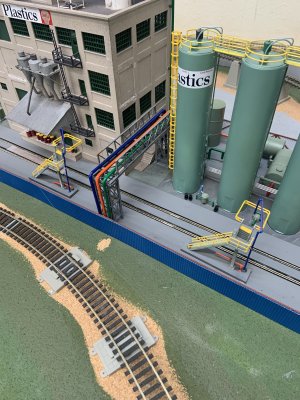
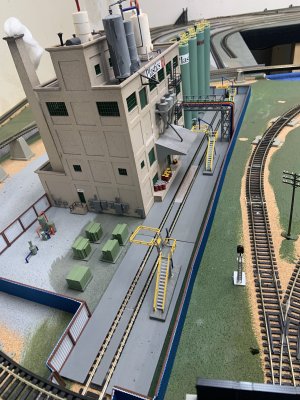
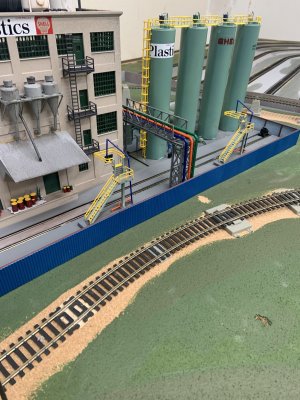
I modeled a plastic pellet plant.
 

Attachments

  • IMG_0854.jpeg
    IMG_0854.jpeg
    600.6 KB · Views: 208
  • IMG_0856.jpeg
    IMG_0856.jpeg
    627.8 KB · Views: 231
  • IMG_0855.jpeg
    IMG_0855.jpeg
    565 KB · Views: 195
  • Like
Reactions: kjd
Here are a few thoughts regarding covered hoppers.

Unless your industries intend to pay a demurrage fee to the railroads, you gotta have a place to store the materials received. It would have to be a pretty big shingle factory to use 2 covered hoppers worth of roofing granules. Of course that could be represented by a backdrop industry, but it would be tough for a stand-alone one.

Bakeries usually don't mill their own flour.

Here are some specific ideas taken from my layout regarding industries that use grain:
1) Flour Mill. Inbound grain hoppers containing wheat. Outbound Airslide hoppers for the flour, and a larger covered hopper for the spent wheat hulls and debris, eventually to ship to animal feed processors. Could also be a cornmeal processor.
2) Animal feed processors. Inbound grain hoppers containing mostly corn and soybeans; inbound boxcars with packaging materials. Outbound boxcars containing bagged feed on pallets.
3) Cereal manufacturers. Inbound grain hoppers containing corn, rice or wheat; smaller 45' covered hoppers containing sugar; inbound boxcars containing packaging materials. Outbound boxcars with Corn Flakes, Rice Krispies or Wheaties. Rice Krispies also would need corn oil shipped in via tank cars.
4) A bakery would need inbound Airslide hoppers for flour, sugar in covered hoppers and corn oil in tankers, as well as boxcars for packaging materials. Outbound shipments generally go by truck. Note that corn oil or syrup is especially heavy and is generally shipped in tank cars in the 35'-40' length.

Undoubtedly there are other industries that I haven't covered. Peanuts is a good example.

You posted "modern" in your initial post, but you mentioned the sidings are short. A modern grain elevator is rather large and would require a long siding or a loop loading track, and a Trackmobile or their own switcher to shunt cars through. If your time frame was in the 70's, smaller grain elevators still existed and a 3' siding might be appropriate.

Thinking outside the box is certainly part of this hobby, but covered grain hoppers does limit one to primarily grains.
I hope that this information helps.
Thanks for the info. All of my industries are only going to have a small part modeled with the majority being beyond the backdrop or into the aisle since my shelves are no more than 20" wide.

I figured that bakeries would usually make their own flour, but I am not worried about being 100% accurate. I want my industries to be plausible. For example, one of my industries is based on where I work, Rainbow Play Systems. We used to bring in lumber via centerbeam flatcars but now ship in via truck. Boo hoo. We ship in plastic slides from a couple different places, and looking at google earth, one place does have a siding for bringing in plastic pellets. So I have a spot for lumber, plastic pellets, and for shipping out via boxcars.

My fictional RR is inspired by the Ellis and Eastern RR in Sioux Falls, SD. Larger cities like Sioux Falls don't have elevators or feed mills any more since farmers usually ship grain to small town elevators. Also, feed mills prefer to be closer to the animals they feed and not in a large urban area. (Or at least South Dakota considers a large urban center). Sioux Falls used to have a major feed mill, Zip Feed, but it was blown up about 20 years ago. Then the rest of it was torn down since the demolition team underestimated the strength of the building and it only collapsed part way.
I need an industry that would only need a few cars on a single siding with what space I have left. Maybe a pet food company?
 
Last edited:


Affiliate Disclosure: We may receive a commision from some of the links and ads shown on this website (Learn More Here)

Back
Top