How can I avoid problems with track expansion?

ModelRailroadForums.com is a free Model Railroad Discussion Forum and photo gallery. We cover all scales and sizes of model railroads. Online since 2002, it's one of the oldest and largest model railroad forums on the web. Whether you're a master model railroader or just getting started, you'll find something of interest here.


conrailocs

New Member
I live in Pennsylvania and we have temperatures well into the 80's during the summer and will have a high of 2 degrees on one day this week. With this change in temperature I've noticed that on the HO railroad I'm building with my dad a few sections of track will expand/contract during certain parts of the year and cause a kinks which could easily derail a train and look absolutely horrible. As I build a HO layout in my room which is next to an attic (causing the temperature to really change between seasons) I want to avoid this problem. I've heard people say that you just "cut gaps" but I'd appreciate it if someone would explain this further so that I, building my first layout, can understand the step by step process and reasoning of this method or present another solution. Thanks!
-conrailocs
 
Heat is actually a smaller part of the problem than is humidity. Your wood doesn't expand a great deal, or shrink, with temperature changes. Your rails do expand, but they only expand about 1/4" over 100' of solid rail (no cuts or joints) with a rise in temps from 32 deg F up to 62 deg F. Four 1/16" gaps over those 100' will take care of any expansion if you have unsoldered joints here and there, say on tangent track.

However, sharp rises in humidity cause your wood to swell, and when it does that it draws the roadbed with it, and if the tracks are ballasted or otherwise well fastened to the roadbed, it will move as well. Those few unsoldered joints, if you have them, will grow to over 1/8" each if your room's humidity rises from 40% to 80% and stays there for five or six days. It takes a while for the wood to absorb humidity, but not weeks.

Okay, so you have a few wider-than-you'd-like gaps, but everything still works and it's still all in line. Now, when the humidity is still at 80%, you decide to extend your layout. You build the benchwork in a morning and lay the roadbed. That afternoon you lay out the rails, and as before, you soldered most curved joints and left most of the tangent track joints free to slide in case of expansion or contraction. However, the next three weeks are very dry, and the new extension shrinks in the now-40% humidity. All your sliding gaps will close up significantly, but your soldiered joints have no outlet for any pressure building up on them. As the surface of the layout shrinks, it wants to draw all the roadbed up into itself linearly, and of course that means the tracks fixed to it begin to go into compression....that builds....and finally the compression overcomes the adhesion and the tracks buckle...up, sideways...

So.............it's mainly the humidity you have to control. I keep a humidistat, a cheap electronic one for $14 had at any hardware store, in my layout. You can get slightly more expensive ones that have a remote sensor. You can be in the house, while out in the building where your layout is, say 20 yards away, the signal between your home unit and the remote sensor in the shed tells you what humidity level you have. If it creeps up higher than 65 in my loft, above my out-building garage, I know to trudge out and plug in the dehumidifier. If it stays in a narrow range near 50%, like it does all wet winter long (defying belief because cool windy wet winters should have high humidity) where I live, I don't need to monitor it except to take a look once a week. Summer time, though, is a different story. Sliding my liftout bridge into place, I can tell when I have been negligent and let the humidity rise too high for too long because it doesn't want to slide down into the gap easily...as it should.

 
Last edited by a moderator:


Hi Conrailocs & Crandel,

Thanks for the question that brought fourth such a great answer!

I have been searching for the maximum acceptable humidity for my train area in my very comfortable basement for months. I even wrote to Lionel for an answer, but all I have gotten is vague answers like this one from Lionel "The least amount of humidity you can keep it at the better. We recommend the engines be ran in a cool dry area whenever possible." What I was doing was if it got above 60%, which is very rare, I would not run my trains.
Thank you Crandell, if you keep your train room below 65% then I will do the same! Do you have any thoughts on the effect of humidity in regards to electronics and electrical circuits involved with model railroading?

Crandell if you ever write a book please let me know, I always enjoy your comprehensive and intelligent posts, thank you.

I hope everybody had Happy Holidays and I wish everyone well in this new year.
 
However, sharp rises in humidity cause your wood to swell, and when it does that it draws the roadbed with it, and if the tracks are ballasted or otherwise well fastened to the roadbed, it will move as well. .


Mostly true, but a little clarification may be useful. Boards do not change in length. That is, like, 2 x 4 or 1 x 6 stock. Since plywood and particle board are a combination of length and width sections, some change will be apparent. Width in lumber is definitely where you will see the most change.

This can be precisely calculated, and is subject to what species of wood and how the board is cut, that is, flat sawn or quarter sawn. Also, the moisture content of the wood, which differs from Relative Humidity.

To get the nitty gritty, check this link: http://www.thisiscarpentry.com/2010/09/03/moisture-content-wood-movement/

Hope this helps, lasm
 
Agreed, lasm, the roadbed has to be largely across the grain, not longitudinally aligned with the grain, for the deleterious effect we are discussing. Wood will swell absorbing water, but it also swells in high ambients...just not as much, or as quickly as it would through capillary action. However, for the modeller who experiences unwanted track changes in geometry, he/she can assume, barring some other unknown phenomenon, and if the room is largely unmonitored and air-conditioned, that it is changes in humidity that have caused the damage, and not likely to be changes in temperature. The latter would happen if the entire track system were essentially monolithic due to solid solders at all joints and the humidity were strictly controlled in a room holding wooden benchwork.

Louis, you are very kind, and also welcome. :)
 
Good of you to ask, individual boards can be bought at Home Deopot or Menards; but I would store them in a dry location in your house for a good month before using. The way they store them at the store, the moisture content could have changed quite a bit from when it was dried.

Somewhere near a heat register, but not right in front of it, if you live in a northern clime.

Specialty and hobby outlets may be reputable. If you walk into a store in Minnesota during winter months and the temp in there is anywhere near 70, the moisture is probably good . If you walk into a store in Minnesota in the summer, and the board has been sitting out, it has probably soaked up some moisture since dried.


lasm
 
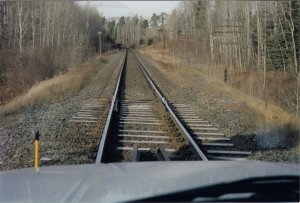
The big guys have this problem too, here's one solution I came across:
Expansion rail.jpg


I did some search on the internet and according to few sources the longitudinal change by humidity should be less than 0.1%. My benchwork is built from 2x4 spf lumber with plywood roadbed on top (its been indoor for a year now) and I am about to layout track this summer with current humidity level in my area ~75%. Do I read this correctly that I'd need to leave 1/32 ... 3/64 gaps between 36" flex track rails to survive winter when indoor humidity will drop significantly?

Thanks,
Slava


Affiliate Disclosure: We may receive a commision from some of the links and ads shown on this website (Learn More Here)

Back
Top