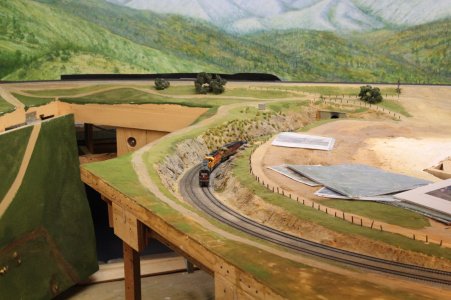
Fighting the sierra grade up to "Dog Soldier Pass" : An ongoing struggle.

ModelRailroadForums.com is a free Model Railroad Discussion Forum and photo gallery. We cover all scales and sizes of model railroads. Online since 2002, it's one of the oldest and largest model railroad forums on the web. Whether you're a master model railroader or just getting started, you'll find something of interest here.


Rocks are definitely a part of the slide problem, and (would if I could or ever get to) model some of those sheds in concrete too.

FWIW, it's also interesting because a (now deceased) former D&RGW "Road Foreman" wrote a book about his experiences (from which I draw more than a little bit of this information), and he called the front plow on the locomotives (at least on the diesels) "rock plows," and not snowplows.

In fact, EMD sold locomotives with two versions of front plows in that era, and those on the D&RGW were the smaller of the two. Those on the SP were often the larger of the two...because of Donner Pass.
Yes correct, I noticed the different plow sizes.
Very visible on photos.
 
I might have asked you before, but I can't remember: Have you ever been to the San Diego Model Railroad Museum? And seen the La Mesa club's rendition of Tehachapi?

If not, you really do want to put that on your own "Bucket List."

In the meantime, there are a lot of videos on Youtube.
Yes I paid a visit in july 2010 during one of my trips through the american west. At the time they were working on the loop.
 
I was something of an unofficial member of the club in the mid 80's. In those days the east end terminated after Tunnel five, and then we ran back down the hill again.

I'm not surprised you've been there before, as your own layout shows "evidence" of older bridges (for one I think--you have a couple of old concrete abutments), and the grade both up and down from "Tunnel One-half" at La Mesa has the remnants of the previous alignment (before the flood). You will obviously know of those if you've spent time there, as you have.

So you might also know of the "shoe-fly" temporary alignment between Tunnel Four and Tunnel Five. I didn't at all myself, but they filled me in on the history of it. Really fine people, all of them.

I'm lucky I got to spend extended time there (twice), a couple of months each, and twice. One of my own fondest memories. Particularly because they let me run trains on the weekends both up and down the hill. Those were "show days," rather than "operations days," so I didn't have to learn the rules to run. All good, since I didn't know many of the rules then either. I've picked up some since.
 
Last edited:


Re: La Mesa again. My train moving east (uphill) was stopped at Caliente. As the rear end of the westbound passed, I had the grade. John Rotsart, the then director of the entire museum, but also one of the founding members of the La Mesa club too was standing right there at the bottom. I was up above the loop, maybe six feet higher...but it was my train. I owned it.

In those days there was no DCC, no throttle steps...just the knob. So I started the train slowly...carefully...to stretch the slack...and then ramped it up a bit through the reverse 180 degree curve and on up the hill.

John watched the whole thing. The meet and pass, and then my start up the hill.

I got it up to about the switchback to the left when he looked up me and said simply "nice start."

Truly the best compliment I ever received on my train-handling skills, even today.

-------------

John was also one of the founding members of the original club, the Northern and Gulf. A small remnant of the original layout sat for years as a display piece, disconnected from everything.

At some point, John, on behalf of the original members, sold that last portion to a guy who wanted to expand upon it for his kids for Christmas. And I was lucky to be there that day when the last part of the original layout went through the double door (we tilted it ninety degrees to get through the door), and then back up to flat again onto the back of a flatbed truck.

So I was there that day to be a part of the final end of a club I never belonged to in the first place...and a larger club I never really belonged to--officially anyway, since I was out of state. A rather unique place to be.

 
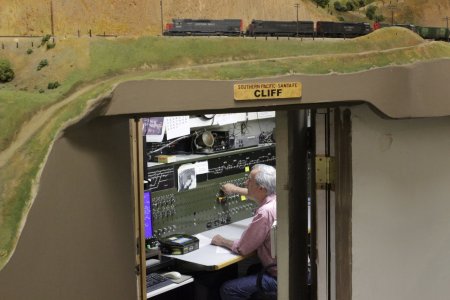
This is the La Mesa dispatcher room, Union Switch and Signal CTC board. Those are black at the top over a military green. The General Railway CTC boards are all black.
 

Attachments

  • La Mesa club dispatcher below..jpg
    La Mesa club dispatcher below..jpg
    212.5 KB · Views: 3
I was something of an unofficial member of the club in the mid 80's. In those days the east end terminated after Tunnel five, and then we ran back down the hill again.

I'm not surprised you've been there before, as your own layout shows "evidence" of older bridges (for one I think--you have a couple of old concrete abutments), and the grade both up and down from "Tunnel One-half" at La Mesa has the remnants of the previous alignment (before the flood). You will obviously know of those if you've spent time there, as you have.

So you might also know of the "shoe-fly" temporary alignment between Tunnel Four and Tunnel Five. I didn't at all myself, but they filled me in on the history of it. Really fine people, all of them.

I'm lucky I got to spend extended time there (twice), a couple of months each, and twice. One of my own fondest memories. Particularly because they let me run trains on the weekends both up and down the hill. Those were "show days," rather than "operations days," so I didn't have to learn the rules to run. All good, since I didn't know many of the rules then either. I've picked up some since.
Well I spent only a couple hours at the La Mesa club, so it was more like an overview than an in detail observation.
But I visited Tehachapi pass twice, back in 1988 and 1991. At the time Walong siding still ended before tunnel 10 west portal.
I also have several old video tapes and DVDs concerning Tehachapi pass, including shots of the shoe-fly building after the earthquake. Now it's an access dirt road.
Books too like John Signor's.
The idea of modeling vestiges of now gone original trackage path didn't come from my Tehachapi visits. I like, when possible, to introduce a sense of history eventhough the layout is freelance.
That's why I modeled remnants of a narrow gauge that originally followed the creek, surrounding the big cuesta through which the twin tunnels were later on pierced. I modeled the abandoned abutments and pier looking like cut stones ones in opposition to the more "concrete" modern ones I modeled else where.

For the same reasons vestiges of an old trestle are still visible crossing Diamond back dry lake just west of US 38 grade crossing at Standing Rock Gap.
Giving a "past" to the layout makes it more real, even for myself.
 
Re: La Mesa again. My train moving east (uphill) was stopped at Caliente. As the rear end of the westbound passed, I had the grade. John Rotsart, the then director of the entire museum, but also one of the founding members of the La Mesa club too was standing right there at the bottom. I was up above the loop, maybe six feet higher...but it was my train. I owned it.

In those days there was no DCC, no throttle steps...just the knob. So I started the train slowly...carefully...to stretch the slack...and then ramped it up a bit through the reverse 180 degree curve and on up the hill.

John watched the whole thing. The meet and pass, and then my start up the hill.

I got it up to about the switchback to the left when he looked up me and said simply "nice start."

Truly the best compliment I ever received on my train-handling skills, even today.

-------------

John was also one of the founding members of the original club, the Northern and Gulf. A small remnant of the original layout sat for years as a display piece, disconnected from everything.

At some point, John, on behalf of the original members, sold that last portion to a guy who wanted to expand upon it for his kids for Christmas. And I was lucky to be there that day when the last part of the original layout went through the double door (we tilted it ninety degrees to get through the door), and then back up to flat again onto the back of a flatbed truck.

So I was there that day to be a part of the final end of a club I never belonged to in the first place...and a larger club I never really belonged to--officially anyway, since I was out of state. A rather unique place to be.
Thank's for the story Snowman, very interesting. Great memories !
I remember in 91 spending a few hours within Caliente curve after crossing at grade the tracks at Bealville !
 
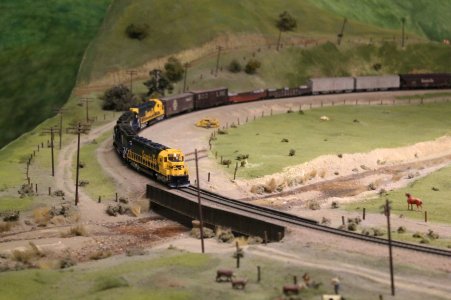
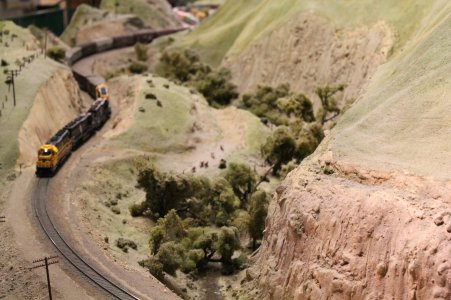
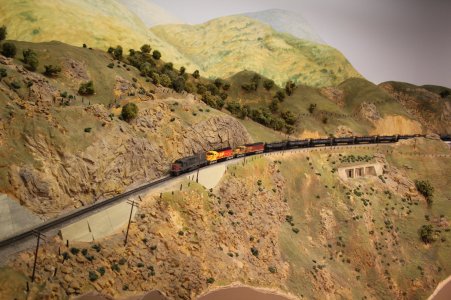
I join some shots, sorry for the quality, I made at the club back in 2010.
 

Attachments

  • USA (1220).JPG
    USA (1220).JPG
    380.2 KB · Views: 5
  • USA (1221).JPG
    USA (1221).JPG
    446.6 KB · Views: 5
  • USA (1228).JPG
    USA (1228).JPG
    560.1 KB · Views: 4
  • USA (1229).JPG
    USA (1229).JPG
    412.2 KB · Views: 5


Affiliate Disclosure: We may receive a commision from some of the links and ads shown on this website (Learn More Here)

Back
Top