
You are using an out of date browser. It may not display this or other websites correctly.
You should upgrade or use an alternative browser.
You should upgrade or use an alternative browser.
Ever Been Disappointed with your Steam Engines Pulling Power?
- Thread starter beiland
- Start date
ModelRailroadForums.com is a free Model Railroad Discussion Forum and photo gallery. We cover all scales and sizes of model railroads. Online since 2002, it's one of the oldest and largest model railroad forums on the web. Whether you're a master model railroader or just getting started, you'll find something of interest here.


The larger locomotive is a 4-6-2 Br.03, the second a 2-10-2 Br.95. Even if they are capable of pulling twice what they do, it would look ridiculous on my layout. It is not large enough for trains as long as that.
Note that the smaller trucks on the bottom car are from the shorter chassis that came from the ConCor engines. I actually prefer these on that size car,...but it does involve making use of the shorter Kato chassis that needs to be lengthened via method I have shown HERE,..
https://forum.mrhmag.com/post/improving-our-steam-engines-performance-12219656?pid=1340416842
https://forum.mrhmag.com/post/improving-our-steam-engines-performance-12219656?pid=1340417160
https://forum.mrhmag.com/post/improving-our-steam-engines-performance-12219656?pid=1340417224
https://forum.mrhmag.com/post/improving-our-steam-engines-performance-12219656?pid=1340418780
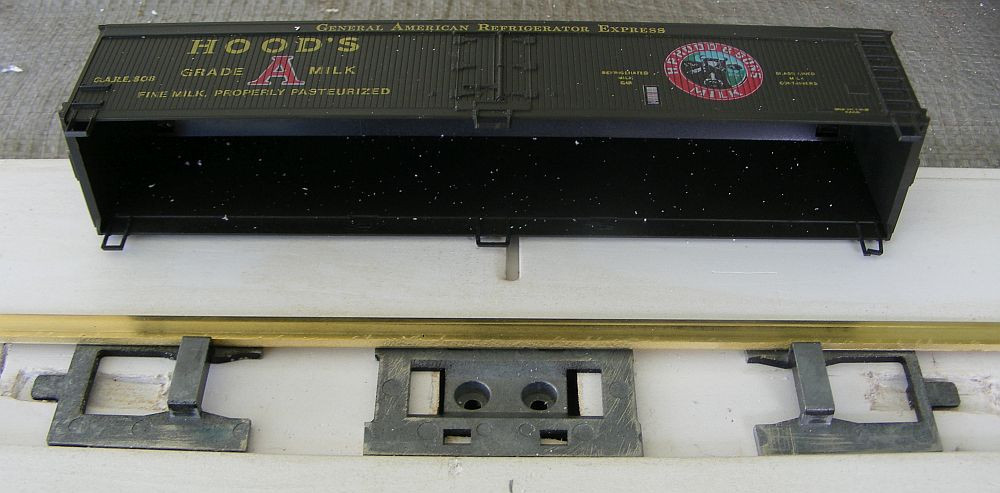
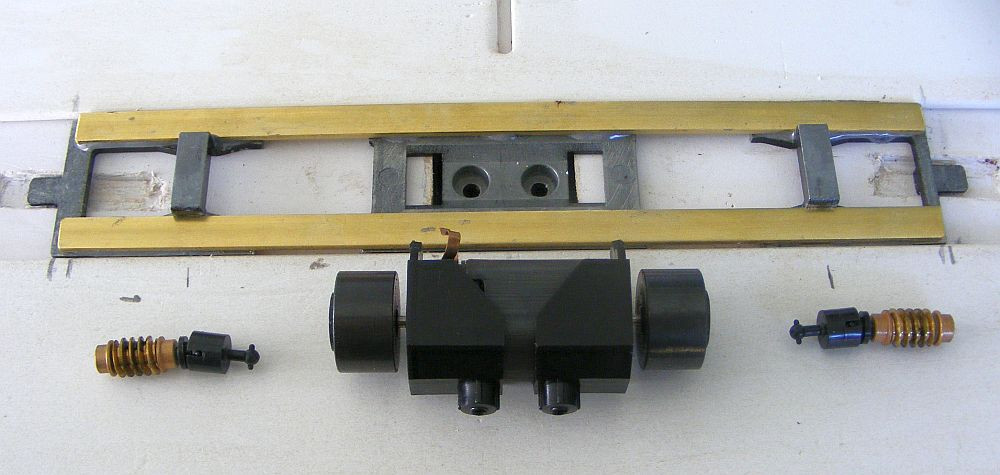
That longer Kato chassis requires no extra lengthening.


BLI does not really need pusher-helpers for their locos, since most have traction tires,....but perhaps that could find a market amoung other brand owners? (and bring other buyers into their product line)?
And perhaps it would be a very reasonable creation cost for them to create such a product, since they already have some really good shells to utilize on them,....the REA frieght cars, and perhaps their excellent aux water tender.

Affiliate Disclosure: We may receive a commision from some of the links and ads shown on this website (Learn More Here)
RhB Michael
RhB Lokführer
Not disappointed at all with locomotives from TRIX and Piko. The two I have will pull seven 303mm wagons up a 3.5% grade without breaking a sweat.
Traction tires.
Traction tires.
What are the wheel configurations on those 2 locos?
What if I told you I might be able to double that capacity,..and/or that Roco might have already done it with a 2-10-0 loco?
Added a link
What if I told you I might be able to double that capacity,..and/or that Roco might have already done it with a 2-10-0 loco?
A little over a year ago I discovered these 2 Roco steam engines in my inventory.
bought a couple of Roco steam engines a few months ago,....to run some experiments with my 'pusher/helper' ideas. It's opened my mind up to a new way to design steam engines, not only European ones, but even our American models.
First thing I did was take the engine portion (boiler,drivers,et) out of the box and put it on the track. It was amazing rolling this engine along the track,..silky smooth,..no binding whatsoever of the connecting side rods, and of course being without a motor,..no...
- beiland
- articulated steam
- Replies: 19
- Forum: Locomotives and Rolling Stock

Added a link
Last edited:
D&J RailRoad
Professor of HO
your locos sweat?Not disappointed at all with locomotives from TRIX and Piko. The two I have will pull seven 303mm wagons up a 3.5% grade without breaking a sweat.
Traction tires.
RhB Michael
RhB Lokführer
What are the wheel configurations on those 2 locos?
What if I told you I might be able to double that capacity,..and/or that Roco might have already done it with a 2-10-0 loco?
A little over a year ago I discovered these 2 Roco steam engines in my inventory.
bought a couple of Roco steam engines a few months ago,....to run some experiments with my 'pusher/helper' ideas. It's opened my mind up to a new way to design steam engines, not only European ones, but even our American models.
First thing I did was take the engine portion (boiler,drivers,et) out of the box and put it on the track. It was amazing rolling this engine along the track,..silky smooth,..no binding whatsoever of the connecting side rods, and of course being without a motor,..no...
- beiland
- articulated steam
- Replies: 19
- Forum: Locomotives and Rolling Stock
Added a link
The larger locomotive is a 4-6-2 Br.03, the second a 2-10-2 Br.95. Even if they are capable of pulling twice what they do, it would look ridiculous on my layout. It is not large enough for trains as long as that.
WHY would I be pursing this project ????,....perhaps just a bit of my history.
A few years ago I experienced some problems with the pulling power of some of the steam engines I had. And in my reading of numerous forums I saw where other folks had experienced the same with some of their steamers. So like some have suggested why not double-head them, or add some sort of other pusher,...perhaps a diesel engine one.
That's what I did back in 2021,..
Pusher/Helper
Back to the pusher/helper idea.
I had been using that DL109 behind the steamers, and very successfully. What smaller engine could i be using?
I happen to have a pretty heavy little switcher engine in my inventory,...an Alco S2 by Atlas,...but could this really substitute for the DL109. (Edited; that may have been a Kato NW2)
WOW, it did a great job. First I put it behind that Bachmann Northern,..
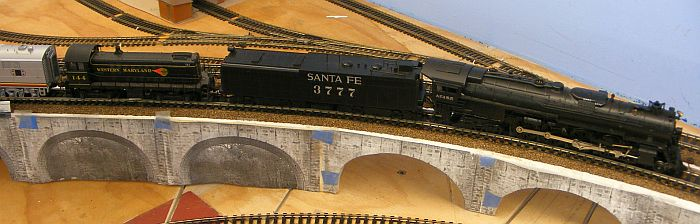
Then behind one of my Mehano mountains,..just plain DC
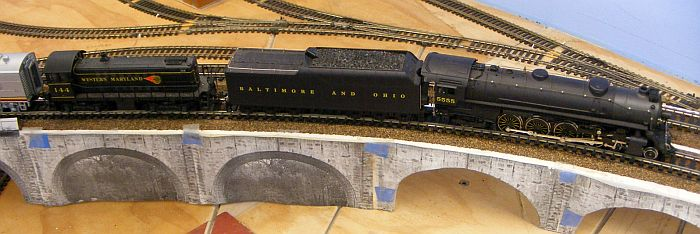
I was really pleasantly surprised. This little Alco diesel model did a great job. I was pulling 20 car trains up the more difficult ramp side of my viaduct,....4.5% grade. It turns out to have a diecast frame that gives it superb weight.
I went onward to try this little diesel by itself. It couldn't quite make it, but it came close.
I then decided to get one of my Bachmann mountains out for a try. A slight problem arose here due to the Bachmann having a DCC decoder installed, so matching the speeds with the pure DC S2 needed a bit more attention. But it also worked extremely well. (BTW I tried the Bachmann mountain by itself, and was pleasantly surprised at its performance. Double heading these Bachmann mountains will definitely be on my list).
I'm convinced that a likely solution for pushing a lot of my steam engines is disguise one of these Atlas switchers into a aux water tender. Sure would save LOTS of custom efforts at adding extra weights to that variety of steamers.
That was posted over here, https://forum.mrhmag.com/post/improving-our-steam-engines-performance-12219656?pid=1331406912
Next came this suggestion from the Prof
Then Rob in Texas added this,..
How could I ignore these suggestions, and my own experimentation?? I was off on a quest to find the best 'pusher-helper' chassis I might find,.... that already existed,....and a way to disguise it.
A few years ago I experienced some problems with the pulling power of some of the steam engines I had. And in my reading of numerous forums I saw where other folks had experienced the same with some of their steamers. So like some have suggested why not double-head them, or add some sort of other pusher,...perhaps a diesel engine one.
That's what I did back in 2021,..
Pusher/Helper
Back to the pusher/helper idea.
I had been using that DL109 behind the steamers, and very successfully. What smaller engine could i be using?
I happen to have a pretty heavy little switcher engine in my inventory,...an Alco S2 by Atlas,...but could this really substitute for the DL109. (Edited; that may have been a Kato NW2)
WOW, it did a great job. First I put it behind that Bachmann Northern,..

Then behind one of my Mehano mountains,..just plain DC

I was really pleasantly surprised. This little Alco diesel model did a great job. I was pulling 20 car trains up the more difficult ramp side of my viaduct,....4.5% grade. It turns out to have a diecast frame that gives it superb weight.
I went onward to try this little diesel by itself. It couldn't quite make it, but it came close.
I then decided to get one of my Bachmann mountains out for a try. A slight problem arose here due to the Bachmann having a DCC decoder installed, so matching the speeds with the pure DC S2 needed a bit more attention. But it also worked extremely well. (BTW I tried the Bachmann mountain by itself, and was pleasantly surprised at its performance. Double heading these Bachmann mountains will definitely be on my list).
I'm convinced that a likely solution for pushing a lot of my steam engines is disguise one of these Atlas switchers into a aux water tender. Sure would save LOTS of custom efforts at adding extra weights to that variety of steamers.
That was posted over here, https://forum.mrhmag.com/post/improving-our-steam-engines-performance-12219656?pid=1331406912
Next came this suggestion from the Prof
Prof_Klyzlr Nov 24, 2021
Replacement sideframes
Dear Brian,
The original Atlas S-series switchers were largely metal, and are standouts in haul capacity. Few contemporary switcher models can match them for "out if box" weight and adhesion. The Kato NW2 might go close?
As for "sneaky sideframes", the Atlas S-series were offered with AAR switcher trucks, which are more "visually non-descript" than the Alco "Blunt trucks". AAR trucks also can be mistaken (from a distance) as express baggage trucks under a boxcar, esp in earlier steam and transition eras
Then Rob in Texas added this,..
I just read through this thread and considered some things that will work for me. I will be building a layout with prototypical grades. Nothing above 1.5 percent and minimum radius of 43 inches scale is HO. I have done some experimenting and found the 2-6-6-6 locomotives to be poor pullers compared to the real thing. There have been lots of good points made about ways to improve this. There have been several comments about why it is not needed because most modelers run 12 car trains or similar points.
This was run after using bullfrog snot and I decided it was unacceptable due to its tendency to clean the rails.
I have discovered that all Steam locomotives are not created equal. I added some weight to some Broadway Limited 2-10-4s and found that they became excellent pullers with out traction tires. As to prototype comparisons the 2-6-6-6s were used in the same territory as the 2-10-4s and pulled the same size trains. It seems to me that pairing a 2-10-4 as a pusher or lead engine and a 2-6-6-6 on the opposite end of the train would be the path of least resistance to sending 100 car hopper trains over the railroad with out issue. The prototype would send 160 car trains over the line with either locomotive unassisted. Another strong puller is their 2-8-8-2 model. A while back they loaded some flat cars with real bricks to demonstrate their pulling power. One of my fellow club members commented that some of those bricks were chipped....
Point I am making is there is more than one way to skin the cat. A weaker pulling model can be augmented by a stronger locomotive. If the train length is long enough the coupler slack will run in and out between the locomotives as each shoulders a different portion of the load and it changes due to the dynamics of the rail line.
Another alternative is the diesel locomotive in the tender shell or a cistern. I am inclined to try this with some models that might not be up to the grade and finding something like an RS1 from Atlas and stuffing it into a 3D printed shell. It might mean adding water bottles to trains that did not normally have them. The advantage is that 2-8-2 might then look good pulling that longer train on the layout and have a much easier time doing so. The mechanism would likely last a lot longer as well.
So the solutions for me add weight if it will work. If it will not work then I will add power in the form of another locomotive, or a powered water car.
How could I ignore these suggestions, and my own experimentation?? I was off on a quest to find the best 'pusher-helper' chassis I might find,.... that already existed,....and a way to disguise it.
Last edited:
Basically I have been a little disappointed at times by the pulling power of some of my MODEL train steamers,...they lack the capabilities and images I have of their prototype brethren.
What if I could buy a RTR powered freight car that I could simply put behind that steam engine and make it more realistic and more powerful. I realize that I could simply use some diesel engine, but I would like to have that diesel camouflaged / disguised as an express freight car.
Express Freight in the Steam/Transition Era
"Wooden express reefers were a fixture of America's long-distance passenger trains from the late 1920s to the 60s. Hustling perishables to distant markets, they also carried mail, packages and nonperishable items. Easily identified by their unique shape and paint schemes, the cars also had heavy steel underframes, special trucks, brake gear, steam lines and signal equipment needed for passenger service. These Walthers models are faithful replicas of the General American Express Reefers seen on virtually every railroad, and look great running with streamlined or heavyweight cars.”
“Iced reefers were common on express and 'limited' passenger trains from the late 90's through to about the end of the Depression. They were always head-end cars, and trains carrying them in the consist were given priority over freight and regular passenger trains. Meat and milk were always prioritized, as was any perishable like fruits and produce, particularly if being delivered to 'high end' markets”
“Nearly every major railroad had express freight trains running by the 1930's. I am familiar only with the SP Overnight services between LA and San Francisco which had specially modified box car equipment including wrought steel high speed wheels were used in specially maintained high speed trucks, passenger signal lines and type E couplers. The box cars were painted in a distinctive black livery with daylight style lettering in daylight orange. There were big time marketing efforts to go with these services. These were run in special trains with distinctive cabooses. SP coordinated the Overnight services with their trucking subsidiary PMT to concentrate shipments origin and support timed deliveries at destination.
To my knowledge the NYC, PRR and B&O/C&O built or rebuilt equipment for high speed service as well for the NYC-Chicago routes. I think the Milwaukee also had a high speed freight service to go with their Hiawatha passenger train services between Milwaukee and Chicago. There were many others throughout the country. Many were geared to attract LCL freight and were competitive until the Interstate highway system made RR LCL unprofitable and slow compared to trucking.”
What if I could buy a RTR powered freight car that I could simply put behind that steam engine and make it more realistic and more powerful. I realize that I could simply use some diesel engine, but I would like to have that diesel camouflaged / disguised as an express freight car.
Express Freight in the Steam/Transition Era
"Wooden express reefers were a fixture of America's long-distance passenger trains from the late 1920s to the 60s. Hustling perishables to distant markets, they also carried mail, packages and nonperishable items. Easily identified by their unique shape and paint schemes, the cars also had heavy steel underframes, special trucks, brake gear, steam lines and signal equipment needed for passenger service. These Walthers models are faithful replicas of the General American Express Reefers seen on virtually every railroad, and look great running with streamlined or heavyweight cars.”
“Iced reefers were common on express and 'limited' passenger trains from the late 90's through to about the end of the Depression. They were always head-end cars, and trains carrying them in the consist were given priority over freight and regular passenger trains. Meat and milk were always prioritized, as was any perishable like fruits and produce, particularly if being delivered to 'high end' markets”
“Nearly every major railroad had express freight trains running by the 1930's. I am familiar only with the SP Overnight services between LA and San Francisco which had specially modified box car equipment including wrought steel high speed wheels were used in specially maintained high speed trucks, passenger signal lines and type E couplers. The box cars were painted in a distinctive black livery with daylight style lettering in daylight orange. There were big time marketing efforts to go with these services. These were run in special trains with distinctive cabooses. SP coordinated the Overnight services with their trucking subsidiary PMT to concentrate shipments origin and support timed deliveries at destination.
To my knowledge the NYC, PRR and B&O/C&O built or rebuilt equipment for high speed service as well for the NYC-Chicago routes. I think the Milwaukee also had a high speed freight service to go with their Hiawatha passenger train services between Milwaukee and Chicago. There were many others throughout the country. Many were geared to attract LCL freight and were competitive until the Interstate highway system made RR LCL unprofitable and slow compared to trucking.”
Last edited:
So I started this subject thread a number of years ago,..
Improving Our Steam Engines Performance
https://forum.mrhmag.com/post/improving-our-steam-engines-performance-12219656
It went on & on about my search for a diesel engine chassis that I might disguise for that task. I was having real problems finding one with trucks of a reasonable size and appearance.
https://forum.mrhmag.com/post/improving-our-steam-engines-performance-12219656?pid=1340379845
https://forum.mrhmag.com/post/improving-our-steam-engines-performance-12219656?pid=1340379894
Some folks even complained about the discussion’s length,...and particularly when I finally discovered those Kato ConCor chassis (2 years later) that I needed to modify and find new driveshafts for.
https://forum.mrhmag.com/post/improving-our-steam-engines-performance-12219656?pid=1340382681
ConCor Switcher Chassis with Kato Drives
https://forum.mrhmag.com/post/concor-switcher-chassis-with-kato-drive-system-1225449
These trucks are MUCH better representatives of those that would be found on express freight or refrigerated cars.
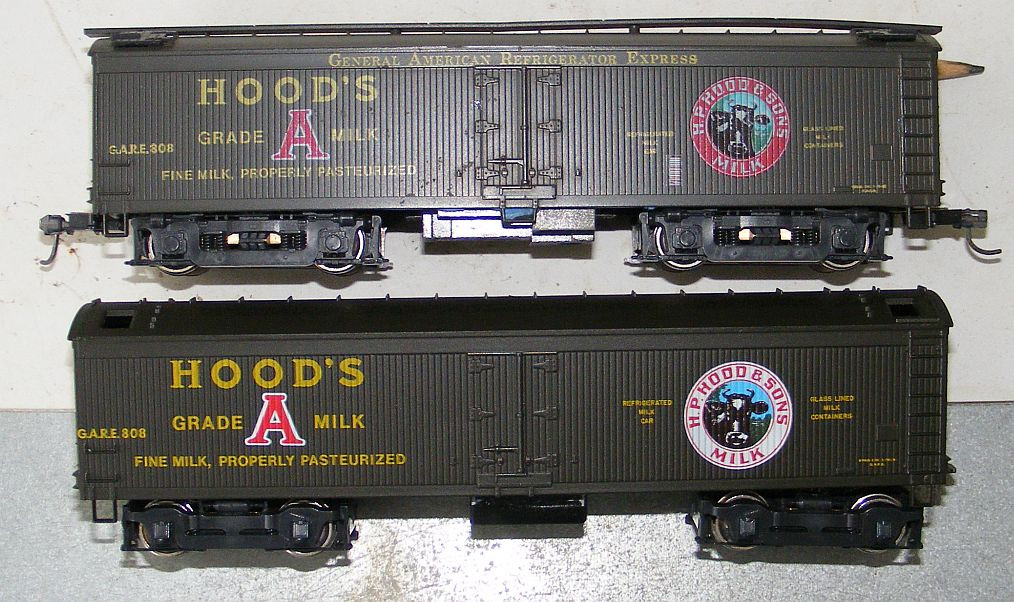
Both of these trucks are on power chassis that are Kato built,...and most of us are appreciative of that brand.
Improving Our Steam Engines Performance
https://forum.mrhmag.com/post/improving-our-steam-engines-performance-12219656
It went on & on about my search for a diesel engine chassis that I might disguise for that task. I was having real problems finding one with trucks of a reasonable size and appearance.
https://forum.mrhmag.com/post/improving-our-steam-engines-performance-12219656?pid=1340379845
https://forum.mrhmag.com/post/improving-our-steam-engines-performance-12219656?pid=1340379894
Some folks even complained about the discussion’s length,...and particularly when I finally discovered those Kato ConCor chassis (2 years later) that I needed to modify and find new driveshafts for.
https://forum.mrhmag.com/post/improving-our-steam-engines-performance-12219656?pid=1340382681
ConCor Switcher Chassis with Kato Drives
https://forum.mrhmag.com/post/concor-switcher-chassis-with-kato-drive-system-1225449
These trucks are MUCH better representatives of those that would be found on express freight or refrigerated cars.

Both of these trucks are on power chassis that are Kato built,...and most of us are appreciative of that brand.
I'm hoping to entice some manufacturer to build some of these pusher-helper express freight cars that we could just buy retail to give a little boost to our steam engines. Perhaps they could offer it just as a chassis, onto which the buyer could place his own particular shell?
And likely it needs to be dcc motor only decoder, so the buyer could get it to run compatible with their powered engine? And if consisting with different locos with a variety of decoders to mate up with presents any problems, then perhaps those buyers might just go ahead and buy several such units that 'belong' (run) with certain steamers? (greater market potential?).
I thought i might first contact Kato with the idea, as they have already produced a usable prototype.
And likely it needs to be dcc motor only decoder, so the buyer could get it to run compatible with their powered engine? And if consisting with different locos with a variety of decoders to mate up with presents any problems, then perhaps those buyers might just go ahead and buy several such units that 'belong' (run) with certain steamers? (greater market potential?).
I thought i might first contact Kato with the idea, as they have already produced a usable prototype.
Both of these trucks are on power chassis that are Kato built,...and most of us are appreciative of that brand.
Note that the smaller trucks on the bottom car are from the shorter chassis that came from the ConCor engines. I actually prefer these on that size car,...but it does involve making use of the shorter Kato chassis that needs to be lengthened via method I have shown HERE,..
https://forum.mrhmag.com/post/improving-our-steam-engines-performance-12219656?pid=1340416842
https://forum.mrhmag.com/post/improving-our-steam-engines-performance-12219656?pid=1340417160
https://forum.mrhmag.com/post/improving-our-steam-engines-performance-12219656?pid=1340417224
https://forum.mrhmag.com/post/improving-our-steam-engines-performance-12219656?pid=1340418780


That longer Kato chassis requires no extra lengthening.
Santa Fe Mechanical Refrigeration Pusher Car
I happen to have 2 SF steam engines that could use a little help,....a Heritage 2-8-8-2, and a Bachmann 4-8-4.
Here is my choice for a pusher-helper refrigerator car for those SF locos,..



I have a couple of versions of that mech-refrig car's shell,...and its 'refrigeration' is spelled out on the other versions,.

Of course i only need one pusher-helper for that loco, but just for kicks here is a selection that might appear.

Then again, perhaps just a REA car (shell by Broadway Ltd)

I happen to have 2 SF steam engines that could use a little help,....a Heritage 2-8-8-2, and a Bachmann 4-8-4.
Here is my choice for a pusher-helper refrigerator car for those SF locos,..


I have a couple of versions of that mech-refrig car's shell,...and its 'refrigeration' is spelled out on the other versions,.

Of course i only need one pusher-helper for that loco, but just for kicks here is a selection that might appear.

Then again, perhaps just a REA car (shell by Broadway Ltd)


That REA Express Refrigerator Car by BLI could be utilized by many different steamers, and that shell would fit on the Kato chassis,..


Better yet, I wonder if BLI would be interested in building their own chassis to fit under their existing shell,...lower development and tooling costs ...with perhaps a broad market??


Better yet, I wonder if BLI would be interested in building their own chassis to fit under their existing shell,...lower development and tooling costs ...with perhaps a broad market??
migalyto
Well-Known Member
I highly doubt it! If they thought there was a market for it, they would have done it!Better yet, I wonder if BLI would be interested in building their own chassis to fit under their existing shell,...lower development and tooling costs ...with perhaps a broad market??
Selector
Well-Known Member
There was some minor discussion on the MR forums about 20 years ago over the problem with traction in general. One person offered that it might be interesting to experiment with tungsten-carbide frames. They would probably add as much as $50 to the cost of a typical locomotive, but they would be plenty heavy, about twice what the same frame in carbon steel would be. Or, there's depleted uranium...

Not so sure about that,..I recall contacting 3 manufactures about doing a 'plastic' cyrogenic car after seeing the Overland brass one. It took a number of years before BLI decided to do one at a pretty reasonable price in todays plastic market, and an extremely reasonable price compared to brass. (and to my knowledge BLI's decision to do one was NOT at my suggestions)I highly doubt it! If they thought there was a market for it, they would have done it!
BLI does not really need pusher-helpers for their locos, since most have traction tires,....but perhaps that could find a market amoung other brand owners? (and bring other buyers into their product line)?
And perhaps it would be a very reasonable creation cost for them to create such a product, since they already have some really good shells to utilize on them,....the REA frieght cars, and perhaps their excellent aux water tender.
Affiliate Disclosure: We may receive a commision from some of the links and ads shown on this website (Learn More Here)