Electric Mini-connectors between Locos (and tenders)

ModelRailroadForums.com is a free Model Railroad Discussion Forum and photo gallery. We cover all scales and sizes of model railroads. Online since 2002, it's one of the oldest and largest model railroad forums on the web. Whether you're a master model railroader or just getting started, you'll find something of interest here.


beiland

Well-Known Member
I've been doing a little search for a variety of mini-connecters which we might utilize to connect our locos together for sound and DCC purposes.

Naturally this is most applicable to steam engines where the decoders and speakers are often located in the tender, while the motors (and some wheel pick-up currents) are located in the loco's main body. It seems as though each different manufacturer has chosen a different one from each other, rather than some standard.

Some of these are a little 'sensitive' about repeated use, such as these Bachmann ones that are somewhat difficult to disconnect at times:
http://www.modelrailroadforums.com/forum/showthread.php?33181-Wire-pulled-broke-out-of-4-pin-DCC-plug

I thought that a subject thread on the various ones out there, and some discussion as to the pluses and minuses of various models might be applicable.
 
I like the MTH ones. Signal is passed through the draw bar. No wires.
Here's a close-up of one:
DrawBarUnderside.png
 
The Bachmann's will separate much easier if you remove the little "lock" molded into the side of the plug. The friction of the pins are enough to keep them plugged in during running. I removed all of those locks off of my Spectrums starting with the 2-8-0 I got in '95. Have lost a connection, or connection since due to use.


I've been doing a little search for a variety of mini-connecters which we might utilize to connect our locos together for sound and DCC purposes.

Naturally this is most applicable to steam engines where the decoders and speakers are often located in the tender, while the motors (and some wheel pick-up currents) are located in the loco's main body. It seems as though each different manufacturer has chosen a different one from each other, rather than some standard.
I have some set of F units AB that have a connector between them that I made very similar to the MTH one shown by hamltnblue. It was easy to do for two conductors, not so easy with three and four. In fact with 3 and 4, I had to permanently connect them. That sort of defeats the purpose intended by this thread. Personally I just don't like a bunch of wires strung between units.
 
Last edited by a moderator:
The Bachmann's will separate much easier if you remove the little "lock" molded into the side of the plug. The friction of the pins are enough to keep them plugged in during running. I removed all of those locks off of my Spectrums starting with the 2-8-0 I got in '95. Have lost a connection, or connection since due to use.
Thanks for that hint. I will do not modification for some of my other Bachmann locos.

I have yet to decide how I am going to 'link' these multiple different steam engines and 'super sound tenders'. I want to experiment with:
Adapt Bachmann Vandy Tenders to Run Behind Other Engines
 
I've been doing a little search for a variety of mini-connecters which we might utilize to connect our locos together for sound and DCC purposes.

I thought that a subject thread on the various ones out there, and some discussion as to the pluses and minuses of various models might be applicable.

Just ran across this article/posting I must have bookmarked on my older computer. Granted, it is a little 'dated', but it does address a few of the problems with finding appropriate connectors, and brings up a specific problem with the Miniatronics brand that I heard from another person who installs DCC systems.

One major area of difficulty for the model train modeler is miniature connectors for HO, HOn3 and Sn3 scale steam locomotives.

There is a manufacturer, called Miniatronics Corp., that produces cables with male and female connectors for the use of the aforementioned scale steam locomotives. The problem is that the backshell is to stiff and long. I've tried using them on large steam engines but the combination of the backshell and wire harness lifts or flips the tender off the track. This is especially true when the engine is in a curve or going through a switch/turnout.

There are other connectors but they are too large for these three scales. The exception is Soundtraxx who produce single conductor sets (male & female) for this particular usage. The problem with this type of connector is the modeler ends up with several single connectors dangling between the tender and engine. Generally you need five wires with connectors between the tender and engine.

The only companies that carry the type of connectors needed for these scales are Bachmann, Athearn and Walthers Heritage series. The problem the modeler faces is that these companies will not sell the connector sets to a customer unless it is for a replacement for a damaged set on one of their locomotives.

I've tried Bachmann and Athearn personally with negative results. Walthers did not have any of their connectors in stock. Walthers, who seem to want to sell anything that pertains to model railroading, may sell the connector sets they produce for their Heritage series. This issue I will have to pursue further and will report on my success or failure in the near future.

The requirement is to have different connector sets that can be accommodated between the steam engine and it's tender. The needs are as follows:

1. Two conductor male and female connectors.
2. Three conductor male and female connectors.
3. Four conductor male and female connectors.
4. Five conductor male and female connectors.
5. Six conductor male and female connectors.

The connector set requirements maybe, for example, the following combinations.

1. The use of the two conductor connector set would be for the wires leading to the light in the steam engine. The three conductor connector set would be for the three wires required to run the motor. The two conductor set would be blue and white wires and the three conductor set would be red, orange and gray wires. The red wire is the conductor for the engine that takes the place of the drawbar. This is similar to the Bachmann wire harnesses and connectors. The problem with the Bachmann system is they do not color code their wires per NMRA standards. In fact none of the three companies mentioned follow NMRA color coding standards. When you are trouble shooting a problem this can be the pits.

2. The use of the five conductor connector set would be for all light and motor wires. Using this method has to do with the ability to place the correct hole or holes in the tender for the female connector.

3. The use of the six conductor connector set is for those modelers who wish to install the brown wire for the steam engines cam. This is unique for sound systems so that you can get the steam cadence as accurate as possible as the cam rotates during operation.

4. The four conductor connector set is not used very often unless there is a particular set of conditions where four wires are needed.

A great use of the single conductor connector set is for those that are running DC operations. A big problem with brass steam locomotives is the drawbar. This connection has a tendency to short out or create an electrical fault. It is a very good idea to run a red wire soldered to the frame of the engine to a black wire that is soldered to the frame of the tender. With the connector set between the two wires you now have a very good connection between the engine and tender. This eliminates the use of the drawbar acting like an electrical wire.

My over all point is make the modeler aware that there are no known sources for the type of connectors that I have discussed in this article. If you had to buy these connector sets from China, Korea or Japan you would have to pay a large premium or have to buy 1k to 10k of these connector sets plus import duties.

I am still researching various manufacturers in the U.S. that may produce these supper mini-connectors. I will write an article if I can find a source.


Michael Ball has been involved in the restoration and maintaining of a variety of Brass Model Locomotives. Through their years of expertise, Mr. Ball has perfected the art of train restoration often spending countless hours preserving vintage Brass Locomotives to running condition of even the newest Brass Model Replicas.

http://ezinearticles.com/?Connectors-For-Use-With-HO-Locomotives&id=1392646

 
Last edited by a moderator:
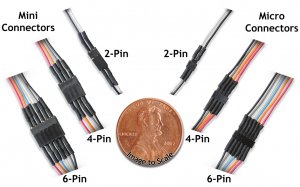
TCS Connectors

It does appear as though this company is making a most complete line of small electric connectors,....mini size. micro size, and their original size
Micro_VS_Mini.jpg


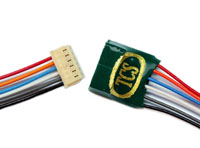
TCS 6-pin connector, DisConZen.jpg

The original size 6-pin connectors (and a 7-pin version) are the most reasonable priced. Does someone have some practical experiences utilizing these particular connectors??
 
The most common connectors out there are called JST Connectors, they are available in different
colours and different pin configurations. You can find heaps of these on Ebay if you put in a search
for the number of pins like "6 pin JST connector" also you can see them on the manufacturers
web site:
http://www.jst.com/

A better view of some of the connectors:
http://www.jst.com/home3.html
 
Last edited by a moderator:
Much as I would like to add DCC and sound to some of my HO steam locomotives, (aside from cost) this is one deterrent to doing so. Since I don't operate my DC and DCC locos simultaneously, I guess I'll wait awhile... :(
 
The "backshell" on the minatronics connectors are no problem. I use them all the time. All I do is trim this back almost to the end of the shell of the connector itself. I've used these in 0-4-0's that I've installed DCC in, and have had no problems as described above.


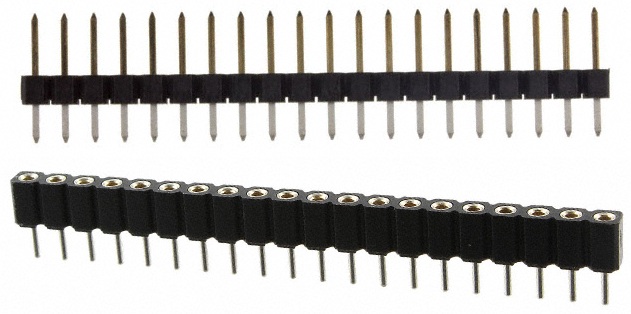
One solution for small connectors is to purchase header pins and matching sockets, like these:

header_connectors.jpg


You can snap off as many or as few pins and sockets as you need to make connectors with any number of conductors. The parts in the photo above have a pin spacing (pitch) of 0.1 inch, but smaller pitches are available.

You can also get these parts with two rows of pins and sockets, and make connectors that are a bit more compact.

I would not recommend such homemade connectors for high stress applications because they aren't terribly robust, but they'll work for many uses.

- Jeff
 
One solution for small connectors is to purchase header pins and matching sockets, like these:

You can snap off as many or as few pins and sockets as you need to make connectors with any number of conductors. The parts in the photo above have a pin spacing (pitch) of 0.1 inch, but smaller pitches are available.

You can also get these parts with two rows of pins and sockets, and make connectors that are a bit more compact.

I would not recommend such homemade connectors for high stress applications because they aren't terribly robust, but they'll work for many uses. Jeff

I use Miniatronics but I also use these and if you use heat shrink tubing as strain relief they work just fine and are plenty robust!
 
One solution for small connectors is to purchase header pins and matching sockets, like these:

header_connectors.jpg


You can snap off as many or as few pins and sockets as you need to make connectors with any number of conductors. The parts in the photo above have a pin spacing (pitch) of 0.1 inch, but smaller pitches are available.

You can also get these parts with two rows of pins and sockets, and make connectors that are a bit more compact.

I would not recommend such homemade connectors for high stress applications because they aren't terribly robust, but they'll work for many uses.

- Jeff
I picked up a sample like this, but I found them to be a little difficult to connect-unconnected in a straight forward manner. They would likely be good for 'removable' speaker and decoder installations within the tender,...such as body of the tender verses its base frame.

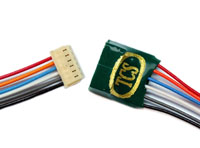
Hope to receive those TCS #1309 connectors tomorrow in the mail, and give then a good inspection
https://www.tcsdcc.com/public_html/Zen/index.php?main_page=product_info&cPath=45&products_id=299
 
Hope to receive those TCS #1309 connectors tomorrow in the mail, and give then a good inspection
https://www.tcsdcc.com/public_html/Zen/index.php?main_page=product_info&cPath=45&products_id=299

I got one of these 1309 mini-connectors in the mail a few days ago. It is definitely of a good small size to utilize, and has nice long wires to attach both the female and male ends to their respective connections within the loco and tender. The wires themselves are subtle enough, not too stiff. There is also an optional female socket available that could be utilized in place of the 'wired' female plug, if someone was doing a PCB installation.

I think this will be my go-to mini-connector for steam engine installations.
 

Attachments

  • TCS 6-pin connector, DisConZen.jpg
    TCS 6-pin connector, DisConZen.jpg
    27.2 KB · Views: 628


Affiliate Disclosure: We may receive a commision from some of the links and ads shown on this website (Learn More Here)

Back
Top