Does anyone use Krylon dulling spray (instead of Dull-Cote)?

ModelRailroadForums.com is a free Model Railroad Discussion Forum and photo gallery. We cover all scales and sizes of model railroads. Online since 2002, it's one of the oldest and largest model railroad forums on the web. Whether you're a master model railroader or just getting started, you'll find something of interest here.


Perhaps someday I'll invest in a proper airbrush and compressor, but for now I think I'm going to try a Tamiya spray paint for the BLMA sign: Tamiya TS-83 (metallic silver). I have some Tamiya spray cans I bought to darken the badging and taillights on my 1:1 vehicles, and the spray seems finer than a Krylon spray can's. The plastic scenery I need to dull is less critical (but large), so I'll probably try one of the dulling sprays mentioned.

You'll probably have a bit more leeway with scenery, so that may work out quite well for you. Not as many fine details like rivets and hinges that need to stay sharp. When someone mentions painting I immediately go to my forte, which is painting locomotives, and forget that people paint other things too :D
 
Thanks, Mike. I have two brand new Kato SD40s in SP road names, and one Kato AC4400 SP loco, which is used, but looks brand new (save for the UP number "patch"). All three have the modern "speed" logotypes on them, and all three are in desperate need of some weathering. Perhaps I can improve them a bit with just a simple powder kit?
 
Thanks, Mike. I have two brand new Kato SD40s in SP road names, and one Kato AC4400 SP loco, which is used, but looks brand new (save for the UP number "patch"). All three have the modern "speed" logotypes on them, and all three are in desperate need of some weathering. Perhaps I can improve them a bit with just a simple powder kit?

Weathering isn't something I've gotten into, unfortunately. I leave mine more or less "fresh from the paint shop" at this point at least. I'm sure one of these days down the road, once I've gotten my layout at least somewhat complete and so forth, I'll begin trying my hand at it. I've seen amazing results here and elsewhere. My roster is just so large that it's a daunting thought to tackle all of them. Even without adding any weathering I've still got a backlog of loco "to do" projects. Not to mention that I have a hard time thinking of weathering a paint and decal job I've worked so hard to make pretty to begin with. It also takes an artistic eye that I'm not entirely sure I'll be good at, whereas the actual paint job of a loco is a more technical than artistic exercise, and I do much better with that.


I think it is more important to keep layers of paint or coatings thin when you weather a model because you add many layers. If you are just adding a color I don't see an issue with any of the model spray paints or even the ones at Walmart.

Dave
 
I think it is more important to keep layers of paint or coatings thin when you weather a model because you add many layers. If you are just adding a color I don't see an issue with any of the model spray paints or even the ones at Walmart.

Dave

I know some brands are better than others, and ironically the cheap WalMart brand paint that's been discontinued actually had the lowest flow and worked best for models out of any other brand I've used. At least in my opinion. There is definitely an issue with some of them, though, especially when you're working in N-scale. You can get by with a heavier spray in HO and larger where the details are more pronounced and don't get rounded off so easily. There's also a difference in what will work well with scenery and buildings as opposed to locomotives and rolling stock.

Testors primer in particular goes on so thickly that it looks almost like you dipped the model in plastic instead of painting it. In fact, it goes on thickly enough that I actually use it as a filler on kit-bash jobs, much like bondo is used on auto bodies. Just spray it on and wet-sand until smooth, and it'll fill in fairly large blemishes and joints. It's actually what I used to fill in the gaps between access doors on the long hood to convert a GP60 into a RP-M4C slug.

I have used Model Master rattle can paint as a color coat back in the day, and it did okay. At the time I thought it was fine. Later on as I got more into painting I needed to actually match colors to what Atlas, Kato etc. were putting out. This more or less forced me into using an airbrush and once you compared the two, you could see how the rattle cans, while not completely obscuring details, really did round off the details and make them less distinct. With the airbrush even the finest details still stand out clearly. And again, this is MUCH more noticeable in N-scale than it would be in larger scales, but even that is relative. Yes, it's very obvious under a magnifier as you work on applying decals and look at the paint job. Is it any more noticeable when the loco is sitting on the rails? Probably not, and a lot of the detail I strive for will probably never be noticed outside of closeup photos that I post here or something.

In the end, it just depends on how picky and anal you want to be about your paint job. I tend to be very much so on my locomotives, at least as much as my skill will allow. Meanwhile, my scenery is always going to look cartoonish and fake and oh well. We all care about different things, and what's super important to me would go completely unnoticed by someone else. Bottom line, I guess, is just to try both and see what looks and works best for you personally.

 
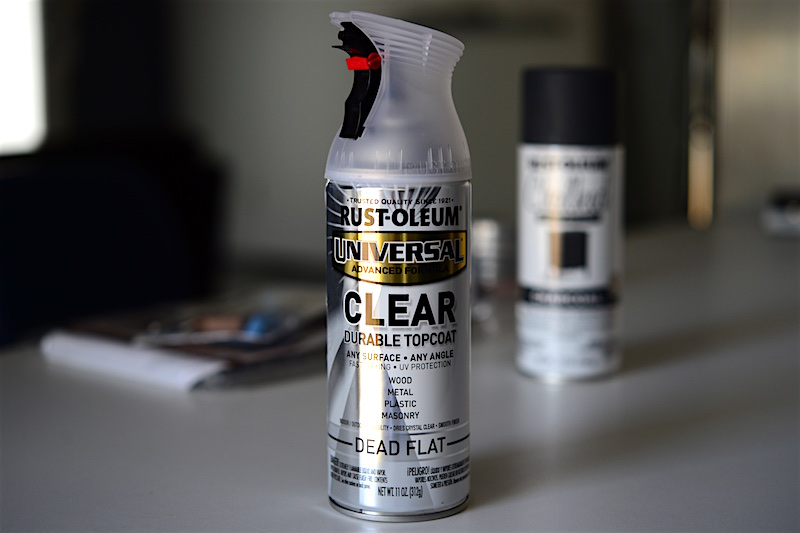
I just bought a can of this stuff at Home Depot (it was the only flat-finish, top-coat product I saw there). The removable 3M Dulling Spray is generally only available at expendable supply stores for the movie industry, which means a long drive to Burbank. I'll test it out on something and see how it works (I liked the fact that they called it "dead flat," rather than the more pedestrian-sounding "matte finish!"):

paint-rustclear-1.jpg
 
Matte & flat are two different things! Matte is a combination of clear gloss and flat. for those in between jobs! I mix 50-50 gloss & flat to get the effect.
 
Matte & flat are two different things! Matte is a combination of clear gloss and flat. for those in between jobs! I mix 50-50 gloss & flat to get the effect.

They're actually not. Matte literally means "flat" or "without shine". The two are synonymous. I think you're thinking of finishes labeled satin, semi-gloss, eggshell, etc., which indicate different "mixes" of glossiness and flat.


I just bought a can of this stuff at Home Depot (it was the only flat-finish, top-coat product I saw there). The removable 3M Dulling Spray is generally only available at expendable supply stores for the movie industry, which means a long drive to Burbank. I'll test it out on something and see how it works (I liked the fact that they called it "dead flat," rather than the more pedestrian-sounding "matte finish!"):

paint-rustclear-1.jpg

Hope you have better luck than I did with this stuff. I am restoring a Mantua 2-8-2 and used regular 2X rust-oleum semi gloss first. It goes on thin and smooth. It was too shiny so I bought a can of this stuff in a satin to tone it down. Well it went on heavy and with an almost tectured finish. Was not impressed. I may have gotten a can with a bad nozzle. I would suggest trying it on scrap first.
 
Rather than start a new thread, I'll report and also ask about a rattle can product I bought today from one of the hardware/paint stores here in Aus. I see it's imported from the USA although the importer has covered the original makers information with a label. It's called PlastiKote Clear Sealer, 340gm and is a Matt (or Mat) finish. I've tried it out on a couple of plastic lids from peanut butter jars as test items. One I had painted with artist's oil paint (squeeze from a tube type, which is quite heavy) 2 weeks or more ago without primer. Had adhered quite well, although I was able to scrape it off once dry. The other lid, I had just washed and dried.

Both have dulled to a very flat finish, no sheen at all, and so far (couple of hours), no sign of damage to either the painted, or the unpainted surfaces.

It has, like Testors, a lacquer smell, so, in order to thin it if I wished to extract some for air-brushing, what would I use, just an automotive GP thinners, or is there some other better type?
 
If it's a solvent based product, you can likely thin with Xylene or Xylol. If you are milking the rattle can you shouldn't need to thin any further. Test before shooting it on a model!
 
PlastiKote is a division of Valspar. The PlasitKote clear finishes use acetone as the primary solvent (30-60%) and xylene as the secondary solvent (10%). The acetone is the solvent that "dissolves" the solids. The xylene is a rapidly evaporating solvent used to thin the coating for better spraying characteristics. You could use either to thin for spraying, but both actively attack plastic.
 
As Testors Dullcote costs an arm & a leg out here, I've also been looking for a product with more volume in the can. I made inquiries at our largest hardware and paint store (Bunnings) because they stock Rustoleum paints now and I had read that they have a flat clear (none in store, gloss and satin only). Haven't had any response from the Aussie agents. I was in there a couple of days ago perusing the shelves when I came across a local brand, Dy-mark, and noticed they had (never seen before) one called "Frosted Glass", intended to produce that effect on windows and clear glass products. I noticed it was Xylene or GP thinners cleanup, so bought a can.

Also have been experimenting with a finish coat for some open hoppers I want to use in a rock/ballast train. I've built one with a permanent load, but could never get the dusty look I wanted. Gave this car several coats of the paint to get a build up on it. Here is the result. It actually looks better in the "flesh" than it shows in the pics. That's an original car to the left, but a bit dark.

DSC04839_zpsxgkrlm9w.png

DSC04840_zpsdh9vdwky.png

DSC04844_zpsoygoz9w5.png

DSC04846_zpsan64nhyk.png


It's enhanced the load's dusty appearance and given the steps and ledges a nice buildup on them as well. This was straight from the spray nozzle, so a bit wasteful. Decanted and applied by airbrush should reduce waste. Don't know if it's being exported to the US, but keep a look out in case you think it might be useful to you.
 
Toot - that stuff looks good but is it a white color added or is that just the lighting on the pictures. To me it seems as if the dull coat is turning the model more white.

Dave
 
Toot - that stuff looks good but is it a white color added or is that just the lighting on the pictures. To me it seems as if the dull coat is turning the model more white.

Dave

I suspect that this product is just a flat clear with a bit of white added to give it's intended frosted appearance to glass. Yes it has given a whiter coating to the car which I have built up with a few coats to get the dust covered effect I've been looking for. It was weathered with a light grey pastel which did the same, but sealing it with clear dullcote virtually destroyed that and just made it slightly dirty. I've seen it suggested to use a very thinned white paint as a first coat on locos to give that sunbleached look to their paint before weathering. This has more or less done the same job, but with that extra dust buildup on ledges and steps you would get on cars visiting a quarry. I'll take a couple more shots out in the natural light, those were taken under flouros and LED torch light. I particularly liked the effect on the gravel, which the white glue had turned darker and shinier than I wanted, and the dullcote didn't improve by much.
 
I just bought a can of this stuff at Home Depot (it was the only flat-finish, top-coat product I saw there). The removable 3M Dulling Spray is generally only available at expendable supply stores for the movie industry, which means a long drive to Burbank. I'll test it out on something and see how it works (I liked the fact that they called it "dead flat," rather than the more pedestrian-sounding "matte finish!"):

paint-rustclear-1.jpg

I would love to see a follow up on this and know how it works. DEAD FLAT makes you think it must be flat but how thick is it.

Dave


Affiliate Disclosure: We may receive a commision from some of the links and ads shown on this website (Learn More Here)

Back
Top