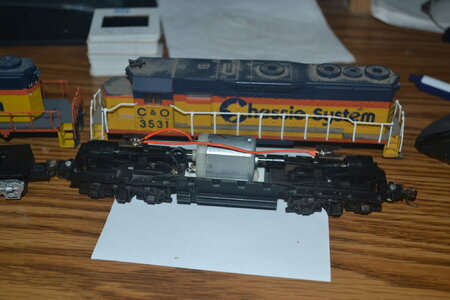
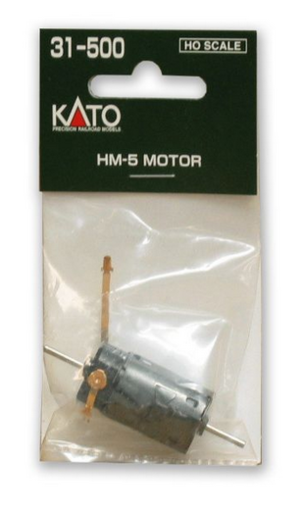
CAN motors...what do you use??

ModelRailroadForums.com is a free Model Railroad Discussion Forum and photo gallery. We cover all scales and sizes of model railroads. Online since 2002, it's one of the oldest and largest model railroad forums on the web. Whether you're a master model railroader or just getting started, you'll find something of interest here.


ShadowNix

UP and GN Modeler
Ok, in general, starting to buy up some can motors for some projects that are up and coming...and I have noted that Sagami and Mashima are rare/no longer produced...what are people using nowadays for remotoring your brass engines? Faulhaber? Canon... and what sizes/models (in general - I know depends on needs, draw etc....). Just wondering and hoping to start a discussion on DC motors we use for remotoring...

Brian
 
What I used were Mabuchi FK-280DA or SF-266SH both available on ebay You might also need some NWSL u joints
 

Attachments

  • DSC_0429.JPG
    DSC_0429.JPG
    323.2 KB · Views: 233
  • DSC_0430.JPG
    DSC_0430.JPG
    338.3 KB · Views: 232
  • DSC_0427.JPG
    DSC_0427.JPG
    254.1 KB · Views: 214


hoping to start a discussion on DC motors we use for remotoring...
I will start by saying, the word "can motor" has certainly evolved over the years, or should I say devolved. When true can motors first came out in 1972(?) they had to be can shaped because they were of one of three designs.
1. The magnet is a solid cylinder that rotated inside of the external "can shaped" stator coil.
2. The magnet is a solid "can" of a magnet that rotated around an inside stator coil.
3. The coil is a self supporting "can" shape that rotated around an inside stationary magnet. (also called a coreless)
All three of these dictated that the motor be round and can shape or the design doesn't work, and hence the name can motors.

Somewhere in the 1980s manufactures started making standard DC motors and enclosing them. Then someone in sales department came up with the brilliant marketing term "flat can". Don't get me wrong, the technology of the motor is better than it was in the "open frame" days, but not in the same way as the above. Magnets have improved, precision balance and clearances have improved, the rotors became tapered, and the most important is that the number of poles has increased.

All the old open frame motors were 3-pole. A 3-pole straight rotor motor can stall. You know the 1960's "nudge" that one had to give to the really old locos. More modern motors tapered the rotor so that at least part of it would attract/repulse the magnets and not stall. You will still see some motors advertised as anti-stall. But better than that is a 5-pole motor. Much more precision and smoothness especially at low speeds.

So the answer to the thread question is that it depends on the application.
1. If I want a super high torque motor with a super low current draw I will choose one of the first three motor types. One must be aware of the various limitations of these motors, to wordy to explain here (research it). The biggest thing used to be cost. One of my first conversions I paid like $18.75 for a brand new Athearn Blue box loco and $60 for the can motor (1981 prices). The price of these has come way down with production in China. Amazing price here.

2. When I need special applications I will settle for a "flat" can motor. I first look at the torque to current numbers and choose one in the desired speed range (rpm). A motor that has torque only at super high rpm isn't too good in the MR world. Usually these will be motors with 5, 7, or 9 poles. I also try to find ones that have ball bearings rather than friction bearing. Determine needed RPM by the gear ratio being used and desired top speed of the loco.

3. For simply remotoring any old thing that will just be run endlessly at shows where it is noisy anyway and they don't start and stop all the time, just about any "flat" can motor will work, but I still look for 5-poles as generally they will draw less current and run cooler. And once again I don't want a slot car motor with high RPM. High torque at low speed is the key.

 
Last edited:
I will start by saying, the word "can motor" has certainly evolved over the years, or should I say devolved. When true can motors first came out in 1972(?) they had to be can shaped because they were of one of three designs.
1. The magnet is a solid cylinder that rotated inside of the external "can shaped" stator coil.
2. The magnet is a solid "can" of a magnet that rotated around an inside stator coil.
3. The coil is a self supporting "can" shape that rotated around an inside stationary magnet. (also called a coreless)
All three of these dictated that the motor be round and can shape or the design doesn't work, and hence the name can motors.

Somewhere in the 1980s manufactures started making standard DC motors and enclosing them. Then someone in sales department came up with the brilliant marketing term "flat can". Don't get me wrong, the technology of the motor is better than it was in the "open frame" days, but not in the same way as the above. Magnets have improved, precision balance and clearances have improved, the rotors became tapered, and the most important is that the number of poles has increased.

All the old open frame motors were 3-pole. A 3-pole straight rotor motor can stall. You know the 1960's "nudge" that one had to give to the really old locos. More modern motors tapered the rotor so that at least part of it would attract/repulse the magnets and not stall. You will still see some motors advertised as anti-stall. But better than that is a 5-pole motor. Much more precision and smoothness especially at low speeds.

So the answer to the thread question is that it depends on the application.
1. If I want a super high torque motor with a super low current draw I will choose one of the first three motor types. One must be aware of the various limitations of these motors, to wordy to explain here (research it). The biggest thing used to be cost. One of my first conversions I paid like $18.75 for a brand new Athearn Blue box loco and $60 for the can motor. The price of these has come way down with production in China. Amazing price here.

2. When I need special applications I will settle for a "flat" can motor. I first look at the torque to current numbers and choose one in the desired speed range (rpm). A motor that has torque only at super high rpm isn't too good in the MR world. Usually these will be motors with 5, 7, or 9 poles. I also try to find ones that have ball bearings rather than friction bearing. Determine needed RPM by the gear ratio being used and desired top speed of the loco.

3. For simply remotoring any old thing that will just be run endlessly at shows where it is noisy anyway and they don't start and stop all the time, just about any "flat" can motor will work, but I still look for 5-poles as generally they will draw less current and run cooler. And once again I don't want a slot car motor with high RPM. High torque at low speed is the key.
Thanks for the great reply...gave me a lot to read about...despite lots of electrical work over the years in scientific instruments, none if it was in motors, so reading a lot from what you posted! Thanks a bunch.

Brian


Affiliate Disclosure: We may receive a commision from some of the links and ads shown on this website (Learn More Here)

Back
Top