ModelRailroadForums.com is a free Model Railroad Discussion Forum and photo gallery. We cover all scales and sizes of model railroads. Online since 2002, it's one of the oldest and largest model railroad forums on the web. Whether you're a master model railroader or just getting started, you'll find something of interest here.
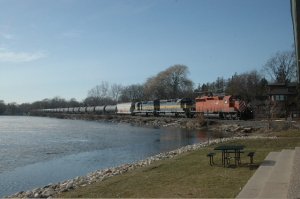
I have a question about rail protocol. I have noticed that all, if not most all, of the tanker trains that I see have a box car between the engines and the tanker cars. Is this a recent thing or has it been rail protocol for a long time? Just doing some "supposing" I'm guessing this configuration is for separating the engines from the tanker in the event that the tankers start to blow up. Not sure about that but an answer to that question would be appreciated as well. I'm modeling in the 40's to 60 era (or trying to at least) and I do have a tanker train. Should I have a box car between the f-diesels and the tanker cars? I thought at one time I saw something that actually had a name that the box car is called. It would be nice to know. As always, thanks in advance for your response.
I have a question about rail protocol. I have noticed that all, if not most all, of the tanker trains that I see have a box car between the engines and the tanker cars. Is this a recent thing or has it been rail protocol for a long time? Just doing some "supposing" I'm guessing this configuration is for separating the engines from the tanker in the event that the tankers start to blow up. Not sure about that but an answer to that question would be appreciated as well. I'm modeling in the 40's to 60 era (or trying to at least) and I do have a tanker train. Should I have a box car between the f-diesels and the tanker cars? I thought at one time I saw something that actually had a name that the box car is called. It would be nice to know. As always, thanks in advance for your response.
The name varies from railroad to railroad but in general it is called an idler car if the car is empty and being used specifically for that purpose. The purpose being separating the hazmat from the loco or caboose. If the car is full and in revenue service it is a buffer car.
I do not know when this practice started. I'm thinking the 1940's - 1960's it was not a government regulation. I'm GUESSING it came about in the 1970s with all the other safety rules like the train has to stop for trainmen to get on and off. Looks like the Hazardous Substance Transportation Act of 1975. Hmmm that is interesting, reading this (link below), it seems that depending on the substance some cars cannot be within 6 cars of the locomotive. Now this does not mean there weren't other requirements/rules in the books before this, but I do have photos of tanks directly behind locomotives. The book Coach Cabbage and Caboose, page 93 has a 1959 photo of tankers directly in-front of the combine tail car!
My uncle works for Norfolk Southern in Bellevue Ohio. He said with a box car being used as main buffer, the other, less hazardous tankers could be used as additional buffers. He said some materials can't "co-mingle" on a train. Some need their own train entirely, like radioactive material.
Check out the link he sent me. It has info about hazmats, special provisions, communications, emergency response info, training reqs and security plans. I thought the labeling section may come in handy.
While railfanning yesterday, I watched a unit train of tank cars placarded for denatured alcohol go by. An old 3 bay covered hopper was between the locomotives and the tank cars. Nothing special, seen this many times. However, the last car was an old rust bucket. another covered hopper I think, but in large letters on the side was painted "buffer car." That's the first time I've sen that. Unfortunately, no pictures. Someday I'm going to learn to keep the camera ready even if it is just another unit train.
A situation like this can also be used in a model RR setting. A friend used to operate a dynamite carrying boxcar from a manufacturer to various industries around his layout. The rule was 2 cars behind the loco, and 3 cars in front of the caboose. If the train was only 3 cars long, it had to be filled out with empty cars, not assigned to a train. Which was OK, but those cars then had to be returned to the main yard for further assignment after their use, and if the train wasn't a turn, going back to the main yard, a place had to be found to drop them off somewhere, and arraignments made to pick them up by another train. It made for some interesting operating fodder for the session.
If I recall correctly from a video that DJ from djstrains did, he said that on the railroad he engineered for that there was 6 cars between the engine and any tanker containing hazardous material. He didn't mention non-hazardous material. As a rule on my railroad, I require 2 cars between loco/caboose and any tankers...due to shorter length trains.
willie
along with tankers of crude oil, loaded or empty, we sometimes haul big steel pipe on 89 ft flatcars without bulkheads and they also require a buffer car for safety....