4%

ModelRailroadForums.com is a free Model Railroad Discussion Forum and photo gallery. We cover all scales and sizes of model railroads. Online since 2002, it's one of the oldest and largest model railroad forums on the web. Whether you're a master model railroader or just getting started, you'll find something of interest here.


Wastrel

Member
Ok guys, question for you. I am wanting to remove my helix, which is a 1.2% gradient 42" radius and replace it with a 4% 30" radius return. This will allow the trains to remain in sight for a much longer time as well as open a section of the layout for something a bit more dramatic than a blob mountain.
Having never violated the 2% grade I am wondering what your experiences are with the more severe grades. Typical trains are dual or triple consist lashing on 25-30 car trains.
 
Last edited by a moderator:
I don't think you'll be happy with the results. A 4% grade on a curve is more like 5% because of flange friction. You're also going to need room for grade transitions on both ends or you'll get stringlining on a 30 car train, where part of the train moving faster downgrade while the rest is moving slow because it still hasn't crested the grade. This is an invitation to derailments. Sticking with your 2% rule is a good idea.
 
I have done a 4% on a previous layout, and I would not recommend using one on any sort of curve. I had to remove some of the weight from my cars to get certain engines to pull a full train up it. This just opened the layout to derailments with the lighter cars. Can you open one part of your helix so the train looks like it is cruising along a cliff face? Maybe widen your helix at this section so the cliff can look more natural. Post some pictures of what you are working with so we can dump some ideas on you.


Better have some helper power on duty or run DP trains ;) That is a serious grade for straight track, let alone any radius curve.
 
My own opinion is that the huge bulk of your problem, if one is to plague you with this change you are contemplating, will be in the form of the stringlining. A 30" curve is classed as broad, although at the low end. I don't know that the engine, itself, will be greatly affected in terms of flange friction, but what follows behind certainly will. The reason is twofold: the weight of the train behind the engine will be closer in vector to a vertical gravitationally, so the weight of the train will be greatly increased in the way of wanting to follow gravity...moreso than on a 2% grade. Also, the cars further back will exert a torque of sorts that will want to draw the forward cars toward the centre of the curve...instant stringlinging. Adding weight to forward cars will really help, but then you are compromising the engine's ability to do what you need it to do on this severe grade.

I might as well throw in, while you are reading, that it isn't going to improve your visuals as much as you might hope...unless we're talking about a Climax in the deep woods on temporary tracks that will be used for three weeks logging this one spot. I have grown to regret my own 3% grades for the stress they impose on my engines, but it really looks steeper, now two years on, than I would like it to.

If you can stomach redoing a bunch more track, you may find that re-thinking and relaying about twice as much linear track (IOW, working your way back from the onset of the helix/grade) will result in a better grade for you. Can you realign more of your track?

-Crandell

 
the problem I have is that my yard takes up a 23' section of wall, then runs down another wall for 18' and enters a helix which raises the train 17" to my second level. By the time I allow for the throat to the yard and the associated crossovers my available run (out and back from the throat to the minimum step-up to the second level) is only a paltry 442" total, and this doesnt even allow for any industries or switching along the way. In essence this will reduce any lineside industries which I may have to being located directly above the yard, again, not a great idea. Looks like I am going to have to do some more head scratching and maybe move the helix to a peninsula instead.
 
If you can, that or move the yard, but 17" will take a lot of space to climb at 2%. And you will most likely run into loosing realism between levels.
 
A 17" rise will take 1700" of run to get up to the top and back down on the other side with a 2% grade. That's about 142 feet, not counting grade transitions, which will add about another 10% of space to the rise requirement. A 4% grade will still require 71 feet plus that same 10% margin. I would move your helix to a peninsula if you want more operating space on the lower level or leave things as they are. Unless you've got one heck of a big train room, you are never going to have enough space to do a straight grade up 17".
 
I pretty much came to the same conclusion. What a shame, I really hate the helix as trains dissapear for 3-4 minutes while they transition. Oh well, I guess this falls under the category of compromises you are forced to live with.
 
Helix sounds

When I was a kid the NYC tracks were only a 100 yards from my bedroom in plain sight but because the NH tracks were about 5 miles away I could only hear the 100 car freights struggling up the grade over Pawling mountain. I couldn’t see them but just listening was fun. From where I control the trains on my layout I cannot see the helix but I can hear the engines struggling up the grade and again just listening is fun.

NYC_George


The CPR has a 4.1% grade on the Rossland Sub in BC, you want to see special instructions.... holy cow!
Here's one example:
"A maximum of 8 loaded cars are allowed except that for every 2 empty cars taken, an extra load can be taken."
For example, 8 loads plus two empties plus one load is okay, and so on.
As for the helix space I have a city in the center of mine which adds some switching.
 
Actually, the math on the 17" rise is: for 1700" or 142' that would be a 1% grade. 2% would be 850" or 71'. This is just a staight cut calculation. You would have to factor in your transition into and out of the grade which will extend it a bit more for the harder grades.

Probably still not doable in the amount of space you have.
 
Ken, you misunderstand. Assuming you want a 2% grade and you need to go both up and down the grade, the amount of run is exactly the same as just climbing a 1% grade up. The 850" figure would apply only if the upbound and downbound grades use the same route. If you want to run up to the second level and come down by a different route, the entire run problem appears again. Thus, you would need 1700" of run to get you up and back down a 2% grade, not counting the transitions. A common planning error is to allow for the grade up but then forget about how you're going to get your train down again on the other side of the layout.
 
I pretty much came to the same conclusion. What a shame, I really hate the helix as trains dissapear for 3-4 minutes while they transition. Oh well, I guess this falls under the category of compromises you are forced to live with.

Well yes, it is a compromise of sorts from one perspective; but look at it this way. If your train disappears from one level of your layout, and quickly - almost magically - reappears on another level, one could say that the layout has taken on a toy-like quality. In other words, the train traveled no distance, either in reality or in the imagination.

I still do not fail to have a sense of the majesty and wonder of a train that I am following along its' course - whether on my layout of a club layout - that disappears into a tunnel only to reappear minutes later at a different location or on a different level. It's gone somewhere, time has elapsed, and the land and terrain of the layout is bigger than it actually is. An empire!

To my mind, a train that is always in sight on a layout is reminiscent of the old oval on a 4 x 8 sheet of plywood. Unless, of course, the layout is vast.
 
Unless it's point to point.

True, but I don't recall any two level layout being point to point. Even if that's the case, you need a loop on the top level to get the train back to the top of the grade to the first level. Unless the second level is a single use, like a mine, it also looks pretty strange to have the same train go up and down the same grade. Most people with two level layouts have the train reach the first level again by a different route, hence the issue of the two part grade comes into play.
 
There is a multi-room CN layout (videos on YouTube) that uses one helix in the furnace room. It is a triple level layout, and does a good job or portraying different scenes. It basically loops around the basement one to three times (depending on what room you are in). The helix takes all of the grade traffic from level to level.


Can you run multiple trains so the when one goes into the helix, there is another train to watch?
 
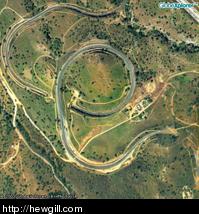
Adam, a helix is a different animal than a straight grade or nolix, where you loop enough track on a gradually rising grade to keep the ruling grade below 2%. The Tehachapi Loop is almost a mile of track just to rise 77 feet. That's less than 11 inches in HO scale. As you can see from the aerial photo, it takes a lot of layout space and track to climb this grade and the ruling grade is still 2.25%

tehachapi-loop-aerial.jpg_resize_200.jpg


There's no technical reason you can't have a train in a helix and another running out in the open. With DCC, this would be easy to do.
 
That's what I was suggesting, keep the helix, and run another train to make up for the 3-4 minutes the other is in the helix. The straight grade would take up too much space, and limit sidings and industry along the way. My last layout was pinned down by a dual grade that eliminated the possibility to add sidings to businesses. If you are going to have a grade, keep it hidden and add things to the foreground that will keep the scene entertaining.


I'm kind of in the same pickle--I'm looking still at a nolix--all be it modified--but only one incline--

My thing would be because I'm modeling a spur type of line to a potash processing plant and a couple of odds and sod type of industries, I'm not looking for a complete circuit up there---does a person have to have two of the things if you're running a supposed spur up there?

Then again, maybe I am barking up the wrong incline----


Affiliate Disclosure: We may receive a commision from some of the links and ads shown on this website (Learn More Here)

Back
Top