2-8-0's?

ModelRailroadForums.com is a free Model Railroad Discussion Forum and photo gallery. We cover all scales and sizes of model railroads. Online since 2002, it's one of the oldest and largest model railroad forums on the web. Whether you're a master model railroader or just getting started, you'll find something of interest here.


I have read several times that the newest plain old Bachmann 2-8-0 is the former Spectrum version, so if that is what you are referring to, it should be a very nice locomotive with a good solid reputation.
 
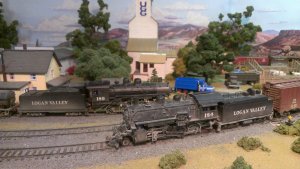
I am not a big fan of Bachmann as most of the locomotives I have are older ones and in th elate 70's and early 80's, Bachmann had a lot to be desired. When they came out with their Spectrum 2-8-0 I read some reviews and being that this is the perfect size locomotive for my layout I got one. I was pleasantly suprised at how good it ran. Very good at slow speeds and did better than I expected for pulling a train up my 2 percent grade. I have a couple for brass consolidations and compared to the brass, I would consider the detail decent. The one in the front, 184 is a PFM brass models and the one in the rear, 189 is the Bachmann. I wouldn't hesitate purchasing one of these.

IMAG0098_BURST002.jpg


What are the difference between the Bachmann Plus and Spectrum?
Thought that I'd try one of the smaller steamers later on...

Bachmann used to have three grades of product. The original straight brand Bachman were toy train set quality. The Bachmann Plus locomotives were one step up, and the Spectrum line was designed for more "serious" model railroaders. Seems like that was the mid to late 1980s. Since then the lines have crossed and merged. The current 4-8-4 is a former Bachmann Plus while the current 2-8-0 is the former Spectrum. If the unit is actually branded as a Bachmann Plus that means it is pretty old and I would not want to recommend it. I would say the Bachmann 4-6-0, modern 4-4-0, 2-8-0 and 2-6-0 are safe bets for a small steamer purchase.
 
All of the Bachmann small locos are superb runners. Their detail mostly consists of separate plastic castings, that are slightly smaller than their brass counterparts. Since the are separately applied, the detail can be easily changed if desired.

Chet;
If you're looking for another great runner, my suggestion would be the Bachmann 2-10-0, the Russian Decapod. It comes available in several variations like the Frisco, Erie, and others. I also had an article here on the forums about tuning up a Decapod. The techniques can also be used on any Bachmann steamer that were/are Spectrums. It deals with improving the suspension, making it more responsive. Tried to locate the article, but was unable to on this computer. I know its on my computer downstairs.

The 4-6-0's came in 2 configurations. One was a low drivered 4-6-0 that is more suitable to freight. The other is a high drivered loco more suitable to passenger service, although it could be used for fast freight. IIRC, the high drivered 4-6-0 has a Ma&Pa engine as the prototype.

I haven't personally tried the 2-6-0, although it is just like the others. I do own a 4-4-0 painted in SRR colors. Comparing it with Princes book on the Southern, it is a perfect match in detail and paint. These were used up to and through WWII, primarily on the Gulf division, pulling passenger trains and mixed freight between Rome Ga, thru Anniston, Talledega, Wilsonville, Selma, down to Mobile Al. It is also a superb running model.
 
Last edited by a moderator:
All of the Bachmann small locos are superb runners. Their detail mostly consists of separate plastic castings, that are slightly smaller than their brass counterparts. Since the are separately applied, the detail can be easily changed if desired.

Chet;
If you're looking for another great runner, my suggestion would be the Bachmann 2-10-0, the Russian Decapod. It comes available in several variations like the Frisco, Erie, and others. I also had an article here on the forums about tuning up a Decapod. The techniques can also be used on any Bachmann steamer that were/are Spectrums. It deals with improving the suspension, making it more responsive. Tried to locate the article, but was unable to on this computer. I know its on my computer downstairs.

The 4-6-0's came in 2 configurations. One was a low drivered 4-6-0 that is more suitable to freight. The other is a high drivered loco more suitable to passenger service, although it could be used for fast freight. IIRC, the high drivered 4-6-0 has a Ma&Pa engine as the prototype.

I haven't personally tried the 2-6-0, although it is just like the others. I do own a 4-4-0 painted in SRR colors. Comparing it with Princes book on the Southern, it is a perfect match in detail and paint. These were used up to and through WWII, primarily on the Gulf division, pulling passenger trains and mixed freight between Rome Ga, thru Anniston, Talledega, Wilsonville, Selma, down to Mobile Al. It is also a superb running model.

I have the 2-10-0 Decapod undecorated and ready to letter. It is a very smooth running locomotive. I got one when they first came out. I am really disappointed in its pulling power of grades. On my 2 percent grade, 4 to 5 cars are the limit for it. The little Bachman 2-6-0 is also a wimp on grades, but can pull 4-to 5 cars on the same grade. The decapod is put away for the time being and will probably end up with switching duty in one of the yards.

attachment.php


If you're looking for another great runner, my suggestion would be the Bachmann 2-10-0, the Russian Decapod.
We (family) have several of the Russians as well (three I think). I have to say they have never been used on any grade. They run on the traveling modular units (both mine and the Youth in Model Railroading) that are all as flat as a pancake. The modulars also always run with short trains less than 8' in length. While the Russian is a 10 coupled it is still tiny and light so there is not much down force on each of those 10 drivers. I'm trying to remember if we've had slipping issues or not.... My, that would have been November 2011 the last time they ran.
 
I was a bit disappointed in the decapod being such a wimpy locomotive on the grades. I have a couple of smaller brass locomotives that can do a decent job on the grades and they really don't weigh that much more than the 2-10-0. I have an Athearn Genisis Mike that is also a wimp. A bras mike weighing about the same can get 6 more cars up the same grade. Must be something inherent with plastic steam locomotives. The only plastic steamer that I have that is a decent performer on the grades is the Spectrum 2-8-0.
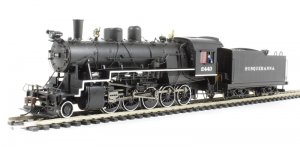
 
I was a bit disappointed in the decapod being such a wimpy locomotive on the grades.
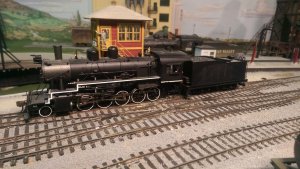
My big disappointment for pulling is the Sunset NP Z6 I purchased about 2 years ago. It has some substantial heft to it, but was unable to get 17 cars up the 2% grade on the museum layout. Very disappointing for such an expensive loco. I'm going to add bullfrog snot to two of the drivers and see if it can't do better.

Humm, or was it 20 cars it wouldn't pull and I had to back it off to 17??? anyway... Such a large loco should do 30-40.
 
That's the little bugger. It's a good looking locomotive and an excellent running locomotive with great slow speed control, but a wimp.
 
A little weight could be put into it, but trying to get it apart could be a problem. Not only do you need weight, but it should be balanced.

IMAG0335.jpg

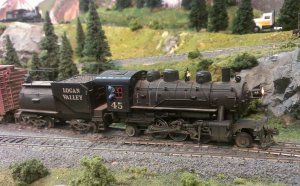
This little locomotive I got from a friends scrap box over 20 years ago. No tender, missing pilot, headlight and other parts. It sat in my scrap box for a few months until I finally found a tender that would work. It was remotored, details added along with a pilot and headlight. Constant lighting was also added. Still runs like a Swiss watch and this little puppy can pull 7 cars and a caboose up the 2 percent grade.

IMAG0105_BURST002.jpg
 
The Decapod and 2-8-0 locos represent small locomotives as were their prototypes. I believe the IC had monster Consolidations, if I recall an old article, but otherwise these were early engines that were brought on line about the same time as the earliest Mikados. Many didn't have superheaters and had boiler pressure in the 165 PSI range. They weighed between 90 and 180 tons, so not what one would term heavy locomotives, or 'heavy steam' with all that term means (heavier axle loadings, as an example).

However, for all that, our models are rather tiny and weigh very little. They just don't scale that well in terms of tractive effort. I notice that BLI initially refused to sell steamers with traction tires, at least in most cases, but they routinely apply them now. It's a fact of life.

BTW, Bull Frog Snot is the cat's PJs. It takes some skill-building to apply it smoothly, but once you learn that, you are in the coal drag business.
 
Last edited by a moderator:


In the article that I mentioned on tuning a Spectrum, I also added about 3oz of weight to it, making sure it was balanced. I took the loco to Rexhea's layout, whose a member here, and it had no problem pulling 17 cars up a 2.5% grade. The weight was added between the drivers inside the frame by building small styrene boxes in the spaces between the drivers. These were filled with #7 birdshot. IIRC, there were only 3 small places this could be done, due to the suspension. Weight was also added by filling the domes, cab roof and spaces around the pilot and lead truck. Small thin blocks of lead were also added on top of the frame, hidden by the "spring" detail on the frame. Again IIRC, I had to punch a hole in some of the lead to fit around its suspension.

These locos can be made into great pullers with just a little ingenuity and work. I don't own a single locomotive that I haven't done something like this to it in one way, shape or form. When possible I try to install a larger higher torque motor and gearbox. I couldn't do it to this one without almost completely rebuilding the frame. There are always places to add weight to a loco, and as long as the loco remains balanced, it's pulling ability can only improve.

OK, I searched again, and FINALLY found the tuneup procedure. Even though this was done to a Decapod, it can be done to any Bachmann steamer. The tuneup procedure starts with post #24. Here's the link!

http://www.modelrailroadforums.com/...ectrum-Steam/page2&highlight=Spectrum+tune+up


Affiliate Disclosure: We may receive a commision from some of the links and ads shown on this website (Learn More Here)

Back
Top